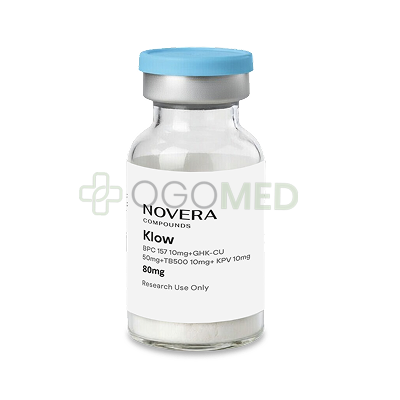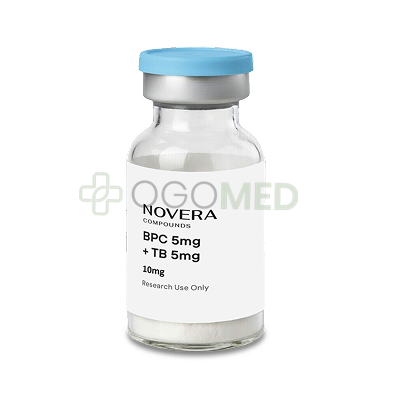







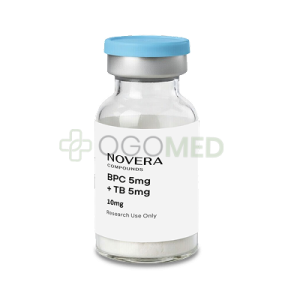
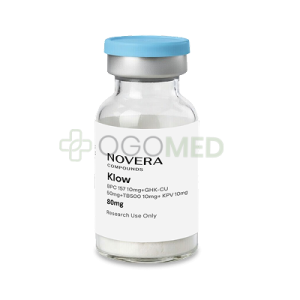


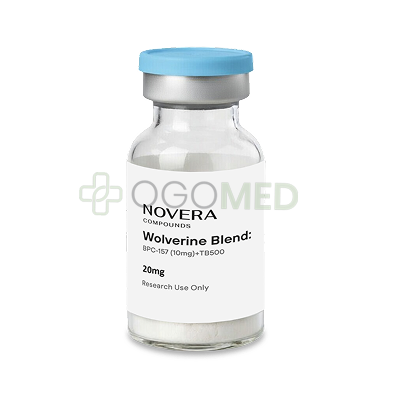

Novera Wolverine Blend: BPC-157 (10mg)+TB500 (10mg)
In Stock
| Category: | Peptides |
| Brand | Novera |
| Strength | 20mg |
| Form | Lyophilized powder |
| Purity (%) | ≥99 |
| CAS number | BPC-157: 137525-51-0 TB500: 77591-33-4 |
| Chemical Formula | BPC-157: C₆₂H₉₈N₁₆O₂₂ TB500: C₂₁₂H₃₅₀N₅₆O₇₈S |
| Molecular weight | BPC-157: 1419.5 g/mol TB-500: 4963 g/mol |
| Synonyms | BPC157-TB500-blend, Healing-combo-peptide, Regeneration-peptide-blend |
| Peptide sequence | Mixed peptides |
| Storage | Store at 2-8 °C or -20 °C. Protect from light |
| Shelf Life (lyophilized) | 12-24 months |
| Shelf Life (after reconstitution) | 7-21 days |
Learn more...
The wolverine peptide stack pairs two synthetic peptides, BPC-157 and TB-500, in a single research vial. Novera Wolverine Blend is a fixed 1:1 combination of these compounds, sometimes called a wolverine blend peptide, designed to let laboratories study hypothesized complementary repair pathways under controlled conditions.
This product is supplied for laboratory research use only. It is not an approved medicine, and neither component has FDA approval for any indication in humans.
What Novera Wolverine Blend: BPC-157 (10mg)+TB500 (10mg) Is
Wolverine Blend is a fixed-combination research peptide pairing BPC-157, a synthetic fragment of a gastric protection protein, with TB-500, a synthetic fragment of thymosin beta 4. BPC-157 is a pentadecapeptide of 15 amino acids originally isolated from human gastric juice protein in the early 1990s. Unlike most peptides, it remains stable in gastric juice, which makes it experimentally distinctive among body protection compound fragments.
The TB-500 component in this blend is thymosin beta-4 acetate: the full 43-residue protein, abundant in platelets and most tissues, not the Ac-LKKTETQ heptapeptide also sold under that trade name. The distinction decides how the literature applies. Nearly all published angiogenesis, cardiac and dermal data were generated with the full-length protein; the heptapeptide has a separate and much thinner record, and results from one are not evidence about the other.
A fixed wolverine pack peptide formulation enables standardized exploration of hypothesized synergy between local repair modulation (BPC-157’s nitric oxide and VEGF-related pathways) and systemic cell-mobilization pathways (TB-500’s actin-mediated migration). The blend is positioned for laboratory studies on peptide therapy mechanisms such as angiogenesis, fibroblast function, and actin-regulated cell migration. It is not an approved medicine.
Why Researchers Study Wolverine Blend: BPC-157 (10mg)+TB500 (10mg)
Investigators study this peptide wolverine stack because both components influence overlapping yet distinct repair pathways. BPC-157 modulates nitric oxide signaling, VEGFR2-driven angiogenesis, and pro-inflammatory cytokine expression. TB-500 promotes tissue repair by sequestering actin monomers and enhancing cell migration to the injury site. Most published studies examine BPC 157 and TB 500 separately; researchers extrapolate to the combined wolverine blend peptide based on shared pathways such as VEGF signaling, integrin modulation, and NF-kB-linked inflammation control.
All effects described below are experimental observations in rodents or cell culture. They cannot be interpreted as established clinical benefits or evidence for human use.
Musculoskeletal Tissue Repair and Injury Recovery
Tendon, ligament, and muscle injury models represent the primary mechanism through which BPC-157 and thymosin beta-4 have drawn interest in preclinical research. BPC-157 has been studied for tendon, ligament, muscle, and bone healing across multiple rodent paradigms.
The rat Achilles transection paper in the Journal of Orthopaedic Research is Staresinic et al. (2003), which reported higher load to failure, Young’s modulus and Achilles functional index after intraperitoneal BPC 157 across doses from 10 pg/kg to 10 micrograms/kg; a ‘Kang et al. 2011’ study in that journal does not exist. Chang et al. (2011, Journal of Applied Physiology) separated the cellular steps in vitro: BPC 157 did not increase tendon fibroblast proliferation in an MTT assay, but it raised survival under hydrogen peroxide stress, dose-dependently increased migration, induced F-actin formation and dose-dependently increased phosphorylation of FAK and paxillin without altering total protein.
In a 2026 randomized rat Achilles tendon study, Bicer et al. compared BPC-157 alone, TB-500 alone, and the combination. Thirty-two male Sprague-Dawley rats, eight per group, received intraperitoneal BPC-157 at 10 micrograms/kg/day, TB-500 at 60 micrograms/kg/day, or both, for four weeks after transection and repair. Maximum load to failure was significantly above control only in the TB-500 group (adjusted p = 0.0406); BPC-157 alone did not reach significance (adjusted p = 0.389), and the combination arm outperformed neither single peptide.
“Tbeta4 stimulates significant outgrowth from quiescent adult epicardial explants, restoring pluripotency.” Smart et al., 2007, Nature.
Gastrointestinal and Visceral Organ Protection
BPC-157 originated from gastric cytoprotection research. Sikiric et al. (1993, Journal de Physiologie Paris) is the overview that first characterised the 15-residue fragment of the roughly 40 kDa gastric juice protein BPC and reported organoprotective effects across organ systems in several species at microgram and nanogram doses, after intraperitoneal, intragastric and local application. Later rodent colitis work reports lower TNF-alpha and IL-6 expression in treated tissue.
“No influence on different basal parameters and no toxicity were observed.” Sikiric et al., 1993, Journal de Physiologie Paris.
TB-500-type fragments have less GI-specific literature but appear in peritoneal adhesion models where thymosin beta-4 increased mesothelial cell migration.
Chronic Pain and Neuroinflammation Models
Chronic pain often links to incomplete tissue repair and ongoing neuroinflammation. Rodent studies explore whether BPC-157’s modulation of the nitric oxide system and reported interactions with serotonin and dopamine pathways alter pain-related behaviors in neuropathic pain paradigms. These are mechanistic observations in animals, not clinical analgesia data.
No controlled adverse-event dataset exists for either peptide in humans, so the side-effect profile of the combination is unknown rather than mild. Thymosin beta-4’s exploration in rodent stroke models, where treatment reduced infarct volume, provides a rationale for hypotheses about chronic pain or neurorepair, but direct evidence linking TB-500 to pain management remains absent.
Cardiovascular and Neurologic Injury Models
Thymosin beta-4 has been studied extensively in cardiac biology, but the landmark paper is narrower than it is usually made to sound. Smart et al. (2007, Nature) identified thymosin beta-4 as essential for coronary vessel development in mice and showed that it drives outgrowth from quiescent adult epicardial explants, triggering differentiation into fibroblasts, smooth muscle and endothelial cells; knockdown reduced the pro-angiogenic cleavage product AcSDKP, and injected AcSDKP did not rescue mutant hearts. This is developmental and explant work, not an infarct-outcome trial, and it used the full-length protein.
Crockford et al. (2010, Annals of the New York Academy of Sciences) reviewed the structure, function and clinical programmes built on thymosin beta-4; like Smart’s work, that review concerns the 43-residue protein rather than a fragment, which is the recurring caveat across this whole literature.
Metabolic, Muscle Preservation, and Exercise-Related Research Questions
Wolverine stack peptide discussions often reference muscle preservation during weight loss or disuse, but no controlled human trials have tested BPC 157 or TB 500 for maintaining muscle mass during pharmacologic weight loss. The stack is often marketed for accelerated recovery and injury healing, yet current evidence for faster healing comes exclusively from animal models where thymosin beta-4 fragments influenced skeletal muscle regeneration after cardiotoxin injury, with improvements in fiber cross-sectional area.
Current literature does not quantify effects on VO2 max, training load, or real-world performance. Laboratories interested in peptide stack interactions may choose Wolverine Blend to compare combined versus single-peptide effects on muscle inflammation markers or satellite cell activation.
How Wolverine Blend: BPC-157 (10mg)+TB500 (10mg) Compares With Related Compounds
Wolverine Blend occupies a distinct niche among other peptides frequently discussed alongside it. The table below positions it against stand-alone BPC-157 and TB-500 constructs on pathway targets, evidence level, and typical research focus.
| Compound | Main Target / Pathways | Evidence Level | Typical Research Focus |
|---|---|---|---|
| Novera Wolverine Blend: BPC-157 + TB-500 | Combines BPC-157 nitric oxide / VEGF signaling with TB-500 actin-binding and thymosin beta-4-like cell migration pathways | Rodent and in vitro data for each component; one controlled rat combination study showing no additive benefit | Interaction studies on tissue repair, angiogenesis, cell migration, and chronic pain markers in tendon, ligament, muscle, and GI injury models |
| BPC-157 (Single Agent) | Gastric protection protein derivative; NO pathways, VEGFR2, inflammatory cytokine expression | Multiple rodent models; small uncontrolled human case series | Gastric ulcers, colitis, anastomotic healing, localized tendon or ligament injury repair |
| TB-500 / Thymosin Beta-4 Derivatives | Actin sequestration, cell migration promotion, pro-angiogenic signaling | Extensive animal data for wound, cardiac, and neural repair; limited human data for full-length thymosin beta-4 only | Systemic tissue repair, wound closure, cardiac ischemia, CNS injury models |
Laboratories may select Wolverine Blend when examining synergy or antagonism between BPC-157-like local repair modulation and TB-500-type systemic cell migration, for example in combined tendon and muscle injury models. Single-agent BPC-157 is preferred when isolating nitric-oxide-linked effects in gastric or tendon research. Thymosin beta-4-derived peptides provide a focused tool for studying actin dynamics and angiogenesis without BPC-157’s GI background. None of these choices imply clinical equivalence; all are strictly for controlled experimental use by qualified teams.
What Research on Wolverine Blend: BPC-157 (10mg)+TB500 (10mg) Does Not Establish
Despite growing consumer demand for the wolverine peptide and wolverine stack peptide online, current evidence is dominated by animal and cell-culture work. No randomized controlled human trials of the fixed BPC-157/TB-500 combination have been published. Prominent marketing claims about the stack are largely based on anecdotal evidence rather than clinical trials.
-
There is no validated dose-response for either component outside rodents, and no published rationale for the ratio in which they are combined. The 1:1 presentation is a commercial convention, not a result: Bicer 2026 ran BPC-157 at 10 micrograms/kg/day against TB-500 at 60 micrograms/kg/day, a six-fold difference, and still found no additive effect.
-
Unsupported online claims include guaranteed acceleration of post-surgical healing, complete chronic pain resolution, muscle preservation during GLP-1 therapy, and “healing like Wolverine.” Published data do not provide controlled human evidence for these outcomes.
-
Neither component has a published carcinogenicity or immunogenicity dataset in any species. Both are pro-angiogenic in rodents, and no study has separated reparative from tumour-associated angiogenesis for either peptide, so the pro-angiogenic profile remains an open experimental question rather than a quantified risk.
-
Both components are on the 2026 WADA Prohibited List and both are prohibited at all times. BPC-157 is named in S0, Non-Approved Substances. Thymosin-beta4 and its derivatives, listed as “e.g. TB-500”, are named in S2.3, Growth Factors and Growth Factor Modulators, not in a peptide hormone section.
-
Most of the literature cited for TB-500 is in fact full-length thymosin beta-4 work: Smart 2007 and Crockford 2010 both concern the 43-residue protein. The parallel conclusion holds for the other component: after three decades of preclinical work, BPC-157 still has no approved formulation, no validated dosing regimen and no completed Phase II trial.
“The absence of additive effects with combination therapy may reflect convergence on shared downstream pathways.” Bicer et al., 2026, Joint Diseases and Related Surgery.
Where to Buy Novera Wolverine Blend: BPC-157 (10mg)+TB500 (10mg)
Novera Wolverine Blend is offered as a wolverine blend peptide for controlled laboratory experiments exploring injury recovery pathways, peptide stack interactions, or chronic pain mechanisms. The product is marketed specifically to institutional and licensed professional buyers for research purposes only.
-
Estimated delivery time 3 to 7 days.
-
Free shipping on orders over $750.
-
All US import fees and tariffs are covered by Ogomed, so the buyer pays nothing extra; customs checks under the new US import rules can add a little time to delivery.
-
Price match: if the same product is listed for less elsewhere, Ogomed will try to match it.
-
Support by phone +1-650-457-5621 and email, 10am to 6pm EST.
-
Sold to licensed professionals, for laboratory research use only.
Wolverine Blend is supplied exclusively to licensed professionals and laboratories for laboratory research use only, not to consumers and not for any form of treatment.
References
- Sikiric, P., et al. (1993). A new gastric juice peptide, BPC. An overview of the stomach-stress-organoprotection hypothesis and beneficial effects of BPC. Journal de Physiologie Paris, 87(5), 313-327. DOI: 10.1016/0928-4257(93)90038-U
- Staresinic, M., et al. (2003). Gastric pentadecapeptide BPC 157 accelerates healing of transected rat Achilles tendon and in vitro stimulates tendocytes growth. Journal of Orthopaedic Research, 21(6), 976-983. DOI: 10.1016/S0736-0266(03)00110-4
- Chang, C. H., et al. (2011). The promoting effect of pentadecapeptide BPC 157 on tendon healing involves tendon outgrowth, cell survival, and cell migration. Journal of Applied Physiology, 110(3), 774-780. DOI: 10.1152/japplphysiol.00945.2010
- Smart, N., et al. (2007). Thymosin beta4 induces adult epicardial progenitor mobilization and neovascularization. Nature, 445(7129), 177-182. DOI: 10.1038/nature05383
- Crockford, D., et al. (2010). Thymosin beta4: structure, function, and biological properties supporting current and future clinical applications. Annals of the New York Academy of Sciences, 1194(1), 179-189. DOI: 10.1111/j.1749-6632.2010.05492.x
- Bicer, O., et al. (2026). Effects of BPC-157 and TB-500 on Achilles tendon healing in rats: A histopathological and biomechanical study. Joint Diseases and Related Surgery, 37(3), 822-837. DOI: 10.52312/jdrs.2026.2951
The wolverine peptide stack is the experimental pairing of BPC-157 and TB-500, two synthetic peptides originally popularized in sports and wellness communities but used in laboratories to study combined effects on tissue repair, angiogenesis, and inflammation. Novera Wolverine Blend is a fixed 1:1 research formulation of these individual peptides supplied for laboratory use only. Neither component has FDA approval for human use.
BPC-157 is associated in rodent and in vitro studies with nitric oxide modulation, VEGFR2 signaling, and cytokine balance. TB-500 mimics thymosin beta-4’s actin-binding region to influence cell migration and angiogenesis. These mechanisms are inferred from non-human experiments and have not been fully confirmed in human tissue, so researchers treat them as working hypotheses rather than established facts.
Animal models report faster tendon or ligament healing, improved muscle regeneration, and reduced ulcer size with BPC-157 or thymosin beta-4 treatment, often with measurable gains in load-to-failure or histologic scores. There is no randomised controlled human trial of either component, and none of the combination. The 2026 Bicer rat study is the only controlled comparison that includes a combination arm, and it found no additive effect over either peptide alone.
Wolverine Blend targets local repair and cell migration pathways, whereas CJC-1295 and Ipamorelin act via the pituitary to alter growth hormone release. Researchers choose Wolverine Blend to isolate tissue-level repair mechanisms rather than systemic endocrine effects. The compounds belong to distinct mechanistic categories in regenerative medicine research.
Typical models include rodent tendon and ligament injury, skeletal muscle trauma, gastric and colitis lesions, ischemic heart or brain injury, and neuropathic pain paradigms. Most experiments administer each peptide separately, and Wolverine Blend allows laboratories to design side-by-side or combination protocols within these models using a standardized formulation.
Major unknowns include long-term safety, carcinogenic potential, immunogenicity, optimal experimental dosing ratios, and whether true synergy exists between BPC-157 and TB-500. Human therapeutic efficacy has not been established. Many claims circulating online are extrapolated far beyond available data, and peptides affect the body through pathways that remain incompletely characterized even in animal models.
Yes, both components. The 2026 WADA Prohibited List names BPC-157 in S0, Non-Approved Substances, and names thymosin-beta4 and its derivatives, “e.g. TB-500”, in S2.3, Growth Factors and Growth Factor Modulators. Both classes are prohibited at all times, in and out of competition.
Licensed professionals and institutional buyers can obtain Novera Wolverine Blend: BPC-157 + TB-500 from the store described above, which sells the wolverine pack peptide strictly for laboratory research use only. Refer to the “Where to Buy” section for delivery timelines, support contact details at +1-650-457-5621, and purchasing conditions.
| Category: | Peptides |
| Brand | Novera |
| Strength | 20mg |
| Form | Lyophilized powder |
| Purity (%) | ≥99 |
| CAS number | BPC-157: 137525-51-0 TB500: 77591-33-4 |
| Chemical Formula | BPC-157: C₆₂H₉₈N₁₆O₂₂ TB500: C₂₁₂H₃₅₀N₅₆O₇₈S |
| Molecular weight | BPC-157: 1419.5 g/mol TB-500: 4963 g/mol |
| Synonyms | BPC157-TB500-blend, Healing-combo-peptide, Regeneration-peptide-blend |
| Peptide sequence | Mixed peptides |
| Storage | Store at 2-8 °C or -20 °C. Protect from light |
| Shelf Life (lyophilized) | 12-24 months |
| Shelf Life (after reconstitution) | 7-21 days |
Learn more...