







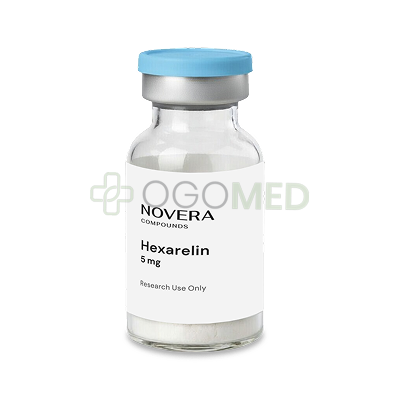
Novera Hexarelin
In Stock
| Category: | Peptides |
| Brand | Novera |
| Strength | 5mg |
| Form | Lyophilized powder |
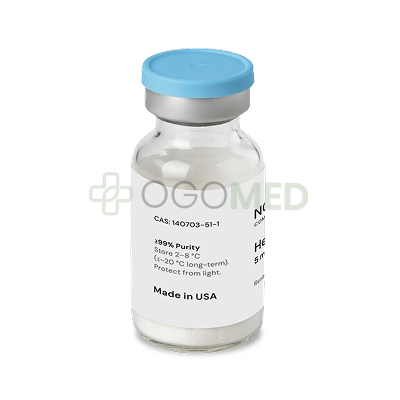
| Purity (%) | ≥99 |
| CAS number | 140703-51-1 |
| Chemical Formula | C₄₇H₅₈N₁₂O₆ |
| Molecular weight | 887.0 |
| Synonyms | Hexarelin, Examorelin, EP-23905, GHRP-6 analog |
| Peptide sequence | His-D-2-Nal-Ala-Trp-D-Phe-Lys-NH₂ |
| Storage | Store at 2-8 °C. Protect from light and moisture |
| Shelf Life (lyophilized) | 18-24 months |
| Shelf Life (after reconstitution) | 7-28 days |
Learn more...
Novera Hexarelin is a 5 mg, freeze-dried peptide that is legally classified as a research chemical in many regions for qualified laboratories investigating growth-hormone signaling and related cellular pathways. Hexarelin is a synthetic peptide, also known as examorelin, and belongs to the growth hormone secretagogue family rather than to the class of replacement hormones. It is supplied for analytical and in vitro research only; it is not a medicine, supplement, cosmetic injectable, or product for human or veterinary use. Most findings discussed around hexarelin remain experimental, and many come from animal or cell models.
The compound offers researchers a defined way to examine endocrine signaling alongside tissue-specific responses. Early human experiments measured acute hormone release, while later work explored the cardiovascular system, metabolic pathways, and skeletal muscle calcium homeostasis. These results describe research questions, not guaranteed outcomes for a person. Its proper place is in teams equipped to interpret preclinical evidence without turning it into a health claim.
What Is Inside Novera Hexarelin Peptide
The vial contains 5 mg of lyophilized hexarelin with the sequence His-2MeDTrp-Ala-Trp-DPhe-Lys-NH2. It is a short chain built from six amino acids, including modified residues chosen to create measurable receptor activity. The reported molecular formula is C47H58N12O6, the molecular weight is 887.04 g/mol, and the CAS number is 140703-51-1. Sequence identity alone does not establish how a vial will perform. Batch documentation and handling conditions remain essential.
- Brand: Novera Compounds;
- Research material: Hexarelin peptide, also called examorelin;
- Strength and form: 5 mg of lyophilized powder in a sealed vial;
- Reported specification: ≥99% product purity, with batch verification to be checked on the Certificate of Analysis;
- Intended setting: qualified laboratory use only.
For researchers comparing other peptides, the compact sequence is one point of difference, but assay design and sample quality matter just as much. The certificate, chromatographic data, and safety data sheet should be reviewed for the exact lot received. Purity percentage does not prove sterility, safety, or efficacy. The current Novera product specification states that the material is not approved for human or veterinary use.
How Hexarelin Works in Experimental Systems
Hexarelin is described as a growth hormone releasing peptide and a ghrelin analog because it acts as an agonist at GHS-R1a, usually called the ghrelin receptor. Activation in an appropriate model can involve the hypothalamic-pituitary axis and the pituitary gland, leading to a measurable rise in GH secretion. Hexarelin peptide is not GH itself.
This pathway is related to, but distinct from, signaling initiated by GH releasing hormone. In early human clinical endocrinology experiments, Hexarelin displayed strong growth hormone releasing activity, and combinations with GHRH produced a larger response than either signal alone. A controlled rising-dose human study documented acute responses, while later work showed that Hexarelin induced growth hormone release varied with dose, age, nutrition, prior exposure, and baseline growth hormone status. Those variables are one reason results should not be generalized between assay systems.
The native hormone ghrelin participates in more than GH signaling, and receptor activation can produce effects outside the endocrine axis. Hexarelin peptide is not identical to the natural ligand, so researchers examine shared and compound-specific pathways. Preclinical research also suggests that Hexarelin may have neuroprotective activity in experimental models of hypoxic-ischemic brain injury, although its ability to preserve cognitive function in humans has not been established. Questions involving intracellular calcium, mitochondrial behavior, or receptor expression require their own controls. This broader mechanism is the valid domain for experimental work, but it establishes no therapeutic indication.
What Researchers Use It to Explore
Novera Hexarelin peptide can support projects that need a defined secretagogue as a reference compound or experimental variable. Appropriate applications are mechanistic: measuring receptor engagement, hormone release, signaling changes, or tissue responses:
- Endocrine assays examining pulse characteristics, receptor activation, and prolactin release;
- Cardiac models measuring remodeling markers, cardiac output, or ventricular-volume responses;
- Metabolic models focused on insulin resistance, triglycerides, and lipid metabolism;
- Muscle models investigating muscle wasting, calcium regulation, and mitochondrial biogenesis.
Each category calls for different readouts, comparators, and statistical plans. Work on body composition or metabolic syndrome cannot be inferred from an isolated hormone peak. A change observed in mouse cardiomyocytes does not predict the response of a human heart. The peptide is useful only when the limits of the chosen model remain visible.
Human Endocrine Findings and Long-Term Hexarelin Therapy
Early human studies established that Hexarelin peptide can provoke a dose-dependent GH response. A published dose response study also measured cortisol and prolactin, showing that the compound is not selective for one hormonal output. Studies in normal elderly subjects found acute responsiveness, although age, adiposity, nutrition, and prior exposure could blunt the peak. The wording oral Hexarelin may appear in historical discussions, but such research does not make this vial an approved oral product.
Repeated exposure adds another complication. Repeated dosing produced partial attenuation of the GH response and raised questions about transient cortisol and prolactin elevations in a published human investigation. Consequently, claims about long-term Hexarelin therapy run ahead of the evidence. Human studies were small and designed to characterize hormones, not to prove improvements in strength, recovery, longevity, or disease outcomes.
Cardiovascular Research: Promising Signals, Preclinical Evidence
Limited human evidence has also been reported. In a controlled study involving 24 male patients with coronary artery disease undergoing bypass surgery, acute Hexarelin administration temporarily improved measures of cardiac performance. The study recorded an increase in left ventricular ejection fraction, but this short-term intraoperative response does not establish a lasting therapeutic benefit or support routine clinical use.
Hexarelin’s cardiovascular action has been studied extensively in isolated tissue and animal models. The paper titled “Chronic administration of Hexarelin attenuates cardiac fibrosis in the spontaneously hypertensive rat” reported less myocardial collagen deposition, changes consistent with reduced collagen synthesis, and lower blood pressure in a rat model. Related experiments after myocardial infarction evaluated ventricular remodeling and chronic cardiac function. These are meaningful laboratory signals, but they are not proof that the product treats fibrosis, hypertension, or heart failure in people:
- Some experiments reported preserved ventricular performance after experimental cardiac injury.
- Receptor-blocking designs suggested that at least part of the response involved GHS-R signaling.
- Investigators described possible GH-independent cardioprotective effects in selected models.
- The findings prompted research studies into fibrosis, autonomic balance, inflammation, and myocardial energetics.
In mice, Hexarelin treatment was associated with preserved myocardial performance and less fibrosis after experimental injury. Separate cell and animal experiments also reported lower markers of oxidative stress and reduced cardiomyocyte apoptosis following experimentally induced cardiac injury. Another paper found that one dose given orally before an induced event protected later ventricular measurements in animals, which does not establish a preventive treatment for humans.
Skeletal-Muscle and Metabolic Models
Researchers have examined growth hormone secretagogues Hexarelin and JMV2894 in chemotherapy-related muscle models. In cisplatin induced cachexia, animal experiments found that Hexarelin helped restore markers of mitochondrial biogenesis and mitochondrial mass while countering mitochondrial damages in rat muscle. Related work linked cachexia with disturbed muscle-tissue calcium control, then tested whether secretagogue exposure modified that pattern. The published muscle study supports a research rationale, not a claim that Hexarelin treats patients.
Metabolic research has produced similarly interesting but limited results. In a genetically modified mouse model of insulin resistance, a study reported that the compound improves lipid metabolic aberrations, insulin and glucose tolerance, plasma triglyceride levels, and liver lipid accumulation. It was not a clinical trial and cannot establish weight-loss, glucose-control, or cholesterol benefits. One study can identify a pathway worth testing, but it cannot replace replicated human data.
The line between hormone-mediated and tissue-specific activity is still being clarified. Investigators continue to ask whether metabolic or muscular observations result from receptor signaling, altered GH/IGF biology, appetite pathways, or a combination of mechanisms.
Side Effects, Safety Questions, and Research Uncertainty
Hexarelin peptide lacks a complete, modern clinical safety profile for therapeutic use. Acute human studies observed stimulation of GH and, depending on context, ACTH, cortisol, and prolactin. Sleep research also reported changes in slow-wave sleep. Repeated exposure may diminish the GH response, while the consequences of recurring endocrine peaks remain unclear. Short studies reporting few immediate events do not make an experimental peptide risk-free:
- Dose-dependent or context-dependent changes in GH, cortisol, ACTH, and prolactin;
- Partial loss of responsiveness after repeated exposure;
- Unknown long-term metabolic, cardiovascular, reproductive, and immune effects;
- Hexarelin can cause neurological sensations like tingling or numbness.
- Material risks related to contamination, aggregation, impurities, handling errors, or use outside a controlled laboratory.
Research personnel should follow an approved protocol and local laboratory rules. Anyone seeking help with a medical condition should use licensed clinical care rather than this compound. Hexarelin should be avoided by pregnant or breastfeeding individuals. Also, it should be administered in defined cycles to prevent hormonal imbalances.
Storage, Handling, and Stability
Keep unopened vials refrigerated at 2–8 °C and protected from light, heat, and moisture. For long-term storage, the specification permits temperatures at or below −20 °C; the vial should remain sealed. Avoid repeated temperature cycling, and record the lot number, location, and access dates. Temporary room-temperature transport may be acceptable, but damaged or improperly sealed vials should be quarantined.
The stated shelf life is 24 months from the manufacturing date when the product remains under specified conditions. Laboratories should rely on the date and documentation for the exact lot rather than calculating stability from the purchase date. Once a material is prepared for an assay, stability depends on solvent, concentration, container, temperature, light exposure, and the validated protocol; no universal prepared-solution period should be assumed. Do not use a vial after its labeled expiry or when appearance, seal integrity, or documentation raises a concern.
Before work begins, compare the vial label with the Certificate of Analysis and confirm that the sequence, mass, purity result, and lot identifier match the order. Storage logs and calibrated monitoring help protect both the material and reproducibility. A high headline purity cannot compensate for an interrupted cold chain or unsuitable design. Novera Hexarelin peptide should remain secured and be handled only by qualified personnel.
Where to Buy Hexarelin and Bacteriostatic Water
Hexarelin is available from OGOMed, where buyers can find the Novera listing, check current availability, review the price, and place an order online. The product appears within the store’s wider selection of peptides, which can be convenient for laboratories purchasing several materials from one supplier. Before completing checkout, customers should verify the selected quantity, delivery estimate, shipping terms, and any import requirements that apply to their destination.
OGOMed can be a practical purchasing option for teams sourcing materials for planned research studies as injectable substances produced outside of regulated facilities may not be sterile. Buyers comparing growth hormone secretagogues should review the current listing and confirm that the available batch documentation meets their laboratory’s requirements.
| Category: | Peptides |
| Brand | Novera |
| Strength | 5mg |
| Form | Lyophilized powder |
| Purity (%) | ≥99 |
| CAS number | 140703-51-1 |
| Chemical Formula | C₄₇H₅₈N₁₂O₆ |
| Molecular weight | 887.0 |
| Synonyms | Hexarelin, Examorelin, EP-23905, GHRP-6 analog |
| Peptide sequence | His-D-2-Nal-Ala-Trp-D-Phe-Lys-NH₂ |
| Storage | Store at 2-8 °C. Protect from light and moisture |
| Shelf Life (lyophilized) | 18-24 months |
| Shelf Life (after reconstitution) | 7-28 days |
Learn more...