








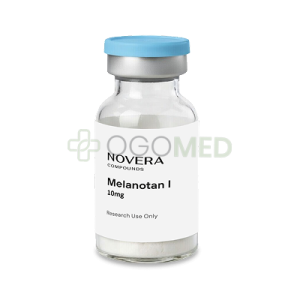


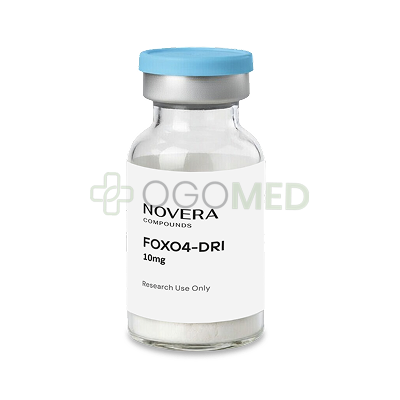
Novera FOXO4-DRI
In Stock
| Category: | Peptides |
| Brand | Novera |
| Strength | 10mg |
| Form | Lyophilized powder |
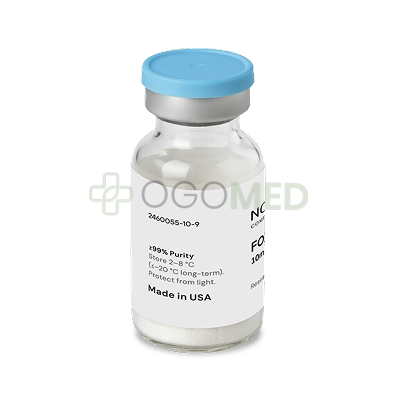
| Purity (%) | ≥99 |
| CAS number | 2460055-10-9 |
| Chemical Formula | C₂₂₈H₃₈₈N₈₆O₆₄ |
| Molecular weight | 5358 |
| Synonyms | FOXO4-inhibitor-peptide, Dominant-negative-FOXO4, Cell-senescence-inhibitor |
| Peptide sequence | LTLRKEPASEIAQSILEAYSQNGWANRRSGGKRPPPRRRQRRKKRG (DRI peptide) |
| Storage | Store at -20 °C for long-term storage. Protect from light |
| Shelf Life (lyophilized) | 12-24 months |
| Shelf Life (after reconstitution) | 24-72 hours |
Learn more...
Novera FOXO4-DRI is a research peptide developed for laboratory investigation into the biology of aging and cellular senescence. Rather than being marketed as a conventional supplement, this compound has attracted attention because it belongs to a class often described as a senolytic peptide, meaning it is being explored for its potential role in eliminating senescent cells under experimental conditions. Researchers are interested in understanding how these cells influence healthy tissues over time and whether their controlled removal may help maintain normal biological processes.
Unlike nutrients that simply support daily wellness, this peptide is intended for scientific exploration of age-related mechanisms. Most available information comes from laboratory experiments and animal models, making it important to distinguish research findings from proven clinical outcomes in humans.
What Is FOXO4-DRI?
FOXO4-DRI belongs to a family of synthetic peptides designed to mimic specific regions of naturally occurring proteins. The name dri peptide refers to a specialized design strategy that improves molecular stability while preserving biological activity during laboratory testing. More specifically, it is considered a d retro inverso peptide, a format that uses d amino acids instead of the naturally occurring L-form amino acids. This modified structure helps reduce enzymatic degradation, allowing the peptide to remain more stable in experimental environments.
Scientists originally synthesized this molecule to study how senescent cells survive despite extensive cellular damage. Under normal circumstances, severely damaged cells undergo programmed cell death, but senescent cells often remain metabolically active even after they have permanently stopped dividing. This unusual survival pattern has become an important area of aging research.
Researchers continue examining how the peptide may interact with intracellular signaling networks responsible for cell survival and stress adaptation. Its unique binding characteristics have made it a valuable laboratory tool for studying complex biological mechanisms without altering the genetic makeup of the experimental system.
FOXO4-DRI Main Characteristics
- Built using d amino acids for improved stability.
- Designed as a D-Retro-Inverso peptide.
- Investigated primarily in laboratory and animal research.
- Not established as an approved therapeutic product.
Interest in FOXO4-DRI has grown because aging tissues gradually accumulate senescent cells that no longer perform their original function efficiently. These cells remain alive while releasing signaling molecules capable of affecting neighboring healthy cells.
How Does FOXO4 D-Retro-Inverso Work
The proposed mechanism centers on the FOXO4-p53 interaction, which plays a major role in cell cycle regulation. Experimental evidence suggests that disrupting this interaction may selectively induce apoptosis in senescent cells while leaving healthy cells relatively unaffected under laboratory conditions.
Rather than damaging every cell indiscriminately, investigators are exploring whether the peptide can promote targeted apoptosis and trigger apoptosis specifically in cells that have accumulated significant DNA-damage. This selective approach is one reason the compound has generated scientific interest.
Current research also examines how the peptide may influence oxidative stress signaling pathways, an area closely linked with aging and chronic cellular dysfunction. Scientists believe these interconnected mechanisms may affect overall tissue homeostasis, although many details remain under active investigation.
Age-Related Processes Under Investigation
- Cellular aging mechanisms.
- Stress-related signaling pathways.
- Protein interaction networks.
- Cell survival versus apoptosis balance.
These studies focus on understanding biological processes rather than demonstrating clinical effectiveness. At present, no consensus exists that these experimental findings directly translate into routine human medical use.
Areas of Scientific Interest
One reason senescent cells attract attention is their ability to produce inflammatory molecules collectively known as the senescence associated secretory phenotype. This persistent signaling may contribute to changes in the surrounding cellular environment and influence overall tissue function over time.
Experimental work has evaluated FOXO4-DRI in several biological contexts, including musculoskeletal, metabolic, and reproductive systems. Laboratory investigations involving vitro expanded human chondrocytes have examined how cellular aging influences cartilage biology, while separate experiments have explored possible relationships with insulin signaling and metabolic regulation.
Additional work has examined targeting senescent leydig cells within the testicular microenvironment. Scientists are interested in whether reducing the burden of dysfunctional cells could influence hormone-producing tissues affected by male late onset hypogonadism, although these observations remain preliminary.
FOXO4-DRI Research Topics
- Healthy aging biology;
- Cartilage cell research;
- Reproductive aging;
- Metabolic regulation;
- Tissue regeneration.
These areas remain active fields of investigation, and many published findings emphasize the need for further investigation before drawing conclusions about real-world applications.
What Do Preclinical Studies Show
Most available evidence comes from preclinical studies, including experiments involving cultured cells and aged mice. In several reports, scientists observed measurable changes in markers associated with senescence, with some data suggesting reductions in overall senescence level after experimental intervention.
Animal studies have also explored whether reducing senescent cell populations could help protect normal organ function during age related decline. Some publications describe improvements in specific physiological measurements following experimental treatment, although results vary depending on the model being studied.
Scientists continue evaluating whether these findings demonstrate meaningful efficacy across different tissues or simply reflect unique characteristics of individual experimental systems. Because biological aging involves many interconnected pathways, it remains uncertain how broadly these observations apply across species. Researchers also caution that positive laboratory findings should not be interpreted as evidence of established medical benefit in humans.
Potential Applications Being Explored
Current investigations extend across several areas of aging biology rather than a single medical condition. Scientists hope better understanding of senescent cells may eventually enhance knowledge of normal aging mechanisms and their relationship with chronic disease.
Research has explored how reducing senescent cell accumulation might influence cartilage health, cardiovascular tissues, skeletal muscle, endocrine function, and immune activity. Investigators also examine changes in gene expression, inflammatory response, and cellular communication following experimental intervention.
Rather than focusing solely on lifespan, many laboratories study how senescent cell clearance may influence everyday biological performance and preserve normal organ function throughout aging.
FOXO4-DRI Safety and Possible Side Effects
Human safety data remain extremely limited. Available information comes primarily from laboratory investigations rather than large clinical trials, making it impossible to fully characterize the long-term safety profile.
Possible concerns discussed in scientific literature about FOXO4-DRI include:
- Unexpected immune reactions;
- Effects on healthy regenerative cells;
- Individual biological variability;
- Unknown long-term consequences.
Because apoptosis is a fundamental biological process, scientists carefully evaluate whether disrupting survival pathways could produce unintended effects outside the targeted senescent cell population. Different tissues may also demonstrate varying levels of resistance, requiring additional investigation before broader conclusions can be reached. For these reasons, any discussion of FOXO4-DRI should be viewed within the framework of experimental science rather than established clinical practice.
Composition and Storage Conditions
Novera FOXO4-DRI consists of a laboratory-manufactured peptide sequence designed to maintain structural integrity throughout research procedures. High-purity preparations are typically produced under controlled manufacturing conditions suitable for scientific use. To preserve product quality, most laboratories recommend:
- Storage in a freezer before reconstitution.
- Protection from repeated freeze-thaw cycles.
- Keeping the material away from direct light and moisture.
- Using sterile handling procedures during preparation.
After reconstitution, storage recommendations depend on the solvent used and the planned duration of the experiment. Following appropriate laboratory handling practices helps maintain peptide stability throughout the research process.
Where to Buy FOXO4-DRI
Purchasing FOXO4-DRI legally varies by jurisdiction and it is not sold for personal consumption by reputable suppliers. OGOmed focuses on providing high-purity products manufactured with strict quality standards and supported by detailed product documentation. This allows laboratories and research professionals to obtain materials suitable for in vitro and in vivo experimental applications while maintaining consistency between batches. Careful packaging and controlled storage conditions also help decrease the risk of peptide degradation during shipping and handling.
In addition to product quality, OGOmed emphasizes transparent specifications, responsive customer support, and fast order processing. Each peptide is supplied for research purposes, enabling scientists to source materials from a trusted vendor without unnecessary uncertainty about purity or handling recommendations. This combination of quality control and dependable service makes it easier to obtain FOXO4-DRI for laboratory investigations.
| Category: | Peptides |
| Brand | Novera |
| Strength | 10mg |
| Form | Lyophilized powder |
| Purity (%) | ≥99 |
| CAS number | 2460055-10-9 |
| Chemical Formula | C₂₂₈H₃₈₈N₈₆O₆₄ |
| Molecular weight | 5358 |
| Synonyms | FOXO4-inhibitor-peptide, Dominant-negative-FOXO4, Cell-senescence-inhibitor |
| Peptide sequence | LTLRKEPASEIAQSILEAYSQNGWANRRSGGKRPPPRRRQRRKKRG (DRI peptide) |
| Storage | Store at -20 °C for long-term storage. Protect from light |
| Shelf Life (lyophilized) | 12-24 months |
| Shelf Life (after reconstitution) | 24-72 hours |
Learn more...