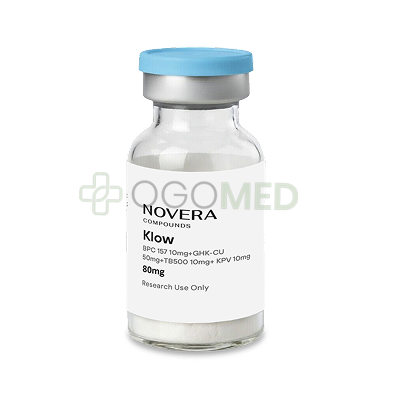








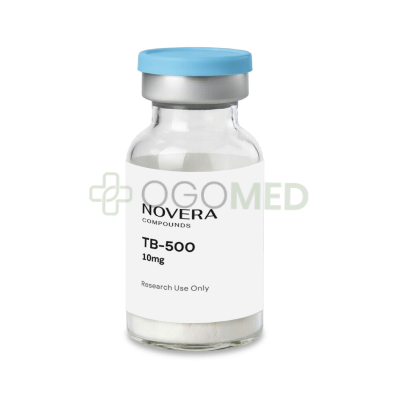
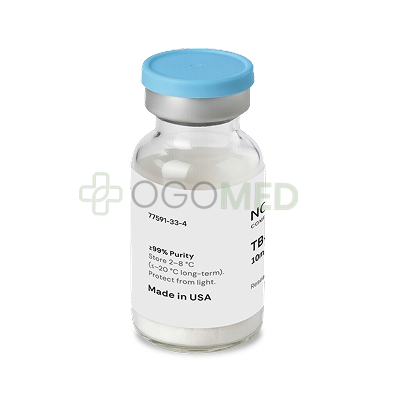
Novera TB-500
In Stock
| Category: | Peptides |
| Brand | Novera |
| Strength | 10mg |
| Form | Lyophilized powder |
| Purity (%) | ≥99 |
| CAS number | 77591-33-4 |
| Chemical Formula | C₂₁₂H₃₅₀N₅₆O₇₈S |
| Molecular weight | 4963 |
| Synonyms | Thymosin-beta4-fragment, TB-4, Thymosin-beta-4 |
| Peptide sequence | Ac-Ser-Asp-Lys-Pro-Asp-Met-Ala-Glu-Ile-Glu-Lys-Phe-Asp-Lys-Ser-Lys-Leu-Lys-Lys-Thr-Glu-Thr-Gln-Glu-Lys-Asn-Pro-Leu-Pro-Ser-Lys-Glu-Thr-Ile-Glu-Gln-Glu-Lys-Gln-Ala-Gly-Glu-Ser |
| Storage | Store at 2-8 °C or -20 °C. Protect from light |
| Shelf Life (lyophilized) | 12-24 months |
| Shelf Life (after reconstitution) | 5-21 days |
Learn more...
Novera TB 500 is a synthetic peptide derived from thymosin beta 4, a protein that is naturally occurring in the human body and plays an important role in multiple biological processes. This synthetic version has attracted attention in laboratory settings because of its broad range of biological applications and the variety of cellular mechanisms that continue to be assessed by researchers. Rather than acting as a simple compound, it is studied for the way it may influence communication between tissues and support normal cellular activity under experimental conditions.
Its sequence includes asp lys, lys thr glu, and glu thr gln, forming part of a carefully designed structure made from specific 43 amino acids. Its molecular weight is 4,963.4 g/mol. It is manufactured under controlled conditions to maintain product quality and batch consistency. It is supplied as a white powder and is readily soluble in water, making it suitable for standard laboratory preparation procedures. Every vial is supplied for research purposes and is intended exclusively for laboratory use.
How TB 500 Works
Researchers are interested in TB 500 because it interacts with actin, a structural protein that helps maintain cell shape and movement. The peptide contains a central actin binding domain, which is believed to promote cell migration, tissue remodeling, and several pathways associated with regeneration. These biological interactions are considered crucial for understanding how cells respond after stress or injury.
Several experimental models suggest that TB 500 may enhance processes connected with wound healing, encourage angiogenesis, and support cell survival while helping to inhibit apoptosis. Some investigations also describe its involvement in modulating inflammation, leading to observations of reduced inflammation in controlled environments. Because of these characteristics, the peptide has shown promise across a broad spectrum of investigation areas. Areas commonly explored include:
- Studies involving stem cells and stem cell differentiation;
- Models focused on cardiac tissue repair;
- Research related to muscle, tendon, and connective tissue;
- Laboratory investigations into recovery following experimental wound models.
Interest in TB 500 continues to expand as researchers attempt to better understand its biological promise and how different pathways may be combined in future experimental work.
Composition and Laboratory Characteristics
TB 500 is generally classified as a research peptide rather than a pharmaceutical ingredient. It is commonly examined in cultures of mammalian cells, where scientists investigate its influence on cellular organization and signaling. TB-500 shows excellent safety in experimental animal models (it is well tolerated in dogs and monkeys at high doses), making additional investigation necessary before broader conclusions can be reached. Laboratory projects often focus on:
- Cellular signaling involving cytokines;
- Pathways associated with anti apoptotic activity;
- Tissue repair and structural remodeling;
- Experimental models exploring biological healing.
Although many findings are encouraging, no single mechanism fully explains every observed effect. Scientists continue exploring how individual pathways interact and whether different biological responses depend on specific experimental conditions.
Research Purposes of Thymosin Beta 4 in Animal Studies
One reason TB 500 remains widely discussed is its versatility in research. Different laboratories investigate its possible involvement in soft tissue recovery, vascular development, and cellular adaptation following mechanical stress. Because many biological systems are interconnected, researchers frequently examine several endpoints simultaneously instead of looking at only one marker.
The peptide has been explored in projects involving connective tissues, cardiovascular models, and laboratory environments where coordinated cellular responses are required. Understanding these processes may contribute to future scientific knowledge, even though many questions remain unanswered. Every new publication adds another piece to the larger picture, helping clarify where this peptide may fit within modern biomedical research.
Laboratory investigations have explored TB-500 across several experimental models. Published preclinical investigations have examined its biological activity in different tissues, although additional research is needed to better understand the findings and their relevance.
- Studies have explored the potential of TB-500 in supporting dermal wound healing in diabetic animal models.
- Preclinical studies have investigated systemic TB-500 in cardiac injury models, including observations related to infarct size.
- Experimental research has examined TB-500 in neurological injury models, where its potential influence on neuronal survival has been evaluated.
- Animal studies have also investigated TB-500 in septic shock models in rats, where researchers evaluated its potential effects on mortality under experimental conditions.
- Some researchers have also discussed whether TB-500 could theoretically influence tumor growth, although this possibility remains uncertain and requires further investigation.
Storage and Handling
Proper handling is important for preserving peptide stability. Novera TB 500 should be kept according to the manufacturer’s instructions, protected from excessive heat, moisture, and direct light. Refrigerated conditions are generally recommended after delivery, while long-term preservation may require freezing when appropriate for laboratory protocols. For best handling practices:
- Avoid repeated freeze-thaw cycles whenever possible.
- Keep the vial sealed until preparation is required.
- Store the product in a clean laboratory environment with controlled conditions.
- Follow all handling procedures strictly to protect sample integrity.
Every batch should be inspected before use to ensure packaging remains intact and that storage conditions have been maintained throughout transport.
Product Information
Novera is committed to manufacturing standards that prioritize consistency, traceability, and safety throughout production. This peptide is not approved as a medicine or dietary supplement for human or veterinary administration. It is produced exclusively for scientific investigation and laboratory experimentation. Although published research remains limited, TB-500 can cause systemic effects such as fatigue and headaches. Any observations related to biological effects should be interpreted within the context of controlled research settings rather than clinical use.
Where to Buy TB 500 for Wound Healing
Choosing a reliable supplier is just as important as selecting the right synthetic peptide for your laboratory work. TB-500 should be obtained through vetted sources for safety. At OGOmed, every product is sourced with an emphasis on consistency, documentation, and handling standards to support professional research purposes. Whether your projects focus on wound healing, regeneration, or other scientific applications, you can order with confidence knowing that consistency remains a priority.
Shopping with OGOmed means access to carefully selected research peptides, transparent product information, and responsive customer support. While experimental outcomes always depend on study design, sample quality, and laboratory methods, using dependable materials can improve the ability to obtain reliable results. Every order is packed with care to help ensure safe delivery and maintain peptide stability throughout transportation.
| Category: | Peptides |
| Brand | Novera |
| Strength | 10mg |
| Form | Lyophilized powder |
| Purity (%) | ≥99 |
| CAS number | 77591-33-4 |
| Chemical Formula | C₂₁₂H₃₅₀N₅₆O₇₈S |
| Molecular weight | 4963 |
| Synonyms | Thymosin-beta4-fragment, TB-4, Thymosin-beta-4 |
| Peptide sequence | Ac-Ser-Asp-Lys-Pro-Asp-Met-Ala-Glu-Ile-Glu-Lys-Phe-Asp-Lys-Ser-Lys-Leu-Lys-Lys-Thr-Glu-Thr-Gln-Glu-Lys-Asn-Pro-Leu-Pro-Ser-Lys-Glu-Thr-Ile-Glu-Gln-Glu-Lys-Gln-Ala-Gly-Glu-Ser |
| Storage | Store at 2-8 °C or -20 °C. Protect from light |
| Shelf Life (lyophilized) | 12-24 months |
| Shelf Life (after reconstitution) | 5-21 days |
Learn more...