






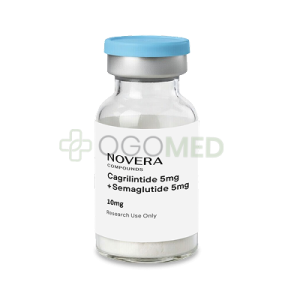



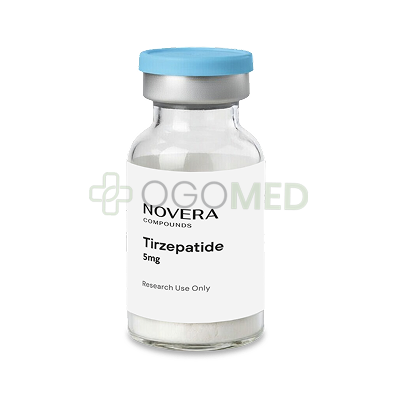
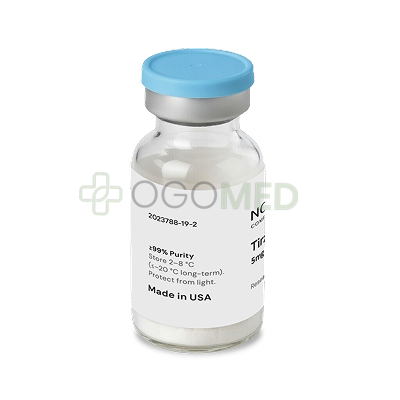


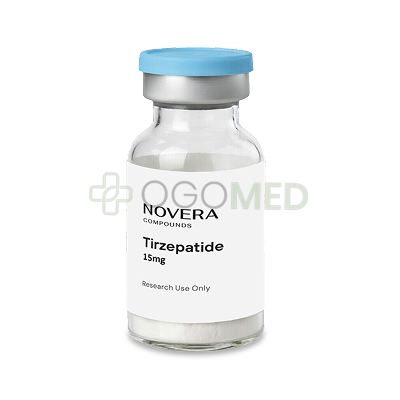

Novera Tirzepatide
| Category: | Peptides |
| Brand | Novera |
| Strength | 100mg, 10mg, 15mg, 30mg, 5mg, 60mg |
| Form | Lyophilized powder |
| Purity (%) | ≥99 |
| CAS number | 2023788-19-2 |
| Chemical Formula | C₂₂₅H₃₄₈N₄₈O₆₈ |
| Molecular weight | 4813 |
| Synonyms | Dual-GIP-GLP1-agonist, Mounjaro-type-peptide |
| Peptide sequence | Proprietary modified peptide |
| Storage | Store at 2-8 °C. Protect from light and moisture |
| Shelf Life (lyophilized) | 24-36 months |
| Shelf Life (after reconstitution) | 7-14 days |
Learn more...
Tirzepatide is a synthetic 39-amino-acid dual incretin receptor agonist studied for its simultaneous activation of glucose-dependent insulinotropic polypeptide (GIP) and glucagon-like peptide-1 (GLP-1) receptors. Laboratory interest centers on its effects in glycemic regulation, body weight reduction, and downstream metabolic signaling across in vitro assays, rodent obesity models, and controlled human trials. The compound is marketed under the brand names Zepbound and Mounjaro as prescription medicines, but those are distinct products with separate regulatory status.
Novera Tirzepatide is supplied as a research-grade peptide for laboratory investigation only. It is not an approved medicine, not intended for human or veterinary treatment, and all information on this page relates to experimental models and published research findings. Licensed professionals looking to buy tirzepatide for bench or preclinical work will find ordering details, evidence summaries, and practical purchasing information below.
What Novera Tirzepatide Is
Novera Tirzepatide is a synthetic analog derived structurally from native GIP, engineered with GLP-1-like sequence segments to produce dual receptor activity. The molecule differs from endogenous GIP and GLP-1 through incorporation of a fatty-acid side-chain conjugated at lysine-20, which enables non-covalent albumin binding in circulation. This modification extends the compound’s effective half-life far beyond that of native incretins, whose plasma persistence is measured in minutes due to rapid DPP-4 cleavage.
For researchers, the extended exposure window matters because it allows chronic-dosing protocols in animal models without continuous infusion, and it introduces altered receptor bias at GLP-1R compared to native GLP-1. Willard et al. (2020, JCI Insight) showed that tirzepatide is biased at GLP-1R, favouring cAMP generation over beta-arrestin recruitment and internalising the receptor more weakly than GLP-1 itself. These properties make tirzepatide a distinct pharmacological tool from selective GLP-1 receptor agonists, which is why many laboratories studying incretin biology choose to buy tirzepatide peptide as a dual-agonist reference compound alongside single-target controls.
The compound is supplied for laboratory research use only and is not an approved therapy.
Why Researchers Study Tirzepatide
The central mechanistic interest in tirzepatide lies in its simultaneous activation of GIP and GLP-1 receptors, which converge on overlapping but non-identical downstream pathways affecting insulin release, glucagon suppression, gastric emptying, and central appetite regulation. No single endogenous hormone engages both receptors with the potency profile this synthetic analog achieves, making it a useful probe for studying receptor crosstalk and synergy.
Published evidence spans in vitro receptor-signaling assays dating to 2018, diet-induced obese rodent models, and multiple randomized phase 2 and phase 3 human trials. The subsections below organize findings by research theme, each grounded in named studies with species, model, and quantitative outcomes.
Metabolic Control And Glycemic Research
Dual GIP/GLP-1 agonism is of particular interest in glucose homeostasis research because both receptors are expressed on pancreatic beta cells and contribute to meal-stimulated insulin secretion through cAMP-dependent pathways, while GLP-1R activation additionally suppresses alpha-cell glucagon output.
In the SURPASS-2 trial, Frias et al. reported in the New England Journal of Medicine in 2021 that once-weekly tirzepatide at 5 mg, 10 mg, and 15 mg reduced HbA1c by 2.01, 2.24, and 2.30 percentage points respectively at 40 weeks in approximately 1,879 adults with type 2 diabetes, compared with a 1.86-point reduction with semaglutide 1 mg. Body weight changes in that same trial were −7.6 kg, −9.3 kg, and −11.2 kg across the three tirzepatide doses, versus −5.7 kg with the GLP-1-only comparator.
The rodent arm of the discovery package is Coskun et al. (2018, Molecular Metabolism): in mice, LY3298176 produced glucose-dependent insulin secretion and improved glucose tolerance through both receptors, and chronic administration decreased body weight and food intake significantly more than a GLP-1 receptor agonist did.
“In patients with type 2 diabetes, tirzepatide was noninferior and superior to semaglutide with respect to the mean change in the glycated hemoglobin level.” (Frias et al., 2021, New England Journal of Medicine, SURPASS-2)
Body-Weight And Energy-Balance Models
Many research groups use the compound to study obesity-related endpoints because its dual receptor profile produces weight reductions in human trials that exceed those reported for selective GLP-1 receptor agonists at approved doses. Changes in food intake, energy expenditure, and adipose tissue distribution are all active areas of investigation.
In the SURMOUNT-1 trial published by Jastreboff et al. in the New England Journal of Medicine in 2022, adults with obesity but without diabetes lost a mean 19.5% of body weight with 10 mg tirzepatide and 20.9% with 15 mg over 72 weeks, versus 3.1% with placebo. The trial randomised 2539 adults, and 57% of the 15 mg group reached a body weight reduction of 20% or more, against 3% on placebo.
The rodent evidence for the appetite arm is Coskun et al. (2018), where chronic dosing in mice cut body weight and food intake further than a selective GLP-1 receptor agonist. Beyond that, the magnitude and selectivity of appetite suppression seen in rodents may not replicate across species or dietary contexts, and the central circuits involved have not been mapped for this compound.
“5 mg, 10 mg, or 15 mg of tirzepatide once weekly provided substantial and sustained reductions in body weight.” (Jastreboff et al., 2022, New England Journal of Medicine, SURMOUNT-1)
Cardiometabolic And Organ-System Outcomes
Glycemic and weight changes in incretin research are often accompanied by shifts in broader cardiometabolic markers, including blood pressure, lipid fractions, and hepatic fat content. These secondary and exploratory endpoints have drawn attention because conditions like high blood pressure and nonalcoholic fatty liver disease share pathophysiological links with insulin resistance.
Across the SURPASS program, prespecified analyses reported reductions in systolic blood pressure, improvements in triglyceride and lipid profiles, and decreases in liver fat fraction as measured by imaging. In SURPASS-5, Dahl et al. (2022, JAMA) reported that adding tirzepatide to titrated insulin glargine in 475 adults reduced HbA1c by 2.40 percentage points at the 10 mg dose versus 0.86 points with placebo at week 40. Preclinical rodent studies under high-fat diet conditions have similarly shown reduced hepatic steatosis scores and lower circulating triglycerides, though these animal findings have not been confirmed in large, long-duration human hepatic outcome trials.
Large dedicated cardiovascular outcome trials designed to assess major adverse events with tirzepatide are either recently reported in preliminary form or still accruing follow-up data. Long-term organ-specific effects remain an open research question.
Mechanistic And Receptor-Signaling Studies
Many laboratories use tirzepatide in cell-based systems to dissect biased agonism, quantify receptor internalization kinetics, and map downstream signaling cascades at each target receptor independently.
Willard et al. (2020, JCI Insight) calculated receptor occupancy at clinically efficacious doses and found greater engagement at the GIP receptor than at the GLP-1 receptor, which is where the word imbalanced comes from. At GIPR the compound behaves like native GIP; at GLP-1R it is biased toward cAMP generation over beta-arrestin recruitment and internalises the receptor more weakly than GLP-1. In primary islets the same group found that beta-arrestin1 limits the insulin response to GLP-1 but not to GIP or tirzepatide, which offers a mechanistic reason for the dual agonist’s insulin output.
“Tirzepatide mimics the actions of native GIP at the GIP receptor but shows bias at the GLP-1 receptor.” (Willard et al., 2020, JCI Insight)
Unresolved questions remain about tissue-specific receptor expression patterns in the central nervous system, the relative contribution of GIP versus GLP-1 signaling to appetite suppression in humans, and whether the biased agonism observed in cell lines translates to differential organ-level effects in chronic treatment protocols.
How Tirzepatide Compares With Related Compounds
Researchers studying incretin biology frequently compare tirzepatide with selective receptor agonists to isolate the contribution of each receptor arm. The table below summarizes how the compound differs from a representative GLP-1-only agonist and a GIP-selective analog on receptor targeting, strength of published evidence, and typical experimental applications. Numbers and receptor targets are grounded in published data, but investigators should consult original sources when designing protocols.
| Compound | Primary Receptor Targets | Evidence Level Highlight | Typical Research Use |
|---|---|---|---|
| Tirzepatide (Novera Tirzepatide) | Dual agonist at GIP and GLP-1 receptors | Multiple phase 2/3 human trials in type 2 diabetes and obesity, plus rodent and in vitro signaling studies | Studies of combined incretin signaling, body-weight control, and receptor bias mechanisms |
| Representative GLP-1 Agonist (e.g., Semaglutide) | Selective agonist at GLP-1 receptors | Extensive human data in diabetes, obesity, and cardiovascular outcomes, along with animal pharmacology | Research focusing on isolated GLP-1 receptor pathways and established incretin pharmacology |
| Representative GIP Analog | Predominantly GIP receptor agonism | Smaller human and preclinical data sets exploring insulinotropic and adipose-tissue effects | Targeted studies of GIP receptor biology and its interaction with insulin secretion and adiposity |
A researcher would choose tirzepatide over a GLP-1-only compound when dual-receptor synergy or the differential contribution of GIP signaling is the primary experimental question. The SURPASS-2 trial showed greater HbA1c and body weight reductions with tirzepatide than with semaglutide at matched time points, but that comparison reflects the dual mechanism rather than inherent superiority of one tool over another. When the goal is to isolate GLP-1 receptor effects without GIP receptor confounding, a selective agonist remains the cleaner pharmacological probe. GIP-selective analogs serve a narrower niche: dissecting the insulinotropic and adipose-tissue effects mediated through GIPR alone.
Differences in receptor targeting and trial outcomes do not imply one compound is clinically better; they define distinct experimental tools suited to different research questions.
What Research On Tirzepatide Does Not Establish
Published data on tirzepatide are substantial across multiple trial programs and preclinical models, but they have clear boundaries defined by species tested, trial durations, endpoints measured, and populations enrolled. Recognizing these limits is essential for researchers interpreting results and for anyone conducting thorough research before designing new experiments.
Several claims circulating online lack strong published support. Assertions about neuroprotective effects, lifespan extension, or cosmetic anti-aging benefits rest on speculation or, at best, on isolated cell-culture observations that have not been tested in controlled animal studies, let alone human trials. No published trial has evaluated tirzepatide for cognitive outcomes, joint health, or dermatological endpoints.
Many mechanistic findings, including selective suppression of palatable food intake, differential effects on visceral versus subcutaneous fat depots, and central appetite-circuit modulation, derive exclusively from rodent or in vitro work. Safety data in diverse human populations, including elderly individuals, those with significant renal impairment, and pediatric groups, remain sparse. Most trials ran 40 to 72 weeks, which limits conclusions about adverse events that might emerge over years of exposure. Gastrointestinal adverse events, particularly nausea, diarrhoea and abdominal pain, are consistent and dose-dependent across trials: in SURPASS-2 nausea was reported by 17 to 22% of tirzepatide participants against 18% on semaglutide. Tirzepatide carries a risk of thyroid C-cell tumors based on preclinical animal findings, and serious side effects reported in clinical trials include acute pancreatitis and kidney injury. Hypoglycemia risk increases when the compound is combined with insulin in study protocols.
No major trial has reported neutral or negative primary outcomes on glycemic endpoints at therapeutic doses, but certain secondary cardiometabolic endpoints (specific lipid subfractions, quality-of-life scores) have not uniformly shown statistically significant changes across all trial arms. Tirzepatide is also absent from the 2026 WADA Prohibited List: neither GIP nor GLP-1 receptor agonists are named there, and no class entry covers them, so anti-doping detection is not among the questions this compound answers.
None of the research discussed on this page constitutes dosing guidance, medical advice, or an endorsement of any off-label human use.
Where to Buy Novera Tirzepatide
Researchers looking to buy tirzepatide online as a peptide reference compound can source Novera Tirzepatide through this store’s ordering system. The product is supplied for laboratory experiments and is available to institutional and licensed professional buyers. For those searching where to buy tirzepatide or how to buy tirzepatide online for preclinical work, the following purchasing details apply.
-
Estimated delivery time 3 to 7 days.
-
Free shipping on orders over $750.
-
All US import fees and tariffs are covered by Ogomed, so the buyer pays nothing extra; customs checks under the new US import rules can add a little time to delivery.
-
Price match: if the same product is listed for less elsewhere, Ogomed will try to match it.
-
Support by phone +1-650-457-5621 and email, 10am to 6pm EST.
-
Sold to licensed professionals, for laboratory research use only.
Novera Tirzepatide is supplied only to qualified buyers for non-clinical, non-human laboratory investigations.
References
- Frias, J. P., et al. (2021). Tirzepatide versus Semaglutide Once Weekly in Patients with Type 2 Diabetes. The New England Journal of Medicine, 385(6), 503-515. DOI: 10.1056/NEJMoa2107519
- Jastreboff, A. M., et al. (2022). Tirzepatide Once Weekly for the Treatment of Obesity. The New England Journal of Medicine, 387(3), 205-216. DOI: 10.1056/NEJMoa2206038
- Coskun, T., et al. (2018). LY3298176, a novel dual GIP and GLP-1 receptor agonist for the treatment of type 2 diabetes mellitus: From discovery to clinical proof of concept. Molecular Metabolism, 18, 3-14. DOI: 10.1016/j.molmet.2018.09.009
- Dahl, D., et al. (2022). Effect of Subcutaneous Tirzepatide vs Placebo Added to Titrated Insulin Glargine on Glycemic Control in Patients With Type 2 Diabetes: The SURPASS-5 Randomized Clinical Trial. JAMA, 327(6), 534-545. DOI: 10.1001/jama.2022.0078
- Willard, F. S., et al. (2020). Tirzepatide is an imbalanced and biased dual GIP and GLP-1 receptor agonist. JCI Insight, 5(17), e140532. DOI: 10.1172/jci.insight.140532
Tirzepatide is a synthetic dual GIP/GLP-1 receptor agonist peptide used to study incretin biology, glucose regulation, and body-weight control in experimental models. The molecule acts on glucose-dependent insulinotropic polypeptide and GLP-1 receptors simultaneously, distinguishing it from selective GLP-1 receptor agonists. Novera Tirzepatide is a research compound, distinct from branded medicinal products such as Mounjaro (FDA-approved for managing type 2 diabetes) and Zepbound (FDA-approved for weight loss and sleep apnea), and is not approved as a therapy.
Willard et al. (2020) showed that at clinically efficacious doses the compound occupies the GIP receptor more than the GLP-1 receptor, mimicking native GIP at GIPR while acting as a biased agonist at GLP-1R. Downstream effects include cAMP production that drives insulin release, glucagon suppression, and changes in gastric emptying rate. Evidence includes both in vitro receptor assays and in vivo rodent models; no step-by-step experimental protocol is provided here.
In SURPASS-2, the compound reduced HbA1c by up to 2.30 percentage points versus 1.86 for semaglutide at 40 weeks in type 2 diabetes. SURMOUNT-1 showed mean body weight reductions of 20.9% at 15 mg versus 3.1% with placebo in adults with obesity. These results inform scientific interest but do not translate into dosing guidance or individual treatment recommendations, and they reflect controlled trial populations that may not generalize to all groups.
Head-to-head data from Frias et al. (2021) showed greater HbA1c and weight reductions with tirzepatide than with semaglutide, consistent with dual-receptor engagement adding effects beyond isolated GLP-1 activation. Researchers choose tirzepatide to interrogate combined incretin pathways, while a GLP-1-only agent is appropriate when isolating GLP-1 receptor contributions without GIP confounding.
Typical settings include in vitro receptor-signaling systems using transfected cell lines, diet-induced obese rodent models for metabolic and weight endpoints, and controlled human clinical trials run by sponsor-funded or academic groups. Novera Tirzepatide is sold for preclinical and analytical laboratory use; investigators planning human trials require full regulatory frameworks beyond what this product page describes.
Open questions include long-term safety across diverse populations (elderly, pediatric, renal impairment), precise central nervous system mechanisms of appetite control, and the relative tissue-specific contributions of GIP versus GLP-1 signaling to metabolic outcomes. Ongoing and future studies aim to clarify cardiovascular outcome data, rare adverse events such as acute pancreatitis and kidney injury, and potential synergies with other research compounds.
Tirzepatide is not on the 2026 WADA Prohibited List. Section S2 names specific peptide hormones, growth factors and related substances, such as growth hormone releasing factors and IGF-1 analogues; GIP and GLP-1 receptor agonists do not appear there, or anywhere else on the list, by name or as a class.
Licensed professionals can buy tirzepatide compound online by ordering Novera Tirzepatide through this store, with estimated delivery in 3 to 7 days and free shipping on orders exceeding $750. All sales are restricted to research use, and the product is not supplied or supported for any human dosing or treatment purpose.
| Category: | Peptides |
| Brand | Novera |
| Strength | 100mg, 10mg, 15mg, 30mg, 5mg, 60mg |
| Form | Lyophilized powder |
| Purity (%) | ≥99 |
| CAS number | 2023788-19-2 |
| Chemical Formula | C₂₂₅H₃₄₈N₄₈O₆₈ |
| Molecular weight | 4813 |
| Synonyms | Dual-GIP-GLP1-agonist, Mounjaro-type-peptide |
| Peptide sequence | Proprietary modified peptide |
| Storage | Store at 2-8 °C. Protect from light and moisture |
| Shelf Life (lyophilized) | 24-36 months |
| Shelf Life (after reconstitution) | 7-14 days |
Learn more...