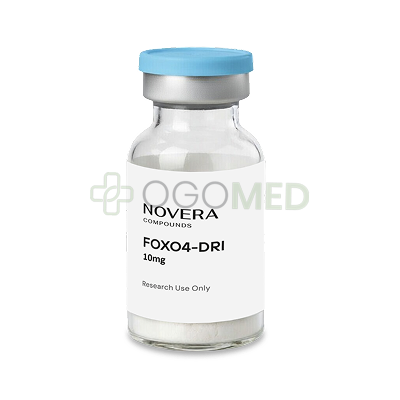












Novera Sermorelin
| Category: | Peptides |
| Brand | Novera |
| Strength | 10mg |
| Form | Lyophilized powder |
| Purity (%) | ≥99 |
| CAS number | 86168-78-7 |
| Chemical Formula | C₁₄₉H₂₄₆N₄₄O₄₂S |
| Molecular weight | 3357.9 |
| Synonyms | GHRH-1-29, GRF-1-29 |
| Peptide sequence | Proprietary modified peptide |
| Storage | Store at 2-8 °C. Protect from light and moisture |
| Shelf Life (lyophilized) | 18-24 months |
| Shelf Life (after reconstitution) | 21-28 days |
Learn more...
Sermorelin is the synthetic 29-amino-acid N-terminal fragment of human growth hormone releasing hormone (GHRH), designated GHRH(1-29)-NH₂. Laboratories study it to probe the growth hormone axis: how the pituitary gland receives releasing hormone ghrh signals, how somatotroph cells produce growth hormone in response, and how that cascade differs across species, age, and disease models. Novera Sermorelin is supplied for laboratory research use only. It is not an approved medication, is not intended to treat, diagnose, or cure any condition, and must not be administered to humans or animals outside a controlled, non-clinical protocol.
When researchers buy sermorelin for controlled endocrine research, they acquire a well-characterized synthetic peptide whose receptor pharmacology, plasma stability, and metabolic fate have been documented in peer-reviewed literature since the mid-1980s. This page summarizes that evidence, states its limits honestly, and provides ordering information for licensed professionals.
What Novera Sermorelin Is
Sermorelin is a synthetic peptide corresponding to residues 1 through 29 of the 44-amino-acid endogenous human GHRH molecule, with an amidated C-terminus. The parent compound, GHRH(1-44), was first isolated from pancreatic tumors and later characterized in hypothalamic tissue. Structure-activity work by Ling et al. (1984) put the potency of hGRF(1-29)NH₂ at about 50% of full-length hGRF on rat anterior pituitary cells in monolayer culture, and found that shorter fragments down to hGRF(1-21)NH₂ keep full intrinsic activity at much lower potency, with bioactivity disappearing only at hGRF(1-19)NH₂.
What makes sermorelin experimentally distinctive is precisely what limits its pharmacokinetic profile: it carries no stabilizing amino-acid substitutions. The enzyme dipeptidyl peptidase IV (DPP-IV) cleaves the first two residues to yield GRF(3-29), a metabolite retaining less than 0.1% of the parent’s activity. That degradation pathway is confirmed in humans: in doping-control work it is GHRH(3-29), not the intact peptide, that is recovered from plasma after subcutaneous injection (Knoop et al., 2016). The result is a narrow, predictable exposure window. For labs conducting structure-activity relationship (SAR) studies, this unmodified sequence serves as a clean baseline against which modified analogs can be measured.
Why Researchers Study Sermorelin
The compound activates GHRHR, a Gₛ-coupled receptor on anterior pituitary somatotrophs, triggering adenylate cyclase, cAMP accumulation, and downstream growth hormone synthesis and release. Because it works through the endogenous pathway rather than bypassing it, sermorelin preserves somatostatin feedback and pulsatile GH secretion patterns, a property that makes it useful for studying the intact regulatory axis rather than isolated receptor pharmacology.
Growth Hormone Axis Regulation in Pediatric Models
Sermorelin was originally developed to diagnose and treat growth hormone deficiencies in children. In the largest published open-label trial, Thorner et al. (1996) administered daily bedtime sermorelin to 110 prepubertal children with GH deficiency who had never received prior treatment. Among 86 evaluable patients, mean height velocity rose from 4.1 cm/year at baseline to 8.0 cm/year at six months and 7.2 cm/year at twelve months. That near-doubling of growth rate in the first six months confirmed that the compound stimulates pituitary GH release in a deficiency model. The study does not, however, establish effectiveness in non-deficient subjects or safety beyond 12 months.
Endocrine Responses in Aging Models
Corpas et al. (1992, Journal of Clinical Endocrinology and Metabolism) gave 10 healthy old men (mean age 68) both 0.5 mg and 1.0 mg of GHRH-(1-29) subcutaneously twice daily for 14 days, with a washout between. Only the high dose produced significant rises in mean 24-h GH (P < 0.001) and IGF-I (P < 0.005), after which neither measure differed from a young comparison group; fasting glucose, urinary C-peptide and blood pressure were unaffected.
The 70% and 107% figures circulated for sermorelin belong to a different molecule. Khorram et al. (1997) measured rises of 107% in men and 70% in women in 12-h integrated GH, but the compound given was [Nle27]GHRH(1-29)-NH₂, not sermorelin. In that 5-month trial, 19 adults aged 55 to 71 self-injected 10 micrograms per kilogram nightly for 16 weeks after a 4-week placebo run-in: IGF-I and IGFBP-3 rose within two weeks, stayed elevated for 12 weeks and drifted back toward baseline by week 16; skin thickness increased in both sexes and lean body mass increased in men only; sleep quality was unaffected in both sexes. No pound figure for lean mass appears anywhere in that report.
“Growth hormone releasing factors, including, but not limited to: growth hormone-releasing hormone (GHRH) and its analogues (e.g. CJC-1293, CJC-1295, sermorelin and tesamorelin)” WADA, 2026 Prohibited List, section S2.2.4.
Pharmacokinetic and Metabolic Profiling
Quantitative pharmacokinetic data provide the foundation for experimental design. Soule, King and Millar (1994, Journal of Clinical Endocrinology and Metabolism) infused GHRH-(1-29)-NH₂ intravenously into 10 normal men at 25 ng/kg per minute and measured a disappearance half-time of 4.3 ± 1.4 minutes with a metabolic clearance rate of 39.7 ± 3.9 mL/kg per minute. No published study gives a subcutaneous half-life for the compound.
Knoop et al. (2016, Analytical and Bioanalytical Chemistry) built an immunoaffinity and LC-HRMS/MS method covering sermorelin, CJC-1293, CJC-1295 and tesamorelin, validated to a lower limit of detection below 50 pg/mL. In the human sample they ran, the intact peptide was not what the assay recovered after subcutaneous injection; the DPP-IV metabolite GHRH(3-29) was.
“a Geref metabolite (GHRH3-29) was found in a human plasma sample collected after subcutaneous injection of the drug to a healthy male volunteer.” Knoop et al., 2016, Analytical and Bioanalytical Chemistry.
Pituitary Cell Culture and Receptor Pharmacology
Rat anterior pituitary cell cultures remain the workhorse model for sermorelin research. Dispersed or superfused rat somatotrophs are highly sensitive to the peptide and closely replicate in vivo potency rank-order across analogs. Ling et al. (1984) found that single substitutions at position 1 of hGRF dropped relative potency to between 0.001 and 0.04 of the parent, a 25- to 1000-fold loss, confirming the stringent requirements of the GHRHR binding pocket. Receptor-binding studies using membrane homogenates from pituitary tissue and radioligand displacement assays further allow quantification of affinity constants for each analog.
Anti-Doping Detection Methodology
Detection of sermorelin and related growth hormone releasing hormone analogs uses LC-HRMS/MS with immunoaffinity purification, achieving lower limits of detection below 50 pg/mL. Because intact peptide disappears rapidly in vivo, validated methods target both the parent compound and GRF(3-29). The metabolite may be the only detectable analyte beyond the first minutes after administration. Sermorelin and all GHRH analogs are listed under Section S2.2.4 of the WADA Prohibited List, prohibited at all times as non-specified substances.
How Sermorelin Compares With Related Compounds
| Compound | Receptor Target | Evidence Level | Typical Research Use |
|---|---|---|---|
| Sermorelin, native GHRH(1-29)-NH₂ | GHRHR on pituitary somatotrophs | Human clinical (pediatric GHD, adult aging), rodent in vivo, in vitro pituitary cultures | Baseline for SAR studies, GH/IGF-I biomarker assays, short-exposure pharmacokinetic work |
| D-Ala²-GHRH(1-29) | Same receptor, same binding site | Human PK studies, animal models | Extended half-life protocols where longer exposure is needed; MCR approximately 21 mL/kg per min versus 39.7 for native sermorelin |
| Tesamorelin (stabilized GHRH analog) | GHRHR | Human RCTs, FDA approved for a specific metabolic indication | Sustained IGF-I elevation studies, body composition trials, longer-duration metabolic research |
Researchers select native sermorelin when a short, well-characterized exposure window and an unmodified amino-acid sequence are priorities, for instance in SAR work or rapid GH-pulse assays. The D-Ala² variant suits protocols requiring lower clearance (half-life approximately 6.7 minutes IV versus 4.3 minutes for the native fragment). Tesamorelin, with its substantially longer duration of action, fits multi-week metabolic or body composition studies where consistent exposure over days matters more than pulse resolution.
“the potencies of the fragments, hGRF(1-31)NH2, (1-30)NH2 and (1-29)NH2 remained at about 50% of that of hGRF” Ling et al., 1984, Biochemical and Biophysical Research Communications.
What Research on Sermorelin Does Not Establish
Honest evaluation of the literature reveals several gaps that buyers should weigh before designing protocols.
Non-deficient human populations. Nearly all controlled human data come from GH-deficient children or small cohorts of older adults measured over days to weeks. No large, long-term randomized controlled trial has evaluated body composition, recovery or stamina in healthy, non-deficient adults. Claims that sermorelin produces fat loss, increased energy, or anti-aging benefits in healthy people lack the controlled evidence needed to determine their validity.
Transient biomarker responses. The 16-week aging study noted above found that IGF-I and IGFBP-3 gains faded toward baseline by week 16. Whether longer or different dosing schedules would sustain the response is unknown. The evidence supporting many anti-aging benefits of sermorelin is limited, and individual results vary by model, dose, and duration.
Sleep architecture. The strongest sleep result in this literature is negative. In Khorram et al. (1997), 16 weeks of nightly [Nle27]GHRH(1-29)-NH₂ left sleep quality unaffected in both men and women, measured by questionnaire alongside the endocrine endpoints. No trial of sermorelin itself reports a sleep benefit. Researchers studying sleep or brain neuroendocrine signals should not assume that acute GH release data predict sustained functional outcomes.
Body composition and performance. Claims about lean mass, metabolism and body composition circulate widely. The only supporting observation in this literature is a lean-mass increase in men but not women in Khorram et al. (1997), a 19-subject trial of a different GHRH analogue, with no replication in any powered trial and no equivalent finding for sermorelin itself.
Long-term safety. Thorner’s 1996 pediatric trial covered 12 months. Beyond that window, high-powered safety data for this specific compound are scarce. Corpas et al. (1992) recorded no change in fasting glucose, urinary C-peptide or blood pressure over 14 days, and Thorner et al. (1996) reported no adverse change in biochemical or hormonal analyses and no excessive IGF-I generation over 12 months. Both windows are too short to characterise the consequences of sustained GHRH-receptor stimulation, which is the actual gap.
No retractions or expressions of concern affecting the core studies cited here were identified during literature review. However, the small sample sizes and open-label designs of several key trials remain a consistent limitation.
Where to Buy Novera Sermorelin
Researchers and lab managers looking for where to buy sermorelin as an unmodified GHRH(1-29) reference peptide can order Novera Sermorelin directly from this store. The product is intended for in vitro and in vivo non-clinical research by qualified professionals.
-
Estimated delivery time 3 to 7 days.
-
Free shipping on orders over $750.
-
All US import fees and tariffs are covered by Ogomed, so the buyer pays nothing extra; customs checks under the new US import rules can add a little time to delivery.
-
Price match: if the same product is listed for less elsewhere, Ogomed will try to match it.
-
Support by phone +1-650-457-5621 and email, 10am to 6pm EST.
-
Sold to licensed professionals, for laboratory research use only.
All sales are restricted to licensed professionals for laboratory research use only. Novera Sermorelin is not sold through patient-facing clinics, pharmacies, or consumer wellness channels.
References
- Thorner, M. O., Rochiccioli, P., Colle, M., et al. (1996). Once daily subcutaneous growth hormone-releasing hormone therapy accelerates growth in growth hormone-deficient children during the first year of therapy. Journal of Clinical Endocrinology and Metabolism, 81(3), 1189-1196. DOI: 10.1210/jcem.81.3.8772599
- Corpas, E., Harman, S. M., Pineyro, M. A., et al. (1992). Growth hormone (GH)-releasing hormone-(1-29) twice daily reverses the decreased GH and insulin-like growth factor-I levels in old men. Journal of Clinical Endocrinology and Metabolism, 75(2), 530-535. DOI: 10.1210/jcem.75.2.1379256
- Soule, S., King, J. A., & Millar, R. P. (1994). Incorporation of D-Ala2 in growth hormone-releasing hormone-(1-29)-NH2 increases the half-life and decreases metabolic clearance in normal men. Journal of Clinical Endocrinology and Metabolism, 79(4), 1208-1211. DOI: 10.1210/jcem.79.4.7962295
- Khorram, O., Laughlin, G. A., & Yen, S. S. C. (1997). Endocrine and metabolic effects of long-term administration of [Nle27]growth hormone-releasing hormone-(1-29)-NH2 in age-advanced men and women. Journal of Clinical Endocrinology and Metabolism, 82(5), 1472-1479. DOI: 10.1210/jcem.82.5.3943
- Ling, N., Baird, A., Wehrenberg, W. B., et al. (1984). Synthesis and in vitro bioactivity of C-terminal deleted analogs of human growth hormone-releasing factor. Biochemical and Biophysical Research Communications, 123(2), 854-861. DOI: 10.1016/0006-291X(84)90309-7
- Knoop, A., Thomas, A., Fichant, E., et al. (2016). Qualitative identification of growth hormone-releasing hormones in human plasma by means of immunoaffinity purification and LC-HRMS/MS. Analytical and Bioanalytical Chemistry, 408(12), 3145-3153. DOI: 10.1007/s00216-016-9377-3
Novera Sermorelin is a synthetic peptide consisting of the first 29 amino acids of human growth hormone releasing hormone, with an amidated C-terminus. It is supplied as a research reagent for laboratory use and is not an approved drug product. The compound is not intended to treat, diagnose, or cure any human or veterinary condition.
The peptide binds the GHRH receptor (GHRHR) on anterior pituitary somatotrophs, activating Gₛ-adenylate cyclase signaling and increasing intracellular cAMP. This pathway triggers growth hormone synthesis and secretion while preserving somatostatin-mediated feedback, which is what makes sermorelin useful for studying pulsatile GH release patterns rather than continuous hormone elevation.
In GH-deficient pediatric models, Thorner et al. (1996) reported a near-doubling of height velocity over six months. In healthy old men, Corpas et al. (1992) showed significant 24-h GH and IGF-I increases over 14 days at the higher of two doses. The 16-week attenuation usually quoted alongside it comes from Khorram et al. (1997), a trial of [Nle27]GHRH(1-29)-NH₂ rather than sermorelin. Large-scale, long-term efficacy data in non-deficient populations do not exist for the native compound.
Both target the same pituitary receptor, but tesamorelin carries stabilizing modifications that extend its half-life and produce sustained IGF-I elevation over weeks. Sermorelin’s unmodified sequence and rapid clearance (IV half-life approximately 4.3 minutes) make it a better fit for acute pulse experiments, SAR benchmarking, and pharmacokinetic reference work.
Primary rat anterior pituitary cell cultures, rodent GH challenge tests (single-bolus or pulsatile protocols), human plasma stability assays, and anti-doping method validation experiments all use GHRH(1-29) as a reference agonist. Historical human studies used the compound as a diagnostic agent to evaluate pituitary GH reserve in pediatric and adult endocrine clinics.
Long-term safety beyond 12 months is not established for any population. Whether the biomarker improvements observed in short trials translate to durable changes in body composition, sleep, recovery, or metabolism has not been demonstrated in controlled studies. The IGF-I fade seen at 16 weeks with the related analogue [Nle27]GHRH(1-29)-NH₂ has no established explanation, and no measurement over a comparable period exists for sermorelin itself.
Yes. Sermorelin is named in section S2.2.4 of the 2026 WADA Prohibited List, among “growth hormone-releasing hormone (GHRH) and its analogues”, prohibited at all times and classed as a non-Specified Substance. Researchers working in sport-science contexts should be aware of this classification and the validated LC-HRMS/MS detection methods targeting both intact peptide and the GRF(3-29) metabolite.
Qualified buyers can buy sermorelin online directly from this store page. Orders ship within the estimated 3-to-7-day window, and support is available by phone or email during business hours. The product is sold exclusively to licensed professionals for non-clinical research.
| Category: | Peptides |
| Brand | Novera |
| Strength | 10mg |
| Form | Lyophilized powder |
| Purity (%) | ≥99 |
| CAS number | 86168-78-7 |
| Chemical Formula | C₁₄₉H₂₄₆N₄₄O₄₂S |
| Molecular weight | 3357.9 |
| Synonyms | GHRH-1-29, GRF-1-29 |
| Peptide sequence | Proprietary modified peptide |
| Storage | Store at 2-8 °C. Protect from light and moisture |
| Shelf Life (lyophilized) | 18-24 months |
| Shelf Life (after reconstitution) | 21-28 days |
Learn more...