









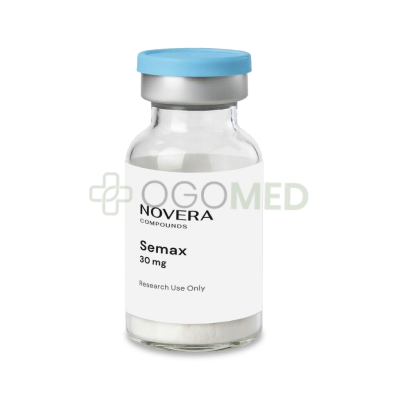

Novera Semax
In Stock
| Category: | Peptides |
| Brand | Novera |
| Strength | 30mg |
| Form | Lyophilized powder |
| Purity (%) | ≥99 |
| CAS number | 80714-61-0 |
| Chemical Formula | C₃₇H₅₁N₉O₁₀S |
| Molecular weight | 813.9 |
| Synonyms | ACTH-4-7-analog, Heptapeptide-nootropic |
| Peptide sequence | Met-Glu-His-Phe-Pro-Gly-Pro |
| Storage | Store at 2-8 °C. Protect from light and moisture |
| Shelf Life (lyophilized) | 18-24 months |
| Shelf Life (after reconstitution) | 7-14 days |
Learn more...
Semax is a synthetic heptapeptide with seven amino acids, derived from the ACTH(4-10) fragment of adrenocorticotropic hormone. The compound is an active area of preclinical investigation for its influence on neurotrophin-associated signaling pathways, monoaminergic neurochemical systems, and gene expression changes observed after ischemia and stress in animal models. Semax research spans rodent behavioral paradigms, cell-culture transcriptomics, and a small number of exploratory human studies, none of which meet Western regulatory standards for therapeutic approval.
Novera Semax is supplied strictly for laboratory research use only. It is not an approved medicine, dietary supplement, or product intended for human or animal consumption in the United States, the European Union, or most Western jurisdictions. Laboratories that buy semax peptide through qualified suppliers receive a lyophilized powder classified as a research reagent. No human dosing guidance, treatment protocols, or clinical-use recommendations accompany this material.
What Novera Semax Is
Semax is a synthetic peptide constructed from the core tetrapeptide of ACTH(4-7), the biologically active fragment of adrenocorticotropic hormone, extended at the C-terminus with the tripeptide Pro-Gly-Pro. The PGP tail was engineered to increase resistance to enzymatic degradation by tissue proteases, extending the compound’s functional window in experimental systems compared with the unmodified ACTH fragment. This increased stability allows the molecule to persist long enough in rodent and cell-culture protocols to exert measurable effects on signaling networks that would otherwise be lost to rapid proteolysis.
Unlike the full-length ACTH molecule or even the ACTH(1-10) segment, Semax lacks the N-terminal residues responsible for classical melanocortin receptor activation and corticotrophic hormonal signaling. That structural difference shifts its mechanistic profile: rather than engaging endocrine pathways tied to cortisol release and pigmentation, this synthetic heptapeptide derived from ACTH interacts with neurotrophin and neurochemical systems in ways that are still being mapped. Binding data from Dolotov et al. (2006, Journal of Neurochemistry, 97 Suppl 1, 82-86), using rat basal forebrain membranes, identified specific, reversible, calcium-dependent binding of tritium-labelled Semax with a dissociation constant of 2.4 ± 1.0 nM, but the molecular identity of the receptor or receptors remains unresolved.
Its size and composition place Semax among the short regulatory peptides studied for effects on neuronal survival, synaptic plasticity and stress-response pathways. No guidance for human administration is provided with this material.
Why Researchers Study Semax
The compound attracts laboratory interest because it sits at the intersection of several mechanistic themes: it enhances BDNF and NGF expression in the brain across multiple rodent brain regions, it modulates dopaminergic, serotonergic, and cholinergic systems in striatal and cortical tissue, and it triggers broad gene expression changes in ischemic or stressed neural tissue. Those three strands are what make it a useful probe for recovery after ischaemic brain injury.
Most of this evidence comes from rodent or cell-culture experiments. Human studies exist but are small, often open-label, and conducted primarily in Russian clinical centers without the blinding or randomization expected by Western regulatory agencies. No therapeutic conclusions should be drawn from the data summarized below; each subsection names specific authors, years, species, and at least one measured outcome to ground the discussion in verifiable literature.
“a single application of Semax (50 microg/kg body weight) results in a maximal 1.4-fold increase of BDNF protein levels” Dolotov et al., 2006, Brain Research.
Neurotrophin and Synaptic-Plasticity Research
Dolotov, Karpenko, Inozemtseva, and colleagues published in Brain Research in 2006 that intranasal Semax at 50 microg/kg in rats raised hippocampal brain derived neurotrophic factor protein by about 1.4-fold over baseline, increased BDNF exon III mRNA approximately 3-fold, elevated trkB mRNA roughly 2-fold, and boosted TrkB receptor tyrosine phosphorylation by approximately 1.6-fold. The same study noted improved performance in a conditioned avoidance task, although all observations were confined to rodent laboratory models under controlled experimental conditions.
Agapova et al. (2007, Neuroscience Letters, 417(2), 201-205) reported that Semax changes neurotrophin gene expression in rat brain, with effects that differ by region and time point rather than a uniform rise. Effects were region-specific and time-dependent, illustrating that the compound does not uniformly upregulate all neurotrophins across the brain. Semax enhances BDNF and NGF expression in animal models, but the pattern is more nuanced than a simple global increase.
These preclinical studies provide mechanistic hypotheses about information processing and memory consolidation, but translating molecular-level changes in rodent hippocampus to functional cognitive enhancement in humans remains undemonstrated.
Dolotov et al. (2006), working in rat hippocampus in vivo, found that a single intranasal dose of Semax (50 microg/kg) produced about a 1.4-fold increase in BDNF protein, a 3-fold rise in BDNF exon III mRNA, and a 2-fold increase in trkB mRNA compared with saline controls. These are animal-only data from a single laboratory, published in Brain Research, volume 1117, pages 54-60.
Cerebral Ischemia and Neuroprotection Models
Dmitrieva, Povarova, Skvortsova, Limborskaya, and Myasoedov reported in Cellular and Molecular Neurobiology in 2010 that in rats subjected to permanent middle cerebral artery occlusion (pMCAO), Semax enhanced transcription of Bdnf, TrkC, and TrkA at 3 hours post-occlusion, then increased Nt-3 and Ngf expression at 24 hours, with Ngf still elevated at 72 hours. These changes were measured in cortical tissue surrounding the ischemic damage, suggesting a time-dependent cascade of neurotrophin gene activation after cerebral ischemia.
Romanova and colleagues, in a 2006 study of focal photo-induced ischemia of the prefrontal cortex in rats, found that six days of intranasal Semax decreased cortical infarction volume significantly and improved conditioned passive avoidance retention. Neither of those studies measured cerebral blood flow, so the neuroprotection they describe is an infarct-volume and behavioural result, not a haemodynamic one, and it does not demonstrate clinical efficacy in human ischaemic stroke. Sudarkina et al. (2021, International Journal of Molecular Sciences, 22(12), 6179) added protein-level work in a transient MCAO rat model, reported as confirming the protective effect of the peptide at 24 hours post-ischaemia.
“both Semax and PGP activate the transcription of neurotrophins and their receptors in the cortex of rats subjected to pMCAO” Dmitrieva et al., 2010, Cellular and Molecular Neurobiology.
Monoaminergic and Neurochemical Signaling Studies
Eremin, Kudrin, Saransaari, Oja, Grivennikov, Myasoedov, and Rayevsky published in Neurochemical Research in 2005 that Semax modulates dopaminergic, serotonergic, and cholinergic systems in rodent brain. After intraperitoneal injection of 0.15 mg/kg in rats, tissue content of 5-HIAA (the primary serotonin metabolite) in striatum increased by approximately 25% at two hours. Extracellular 5-HIAA in rat striatum rose to about 180% of baseline within one to four hours. Dopamine tissue levels themselves were not directly altered, but the peptide enhanced amphetamine-induced extracellular dopamine release and locomotor activity when administered beforehand.
These neurochemical shifts are used for hypothesis-building in experimental models of sustained attention, motivation, and stress adaptation. The serotonergic activation and dopamine-system interaction suggest that the mechanistic profile of Semax extends beyond neurotrophin modulation into monoaminergic tone regulation, which is relevant to mood regulation and cognitive function research in animal models. All findings in this domain remain preclinical, and no controlled human trial has confirmed these neurochemical changes in patient populations.
Eremin et al. (2005), in a rodent model, found that intraperitoneal Semax (0.15 mg/kg) raised tissue 5-HIAA in striatum by 25% at 2 hours versus control, while extracellular striatal 5-HIAA reached approximately 180% of baseline within 1-4 hours. Published in Neurochemical Research, volume 30, pages 1493-1500. Results are animal data only.
Gene-Expression and Transcriptomic Research
Filippenkov et al. (2020, Genes, 11(6), 681) carried out RNA-Seq analysis after transient middle cerebral artery occlusion in rats and identified 394 differentially expressed genes at 24 hours in Semax-treated animals relative to saline. The technique revealed suppression of inflammatory gene clusters alongside activation of neurotransmitter-system and receptor genes, a pattern confirmed at the protein level by their 2021 study measuring MMP-9, c-Fos, JNK, and CREB.
The Dmitrieva pMCAO study from 2010 used RT-PCR to track neurotrophin and receptor genes at multiple time points, documenting that Semax promotes early upregulation of Bdnf, TrkA, and TrkC within 3 hours, followed by slower changes in Ngf and Nt-3 over the subsequent 24 to 72 hours in cortex surrounding the infarct. These transcriptomic and gene expression datasets provide a molecular map of the compound’s effects in ischemic tissue, but they describe events in rodent cortex under controlled experimental conditions that may not replicate in human neural tissue.
“We have identified 394 differentially expressed genes (DEGs) (>1.5-fold change) in the brains of rats at 24 h after tMCAO” Filippenkov et al., 2020, Genes.
ACTH-Derived Peptide and Structure-Activity Comparisons
Semax is used alongside its parent ACTH fragments and the isolated PGP tripeptide to explore structure-activity relationships in signaling networks. Dmitrieva et al. (2010) examined Semax and PGP separately in the pMCAO model and found overlapping but distinct neurotrophin transcription profiles: the full peptide induced earlier increases in Bdnf, TrkC, and TrkA at 3 hours, while PGP alone showed some activity but with different timing and regional specificity. The PGP extension thus contributes to both metabolic stability and biological activity, not merely half-life extension.
No single high-affinity receptor has been conclusively identified for this compound. The binding data from Dolotov et al. (2006) in rat basal forebrain membranes (Kd of approximately 2.4 nM, Bmax of approximately 33.5 fmol/mg protein) point to saturable binding sites, but whether these represent a novel peptide receptor, a member of the melanocortin family, or another target remains an open question. Semax research in this area focuses on network-level modulation, with proposed mechanisms including indirect effects on BDNF-TrkB signaling cascades rather than direct agonism at a single defined receptor.
How Semax Compares With Related Compounds
Researchers often compare Semax with other short regulatory peptides when planning experimental studies. Selank, a tuftsin-derived heptapeptide, targets GABAergic and monoaminergic modulation in anxiety and stress paradigms. The native ACTH(4-10) fragment serves as a baseline comparator for understanding what the PGP extension adds to receptor engagement, metabolic stability, and functional outcomes. The table below contrasts these three research peptides on their primary pathways, evidence base, and typical applications in laboratory models.
| Compound | Primary Research Pathways | Main Evidence Level | Typical Laboratory Use |
|---|---|---|---|
| Semax (Novera Semax) | Neurotrophin-associated signaling (BDNF, NGF), monoaminergic systems, gene expression changes after stress or ischemia | Predominantly rodent models, limited human exploratory studies | Ischemia models, cognitive and plasticity paradigms, transcriptomic profiling |
| Selank | GABAergic and monoaminergic modulation, stress-response pathways | Rodent behavioral studies, small human experiments | Anxiety- and stress-model research, comparison with classical anxiolytic frameworks |
| ACTH(4-10) Fragment | Melanocortin receptor-associated signaling, endocrine regulation | Physiological and pharmacological in vivo models | Baseline comparator for ACTH-derived peptide signaling, hormonal pathway investigations |
A researcher designing ischemic brain injury or neuroprotection protocols would likely select Semax because its animal literature is strongest in stroke and ischemia contexts, with quantitative data on infarct volume, neurotrophin upregulation, and inflammatory gene suppression. If the study centers on anxiety, stress response, or immunomodulatory endpoints, Selank offers more directly relevant mechanisms and behavioral assay data. Where the goal is mapping melanocortin receptor pharmacology or endocrine signaling, the unmodified ACTH(4-10) fragment provides a cleaner probe for receptor-level work without the confounding effects of the PGP extension.
What Research on Semax Does Not Establish
Despite extensive rodent data and a handful of exploratory human studies, Semax is not an approved therapy for any medical indication and should not be extrapolated to patient care, self-experimentation, or clinical use. The compound lacks FDA approval for medical use in the United States, and no Western regulatory body has granted it therapeutic status. Long-term safety data in humans are lacking.
Several claims circulate in online forums and vendor marketing that are not supported by rigorous evidence. Guaranteed cognitive enhancement in healthy humans has no published backing from controlled trials. Broad neuroprotection in human stroke patients is not established. The most substantial human report, Gusev et al. (2018, Zhurnal Nevrologii i Psikhiatrii imeni S. S. Korsakova, 118(3 Vyp 2), 61-68), followed 110 post-stroke patients split into early and late rehabilitation groups with and without semax; the published account describes no randomisation and no blinding, and its primary measures were plasma BDNF, a motor scale and the Barthel index.
Most positive findings come from animal or cell-culture work with small group sizes and model-specific endpoints. The transcriptomic studies identify hundreds of differentially expressed genes, but functional significance for most of those changes is unknown. Dose-response relationships vary across species; optimal timing of administration after injury is incompletely mapped. No retractions of major Semax studies have been noted, but independent replication outside Russian research groups is sparse, and oversight by international peer-review standards has been limited.
Potential risks are also under-characterised. No chronic-administration toxicology study has been published in any species, and off-target signalling and immunogenicity remain open questions. The receptor through which the peptide acts has not been identified, which makes off-target prediction guesswork rather than pharmacology.
Where to Buy Novera Semax
Laboratories looking to buy semax online can source Novera Semax through this page. The product is sold to qualified professionals running in vitro or in vivo experiments and is not available for human use, veterinary application, or any form of human or animal consumption. In the published rodent literature the peptide is most often given intranasally, which is why intranasal dosing dominates the studies cited above.
-
Estimated delivery time 3 to 7 days.
-
Free shipping on orders over $750.
-
All US import fees and tariffs are covered by Ogomed, so the buyer pays nothing extra; customs checks under the new US import rules can add a little time to delivery.
-
Price match: if the same product is listed for less elsewhere, Ogomed will try to match it.
-
Support by phone +1-650-457-5621 and email, 10am to 6pm EST.
-
Sold to licensed professionals, for laboratory research use only.
References
- Dolotov, O. V., Karpenko, E. A., Inozemtseva, L. S., et al. (2006). Semax, an analog of ACTH(4-10) with cognitive effects, regulates BDNF and trkB expression in the rat hippocampus. Brain Research, 1117(1), 54-60. DOI: 10.1016/j.brainres.2006.07.108
- Dolotov, O. V., Karpenko, E. A., Seredenina, T. S., et al. (2006). Semax, an analogue of adrenocorticotropin (4-10), binds specifically and increases levels of brain-derived neurotrophic factor protein in rat basal forebrain. Journal of Neurochemistry, 97(Suppl 1), 82-86. DOI: 10.1111/j.1471-4159.2006.03658.x
- Dmitrieva, V. G., Povarova, O. V., Skvortsova, V. I., Limborska, S. A., Myasoedov, N. F., Dergunova, L. V. (2010). Semax and Pro-Gly-Pro activate the transcription of neurotrophins and their receptor genes after cerebral ischemia. Cellular and Molecular Neurobiology, 30(1), 71-79. DOI: 10.1007/s10571-009-9432-0
- Eremin, K. O., Kudrin, V. S., Saransaari, P., Oja, S. S., Grivennikov, I. A., Myasoedov, N. F., Rayevsky, K. S. (2005). Semax, an ACTH(4-10) analogue with nootropic properties, activates dopaminergic and serotoninergic brain systems in rodents. Neurochemical Research, 30(12), 1493-1500. DOI: 10.1007/s11064-005-8826-8
- Filippenkov, I. B., Stavchansky, V. V., Denisova, A. E., et al. (2020). Novel Insights into the Protective Properties of ACTH(4-7)PGP (Semax) Peptide at the Transcriptome Level Following Cerebral Ischaemia-Reperfusion in Rats. Genes, 11(6), 681. DOI: 10.3390/genes11060681
- Romanova, G. A., Silachev, D. N., Shakova, F. M., Kvashennikova, Y. N., Viktorov, I. V., Shram, S. I., Myasoedov, N. F. (2006). Neuroprotective and antiamnesic effects of Semax during experimental ischemic infarction of the cerebral cortex. Bulletin of Experimental Biology and Medicine, 142(6), 663-666. DOI: 10.1007/s10517-006-0445-0
Semax is a synthetic heptapeptide derived from the ACTH(4-10) fragment, used to study neurotrophin signaling, gene expression, and neurochemical regulation in preclinical models. The compound is classified as a research reagent, not an approved medicine. Laboratories handle it under the same protocols applied to other research peptides, with documentation of intended in vitro or animal model use.
Rodent data from Dolotov et al. (2006) and Agapova et al. (2007) show that the peptide increases BDNF and NGF mRNA and protein levels in hippocampus and other brain regions after intranasal delivery. These observations are exploratory and mechanistic, providing hypotheses rather than direct evidence of benefit in human subjects.
The most consistent findings appear in rodent ischemia and stress models, where the compound influences infarct volume, behavioral scores, neurotrophin transcription, and inflammatory protein expression. Semax is studied for cognitive enhancement and neuroprotection, but the evidence base consists of small, mostly single-center animal research with limited and methodologically weak human data. No large randomized human trial demonstrating clinical outcomes has been published in a Western peer-reviewed journal.
Semax is typically selected for experimental models centered on neurotrophin-associated signaling, ischemia, and neuroprotection, while Selank is more commonly used in anxiety- and stress-related paradigms involving GABAergic modulation. Both are investigational peptides with largely preclinical data, and neither is approved as a therapy in Western jurisdictions.
Rodent models of global or focal cerebral ischemia (pMCAO, tMCAO, photo-induced infarction) are the most published applications. Stress and learning paradigms such as conditioned avoidance tasks, and in vitro neuronal cultures for gene expression and receptor signaling studies, also use the compound. The peptide is supplied to laboratories running these controlled experiments under institutional oversight.
The absence of a clearly defined primary receptor remains a central gap: binding sites in rat basal forebrain have been characterized (Kd approximately 2.4 nM), but their molecular identity is unresolved. Dose-response relationships across species are heterogeneous, and long-term safety under chronic administration is under-reported. Clinical efficacy and potential risks in humans remain open research questions requiring properly controlled trials.
Semax is not named anywhere on the 2026 WADA Prohibited List, which is the current one. Section S2.2.2 covers corticotrophins and their releasing factors, naming corticorelin and tetracosactide; Semax is a non-corticotropic ACTH(4-7) fragment analogue and is not listed there or in any other section. Because it holds no approval from a governmental regulatory health authority for human therapeutic use, it falls under S0, the non-approved substances class, prohibited at all times.
Novera Semax is available through this store to licensed professionals for laboratory research use only. Orders ship in 3 to 7 days, and purchasers confirm research-only intent at the time of order.
| Category: | Peptides |
| Brand | Novera |
| Strength | 30mg |
| Form | Lyophilized powder |
| Purity (%) | ≥99 |
| CAS number | 80714-61-0 |
| Chemical Formula | C₃₇H₅₁N₉O₁₀S |
| Molecular weight | 813.9 |
| Synonyms | ACTH-4-7-analog, Heptapeptide-nootropic |
| Peptide sequence | Met-Glu-His-Phe-Pro-Gly-Pro |
| Storage | Store at 2-8 °C. Protect from light and moisture |
| Shelf Life (lyophilized) | 18-24 months |
| Shelf Life (after reconstitution) | 7-14 days |
Learn more...