









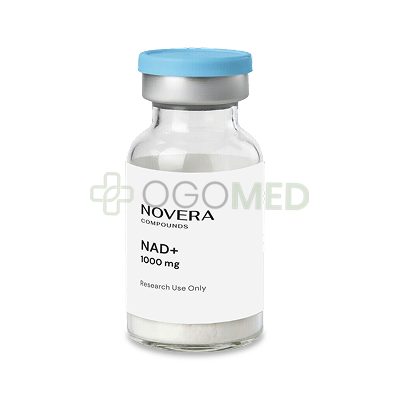

Novera NAD+
In Stock
| Category: | Peptides |
| Brand | Novera |
| Strength | 1000mg |
| Form | Lyophilized powder |
| Purity (%) | ≥99 |
| CAS number | 53-84-9 |
| Chemical Formula | C₂₁H₂₇N₇O₁₄P₂ |
| Molecular weight | 663.43 |
| Synonyms | Nicotinamide-Adenine-Dinucleotide, NAD-oxidized, NAD-coenzyme |
| Peptide sequence | N/A (coenzyme) |
| Storage | Store at 2-8 °C. Protect from light and moisture |
| Shelf Life (lyophilized) | 12-24 months |
| Shelf Life (after reconstitution) | 24-72 hours |
Learn more...
Nicotinamide adenine dinucleotide is a vital coenzyme found in all living cells, where it plays a central role in cellular energy production, DNA repair, and metabolic reactions that sustain cellular function. As a naturally occurring molecule, NAD+ participates in shuttling electrons through the electron transport chain, fueling ATP synthesis and supporting cellular metabolism across every tissue type. Researchers study this compound because tissue NAD+ falls with age. Massudi et al. (2012, PLoS ONE) measured NAD+ in human pelvic skin from 49 donors aged 0 to 77 and found a strong negative correlation with age in both males and females, which drives interest in whether restoring the coenzyme can influence cellular aging, mitochondrial function and age-related conditions. NAD+ is essential for ATP production in cells, and it supports neuronal health and cognitive function through mechanisms that remain under active investigation.
Novera NAD+ is supplied for laboratory research use only. It is not an FDA approved medicine, not a supplement for human consumption, and not a treatment for any medical condition. Licensed professionals and laboratory buyers looking to buy NAD+ will find below a detailed breakdown of product formats, selection criteria, the current state of evidence, and honest limits of what research on this molecule does and does not establish.
What Novera NAD+ Is
NAD+ is not a peptide, despite appearing in some peptide supplier catalogs. It is a dinucleotide coenzyme composed of two nucleotides – one containing an adenine base, the other a nicotinamide moiety – joined by phosphate groups. This structure allows the molecule to cycle between its oxidized form (NAD+) and reduced form (NADH), accepting and donating electrons in hundreds of metabolic processes including glycolysis, the citric acid cycle, and oxidative phosphorylation.
Unlike NAD+ precursors such as nicotinamide mononucleotide (NMN) or nicotinamide riboside (NR), which require enzymatic conversion through biosynthesis pathways before they function as the active coenzyme, exogenous NAD+ provides the complete, functional cofactor directly. That distinction matters experimentally: researchers studying sirtuin kinetics, PARP-mediated DNA repair, or mitochondrial respiration in cell-free or cell-culture systems need the intact coenzyme present in the reaction mixture, not a precursor that must first be metabolized. NAD+ also acts as a substrate consumed by enzymes such as CD38 and PARPs, meaning its concentration in an assay is not merely catalytic but stoichiometric, and depletion rates shape experimental design.
Why Researchers Study NAD+
Scientific interest in NAD+ centers on its involvement in cellular health, metabolic health, and the aging process. The coenzyme is a substrate or cofactor for hundreds of enzymatic reactions, and its decline during aging correlates with diminished cellular resilience and impaired repair in animal models. Researchers across longevity science, neuroscience, and regenerative medicine investigate whether maintaining or restoring NAD levels can influence these trajectories. NAD+ is critical for DNA repair and cellular resilience, and it is involved in regulating stress responses and cell metabolism. The compound also plays a role in how the body processes fats and carbohydrates, linking it to broader questions about metabolic reactions in aging tissue.
Neuroprotection and Cognitive Function
A 2017 rodent study published in Scientific Reports by Liu et al. examined exogenous NAD+ in a pilocarpine-induced status epilepticus mouse model. NAD+ was injected three times within 24.5 hours after status epilepticus. It significantly reduced the incidence of spontaneous recurrent seizures and abnormal EEG activity, rescued contextual fear memory formation, reduced neuronal loss in the hippocampal CA1 region and reversed the seizure-induced depletion of endogenous NAD+. The finding is strictly animal-level evidence and does not establish whether direct NAD+ administration would produce similar neuroprotective effects in human brain tissue. NAD+ supports neuronal health and cognitive function in preclinical models, and raising NAD+ levels may help lower inflammation and protect brain health markers, though this remains an area where current knowledge is limited to non-human data.
“No eligible outcomes trials evaluated intravenous or intramuscular NAD+ itself for anti-aging or wellness indications.” Gallagher and Emmanuel, 2026, Ageing Research Reviews.
How Much Rodent Evidence There Actually Is
Gallagher and Emmanuel (2026, Ageing Research Reviews) screened human and rodent intervention studies published between January 2010 and October 2025 and identified 113 eligible studies: 33 human intervention studies, 28 of them randomized, and 80 rodent studies. In the rodent models NAD+ augmentation was frequently associated with improvements in metabolic, mitochondrial, inflammatory and functional outcomes, although effects varied across models and endpoints. Not one of the eligible outcomes trials used intravenous or intramuscular NAD+ itself, which is the shape of the evidence base for this compound: broad in rodents, absent in humans for the injected coenzyme.
NAD+ Precursor Comparison in Human Trials
Christen et al. (2026, Nature Metabolism) ran a randomized, open-label, placebo-controlled study in 65 healthy participants comparing nicotinamide riboside, nicotinamide mononucleotide and nicotinamide (NCT05517122). Fourteen days of NR and NMN, but not nicotinamide, comparably increased circulatory NAD+ concentrations; only nicotinamide acutely and transiently affected the whole-blood NAD+ metabolome. Using ex vivo fermentation with human microbiota the authors traced the chronic NR and NMN effect to microbial conversion to nicotinic acid in the gut. The trial tested precursors, not the intact coenzyme.
Gallagher and Emmanuel (2026) report that in humans oral NR and NMN consistently demonstrated biochemical target engagement, measured as circulating or cellular NAD-related metabolites, and were generally well tolerated over weeks to months, while effects on functional, metabolic, vascular and other healthspan-relevant outcomes were heterogeneous and often null or endpoint-specific. These precursor findings are relevant to researchers deciding whether to use NAD+ directly or an upstream metabolite.
Aging and NAD+ Decline
The published quantitative work is narrower than the round figures that circulate online. Massudi et al. (2012, PLoS ONE) found a strong negative correlation between tissue NAD+ and age in human skin (p = 0.001 in males, p = 0.01 in females), alongside rising PARP activity and DNA damage, and read the result as PARP hyperactivation driving NAD+ catabolism during aging. Whether raising NAD+ slows that decline is a separate question and remains unresolved. The aging process involves progressive decline in cellular function and mitochondrial efficiency, and NAD+ depletion correlates temporally with these changes, but causation has not been established in human intervention trials.
“14 days of supplementation with NR and NMN, but not Nam, comparably increases circulatory NAD+ concentrations in healthy adults.” Christen et al., 2026, Nature Metabolism.
How NAD+ Compares With Related Compounds
| Compound | Pathway / Target | Evidence Level | Typical Research Use |
|---|---|---|---|
| NAD+ (direct) | Substrate for sirtuins, PARPs, CD38; electron carrier in redox reactions | Extensive in vitro and rodent data; zero human RCTs using injectable NAD+ for aging or functional outcomes | Enzyme kinetics, mitochondrial assays, acute ischemia models, cell culture supplementation |
| NMN (nicotinamide mononucleotide) | Converted to NAD+ via NMNAT enzymes; one enzymatic step upstream | Randomized study in 65 healthy adults: 14 days of NMN raised circulating NAD+ (Christen 2026) | Oral supplementation studies, biosynthesis pathway research, aging interventions |
| NR (nicotinamide riboside) | Converted to NMN via NRK1/2, then to NAD+; two enzymatic steps upstream | Randomized study in 65 healthy adults: 14 days of NR raised circulating NAD+ comparably to NMN (Christen 2026); more published human data overall | Oral bioavailability studies, chronic supplementation trials, metabolic pathway analysis |
Researchers studying direct cofactor availability in biochemical systems – sirtuin activation assays, PARP activity measurements, or mitochondrial respiration analysis – need the intact NAD+ molecule rather than a precursor. By contrast, labs investigating endogenous NAD+ biosynthesis, tissue-specific uptake, or oral bioavailability questions will find NMN or NR more appropriate. NAD+ precursors may not guarantee noticeable health benefits despite raising levels, an important caveat when designing protocols around biomarker endpoints versus functional outcomes. The choice to buy NAD+ versus a precursor should follow directly from the scientific question being asked.
What Research on NAD+ Does Not Establish
The PRISMA-guided systematic review by Gallagher and Emmanuel (2026, Ageing Research Reviews) found that no eligible outcomes trials evaluated intravenous or intramuscular NAD+ itself for anti-aging or wellness indications. One nonrandomized intravenous NMN study met inclusion criteria and contributed short-term safety and biomarker information, and an intravenous NAD+ pharmacokinetic pilot without eligible clinical outcomes was counted only as contextual evidence. Every positive finding for direct NAD+ administration comes from animal models or in vitro systems. Commercial marketing that asserts NAD+ injections reverse aging, treat addiction, or restore youthful cellular function is not supported by controlled human trials.
The extracellular fate of exogenous NAD+ remains incompletely understood. Whether intact NAD+ crosses cell membranes, or whether extracellular enzymes first degrade it into precursors that cells then reimport, is an open question. Some data suggest extracellular metabolism or precursor conversion may mediate the observed effects, which complicates interpretation of any in vivo injection study.
Evidence for meaningful health benefits from NAD+ supplementation remains inconclusive at the human level. NAD+ supplementation is not FDA approved for any indication. Common side effects reported anecdotally include headaches and gastrointestinal discomfort, though systematic safety data from controlled NAD+ injection trials in humans do not exist. The positive effects observed in rodent seizure, ischemia, and aging models have not been replicated in human subjects receiving the intact coenzyme.
“Early-stage intervention with NAD+ prevents epileptogenesis in pilocarpine-induced SE mice by suppressing neuronal apoptosis.” Liu et al., 2017, Scientific Reports.
The review’s own summary is the fairest statement of where this compound stands: NAD+ augmentation shows clear biological activity, but clinical effectiveness for anti-aging or wellness outcomes remains inconclusive, and larger randomized trials with longer follow-up and prespecified endpoints are needed, particularly for parenteral approaches.
Where to Buy Novera NAD+
Researchers and licensed professionals looking for where to buy NAD+ can purchase Novera NAD+ through the store with the following terms:
-
Estimated delivery time 3 to 7 days.
-
Free shipping on orders over $750.
-
All US import fees and tariffs are covered by Ogomed, so the buyer pays nothing extra; customs checks under the new US import rules can add a little time to delivery.
-
Price match: if the same product is listed for less elsewhere, Ogomed will try to match it.
-
Support by phone +1-650-457-5621 and email, 10am to 6pm EST.
-
Sold to licensed professionals, for laboratory research use only.
Novera NAD+ is sold exclusively to licensed professionals for laboratory research use only and is not intended for human administration, clinical treatment, or consumer wellness applications.
References
- Liu, J., Yang, B., Zhou, P., et al. (2017). Nicotinamide adenine dinucleotide suppresses epileptogenesis at an early stage. Scientific Reports, 7(1), 7321. DOI: 10.1038/s41598-017-07343-0
- Gallagher, C., Emmanuel, O. O. (2026). NAD+ supplementation for anti-aging and wellness: A PRISMA-guided systematic review of preclinical and clinical evidence. Ageing Research Reviews, 116, 103057. DOI: 10.1016/j.arr.2026.103057
- Christen, S., Redeuil, K., Goulet, L., et al. (2026). The differential impact of three different NAD+ boosters on circulatory NAD and microbial metabolism in humans. Nature Metabolism, 8(1), 62-73. DOI: 10.1038/s42255-025-01421-8
- Massudi, H., Grant, R., Braidy, N., Guest, J., Farnsworth, B., Guillemin, G. J. (2012). Age-associated changes in oxidative stress and NAD+ metabolism in human tissue. PLoS ONE, 7(7), e42357. DOI: 10.1371/journal.pone.0042357
NAD+ (nicotinamide adenine dinucleotide) is a coenzyme found in all living cells that participates in redox reactions, serves as a substrate for sirtuins and PARPs, and is essential for ATP production. Laboratories buy NAD+ as a reagent for enzyme kinetics assays, mitochondrial respiration studies, and in vivo animal research investigating cellular energy, DNA repair, and metabolic processes.
NAD+ functions as an electron carrier in the electron transport chain and as a consumed substrate for enzymes including sirtuins (which regulate gene expression and cellular aging), PARPs (which mediate DNA repair), and CD38 (which modulates immune signaling). Its dual role as both a redox shuttle and an enzyme substrate makes it central to studies of cellular metabolism and the aging process.
In a mouse status epilepticus model, exogenous NAD+ reduced spontaneous recurrent seizures and neuronal loss in hippocampal CA1 (Liu et al., 2017, Scientific Reports). A 2026 randomized study in 65 healthy adults showed that the precursors NR and NMN, but not nicotinamide, raised circulating NAD+ over 14 days (Christen et al., Nature Metabolism). No outcomes trial has evaluated intravenous or intramuscular NAD+ itself for any aging or wellness endpoint.
NMN and NR are metabolic precursors that cells convert into NAD+ through enzymatic steps, whereas exogenous NAD+ provides the intact coenzyme directly. Precursors have more published human safety and bioavailability data, while direct NAD+ is preferred in cell-free biochemical assays where the active cofactor must be present without relying on cellular biosynthesis machinery.
Common models include in vitro enzyme activity assays (sirtuin deacetylation, PARP cleavage), mitochondrial respiration measurements in isolated organelles, and in vivo rodent studies of neurodegeneration and seizure. Cell culture studies supplement media with NAD+ to investigate its effects on cellular resilience and cell metabolism under stress conditions.
Whether exogenous NAD+ crosses cell membranes intact or must first be degraded extracellularly into precursors remains an open question. Pharmacokinetics, tissue distribution, and dose-response relationships for the intact coenzyme in mammals are poorly characterized. No controlled human data exist for direct NAD+ injection across any indication.
NAD+ is not on the 2026 WADA Prohibited List, by name or as a class. The nearest entry, S4.4.1 metabolic modulators, covers AMPK activators such as AICAR, BAM15 and MOTS-c, and does not reach NAD+ itself.
Licensed professionals can order Novera NAD+ through the store, which offers estimated delivery in 3 to 7 days, free shipping on orders over $750, and price matching. The compound is sold for laboratory research use only and is not available for consumer purchase or clinical administration.
| Category: | Peptides |
| Brand | Novera |
| Strength | 1000mg |
| Form | Lyophilized powder |
| Purity (%) | ≥99 |
| CAS number | 53-84-9 |
| Chemical Formula | C₂₁H₂₇N₇O₁₄P₂ |
| Molecular weight | 663.43 |
| Synonyms | Nicotinamide-Adenine-Dinucleotide, NAD-oxidized, NAD-coenzyme |
| Peptide sequence | N/A (coenzyme) |
| Storage | Store at 2-8 °C. Protect from light and moisture |
| Shelf Life (lyophilized) | 12-24 months |
| Shelf Life (after reconstitution) | 24-72 hours |
Learn more...