











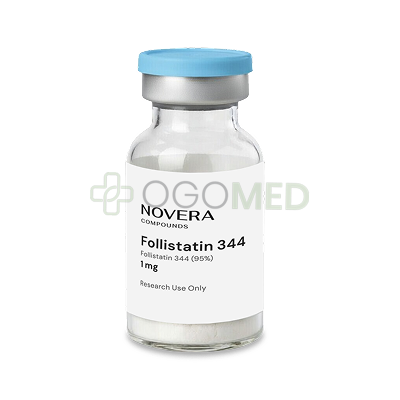

Novera Follistatin 344 (95%)
In Stock
| Category: | Peptides |
| Brand | Novera |
| Strength | 1mg |
| Form | Lyophilized powder |
| Purity (%) | 95 |
| Molecular weight | 37 kDa |
| Synonyms | FST-344, Follistatin-peptide, Myostatin-inhibitor |
| Peptide sequence | N/A (protein) |
| Storage | Store at 2-8 °C or -20 °C. Protect from light |
| Shelf Life (lyophilized) | 12-24 months |
| Shelf Life (after reconstitution) | 24-72 hours |
Learn more...
Novera Follistatin 344 is a research-grade product supplied as 1 mg of lyophilized powder in a single vial. The stated purity is 95%, while the listed molecular weight is approximately 37 kDa. Although commonly grouped with peptides, follistatin is a comparatively large glycoprotein rather than a short amino-acid fragment.
The principal specifications are:
- Brand: Novera;
- Form: lyophilized powder;
- Quantity: 1 mg;
- Stated purity: 95%;
- Approximate molecular weight: 37 kDa;
- Listed shelf life before preparation: 12–24 months;
- Listed stability after preparation: 24–72 hours.
Novera Follistatin 344 is intended for controlled laboratory work. It is not a finished medicine, dietary supplement, or ready-to-use sterile formulation. Any experimental preparation must follow an approved protocol with suitable quality controls and complete documentation.
What Follistatin Is Made Of
Follistatin is sometimes described as a naturally occurring peptide, although glycoprotein is the more precise classification. It is produced in numerous tissues and circulates in several molecular forms. The protein was originally studied in reproductive endocrinology because of its ability to influence FSH, but its biological role reaches into inflammation, fibrosis, metabolism, tissue repair, and muscle development.
Follistatin acts as an activin binding protein. It surrounds activin with a high-affinity complex, preventing the signaling molecule from reaching its receptors. Activin helps control reproductive hormones, cellular differentiation, immune activity, and tissue remodeling. This broad activity explains why manipulating follistatin may affect several biological pathways rather than a single process.
FST-344, a synthetic version of follistatin, is a precursor form containing 344 amino acids. After signal-sequence processing, it is associated with circulating FST-315. Published papers sometimes use FS as a general abbreviation, but researchers should refer to the exact isoform, expression system, sequence, and preparation rather than treating every follistatin compound as interchangeable.
How It Influences Myostatin Inhibitors
Myostatin is produced primarily in skeletal muscle and normally places a biological limit on excessive growth. When it binds to activin type II receptors, it activates intracellular signals that regulate muscle-cell differentiation, protein turnover, and satellite-cell activity. Follistatin can bind myostatin before receptor activation occurs, reducing the intensity of that signal.
Experimental changes associated with myostatin inhibition may include:
- altered muscle-fiber diameter;
- changes in satellite-cell activation;
- modified protein breakdown and repair;
- increased measurements of skeletal muscle mass;
- differences in strength or regenerative activity;
- altered connective-tissue responses.
This mechanism has placed follistatin among the most widely discussed experimental myostatin inhibitors. However, a larger muscle measurement does not automatically mean better strength, coordination, endurance, or physical performance. The body must also adapt its tendons, nerves, blood supply, connective tissue, and energy systems.
Why Follistatin Is Studied
Scientific interest in follistatin is driven by its ability to interact with both myostatin and activin. Current research examines muscle wasting, muscular dystrophy, age-related weakness, tissue injury, reproductive signaling, inflammation, liver fibrosis, and selected metabolic disorders. These are experimental applications, not established indications for treatment.
Preclinical studies also examine whether Follistatin 344 can influence glucose metabolism and enhance insulin sensitivity, although this potential effect has not been established as a clinical benefit in humans. Some preclinical models also examine whether Follistatin 344 can influence abdominal fat accumulation and metabolic markers. Experimental models investigate whether Follistatin 344 can support muscle tissue regeneration after exercise or injury by altering myostatin, activin, and satellite-cell signaling.
Common areas of investigation include:
- skeletal-muscle regeneration after injury;
- experimental strategies for promoting muscle growth;
- activin signaling in inflammatory and fibrotic models;
- reproductive hormone regulation;
- muscle loss associated with aging or disease;
- changes in metabolism and tissue composition.
Follistatin can play different biological parts in each model because the target ligands and receptors vary by tissue. Its lack of complete selectivity is both useful and difficult: broad activity may reveal connections between systems, but it also makes off-target effects harder to predict.
What Animal Studies Have Found
Animal experiments have reported increased muscle size and strength following follistatin gene transfer. In one influential mouse study, FST-344 produced substantial changes even in animals lacking functional myostatin. This suggested that the observed muscle building effects involved activin or other related signals in addition to myostatin.
Other studies have investigated injury repair, muscle wasting, aging, and inherited disorders. Reported outcomes include larger fibers, altered force measurements, and changes in regenerative markers. The apparent effectiveness depends on species, genetic background, delivery system, observation period, and the specific tissue selected for analysis.
Myostatin genetics have also been examined in livestock and horses, where certain MSTN variants are associated with muscle characteristics and racing distance. These observations do not establish the potency of bottled follistatin or justify its use in animals. They simply show that myostatin contributes to a much larger network involved in muscle biology.
What Human Studies Actually Tested
Limited human clinical trials have explored follistatin through gene transfer, not through ordinary exposure to purified FST-344 powder. A small phase 1/2a study in Becker muscular dystrophy used an adeno-associated viral vector to deliver an FS344 sequence into selected thigh muscles. Functional measurements improved in some participants, but the study was small, uncontrolled, and intended mainly to assess safety.
Experimental literature describes subcutaneous or intramuscular administration in different research models, but these routes are not interchangeable and do not establish instructions for using Novera Follistatin 344. Human follistatin studies have mainly involved localized intramuscular gene transfer rather than injection of purified research powder.
That distinction is essential. Gene transfer can cause muscle tissue to produce follistatin for extended periods, whereas the contents of a research bottle may differ in distribution, duration, stability, and immune recognition. Results from vector-based administration cannot establish the clinical efficacy of Novera Follistatin 344.
The existing evidence does not define an accepted dose, therapeutic schedule, or long-term safety profile for purified FST-344. No one should expect animal findings or gene-therapy results to predict what would happen after an injection of a separately manufactured protein.
Limits of Skeletal Muscle Mass and Weight Claims
Marketing discussions often imply that blocking myostatin guarantees rapid muscle gain. That interpretation ignores nutrition, activity, innervation, hormones, age, disease, and mechanical loading. A change in weight could also reflect water, fat, connective tissue, or organ changes rather than functional muscle.
A credible review should ask:
- Was purified polypeptide or a genetic vector used?
- Did the experiment involve cells, animals, or people?
- Was the endpoint size, strength, mobility, or a molecular marker?
- How many subjects were included?
- For how many weeks were they observed?
- Were adverse events and unsuccessful results reported?
These questions reveal the limits of a dramatic headline. Larger muscle fibers in an experimental model do not prove meaningful functional improvement in healthy people. The available data support further study, not personal performance claims.
Side Effects and Experimental Risks in Promoting Muscle Growth
No dependable human adverse-event database exists for purified Novera Follistatin 344. Possible reactions include redness, tenderness, swelling, itching, headache, fatigue, fever, hypersensitivity, and immune responses to the protein or its impurities. The small gene-transfer studies cannot define the risk of another material or delivery method.
Other significant uncertainties include:
- unwanted suppression of activin signaling;
- altered reproductive hormone feedback;
- poorly coordinated tissue enlargement;
- changes in glucose or lipid metabolism;
- interference with inflammation or wound repair;
- antibody formation or allergic reactions;
- microbial or endotoxin contamination;
- aggregation or loss of activity through degradation.
These risks are especially important because activin participates in reproductive function, embryonic development, immunity, and tissue homeostasis. Follistatin may additionally affect organs that are not the primary target of an experiment. Long-term consequences of broad or sustained exposure remain insufficiently characterized.
Animal studies of myostatin deficiency also raise concerns about connective-tissue adaptation. If muscle force increases faster than tendons and ligaments can adjust, a temporary mechanical imbalance may develop. However, direct evidence that Follistatin 344 weakens tendons or ligaments in humans is currently lacking.
Quality and Batch Verification
A purity percentage alone does not confirm molecular identity, correct folding, sterility, endotoxin status, biological activity, or the absence of aggregates. Each characteristic requires an appropriate test. Researchers should verify that the Certificate of Analysis matches the specific batch and identifies the methods used.
The shipping temperature, seal condition, receipt date, preparation, transfers, and disposal should be logged. If the packaging is damaged, the powder changes appearance, or temperature history is unavailable, the material should be quarantined and the supplier contacted promptly. Traceability helps distinguish a genuine biological result from a compromised sample.
Reconstitution and Handling
Behavior after reconstitution depends on solvent composition, pH, concentration, temperature, and container material. Incorrect mixing may introduce foam, aggregation, surface adsorption, or activity loss. The protein should be prepared only under a validated protocol. For example, researchers can add 2ml of sterile water to reconstitute Follistatin 344.
When permitted by the experimental method, personnel may split the material into suitable aliquots to reduce repeated access to the original container. A clear-looking reconstituted solution is not necessarily active or free from microbes. Calibrated equipment, personal protective measures, and controlled handling are recommended to preserve sample quality.
Storage Conditions
The supplier states that unopened Novera Follistatin 344 should be kept at 2–8°C or −20°C and protected from light. Researchers should store it under stable, monitored storage conditions and avoid unnecessary temperature cycling. Reconstituted Follistatin 344 must be refrigerated and used within 7 days. These measures help protect protein integrity before use.
The listed shelf life is 12–24 months in lyophilized form and 24–72 hours after preparation. Personnel should refrigerate the prepared material according to the validated protocol and should not assume it remains suitable beyond the documented interval. Solvent, sterility, concentration, and container type can all influence stability.
Any sample with incomplete traceability, visible changes, a damaged seal, or an unexplained temperature excursion should not enter an assay. Careful records ensure that storage failure is not mistaken for low biological activity or an unexpected experimental response.
Where to Buy Follistatin 344
Injectable Follistatin 344 is not legally available outside of clinical trials. For laboratories looking to source this glycoprotein, OGOMed provides a clear listing for Novera Follistatin 344 in a 1 mg lyophilized format with a stated purity of 95%. The clearly identified strength and storage requirements allow laboratories to evaluate the product for a planned protocol before placing an order.
OGOMed provides delivery information and product support for questions concerning documentation, batch details, or appropriate storage. Access to these specifications makes it easier to assess whether the material fits a planned laboratory protocol and to prepare suitable handling arrangements before it arrives.
| Category: | Peptides |
| Brand | Novera |
| Strength | 1mg |
| Form | Lyophilized powder |
| Purity (%) | 95 |
| Molecular weight | 37 kDa |
| Synonyms | FST-344, Follistatin-peptide, Myostatin-inhibitor |
| Peptide sequence | N/A (protein) |
| Storage | Store at 2-8 °C or -20 °C. Protect from light |
| Shelf Life (lyophilized) | 12-24 months |
| Shelf Life (after reconstitution) | 24-72 hours |
Learn more...