






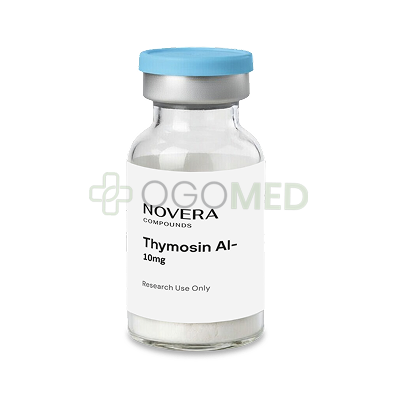
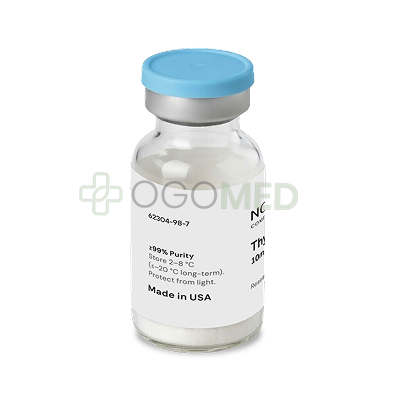
Novera Thymosin Alpha-1
In Stock
| Category: | Peptides |
| Brand | Novera |
| Strength | 10mg |
| Form | Lyophilized powder |
| Purity (%) | ≥99 |
| CAS number | 69521-94-4 |
| Chemical Formula | C₁₂₉H₂₁₅N₃₃O₅₅ |
| Molecular weight | 3108.3 |
| Synonyms | TA1, Thymalfasin |
| Peptide sequence | Ac-Ser-Asp-Ala-Ala-Val-Asp-Thr-Ser-Ser-Glu-Ile-Thr-Thr-Lys-Asp-Leu-Lys-Glu-Lys-Lys-Glu-Val-Val-Glu-Glu-Ala-Glu-Asn |
| Storage | Store at 2-8 °C. Protect from light and moisture |
| Shelf Life (lyophilized) | 18-24 months |
| Shelf Life (after reconstitution) | 7-14 days |
Learn more...
Novera Thymosin Alpha-1 is a premium peptide product developed for laboratory and research applications. This naturally occurring peptide is derived from a sequence originally associated with the thymus gland, an organ known for its involvement in the development and maturation of the body’s defense network. It was discovered in 1972, but it has garnered significant attention in recent decades because scientists continue to explore its wide range of biological actions across different experimental models.
Unlike many synthetic compounds designed to target a single pathway, this peptide appears to interact with multiple biological mechanisms. Researchers have become interested in its possible influence on immune response, cellular communication, and the body’s ability to adapt to environmental challenges. As a result, it has become one of the most extensively studied peptides in modern immunology research. For transparency, Novera Thymosin Alpha-1 is intended strictly for research purposes in controlled laboratory settings and is not presented as a medicine or dietary supplement.
Composition and Product Characteristics
Novera Thymosin Alpha-1 is supplied in lyophilized powder form, allowing researchers to prepare solutions according to the requirements of their laboratory protocols. Freeze-drying helps preserve peptide stability during transportation and storage while minimizing degradation before reconstitution. The peptide consists of a defined 28-amino-acid sequence, providing the structural identity used for laboratory characterization and quality verification:
Ser-Asp-Ala-Ala-Val-Asp-Thr-Ser-Ser-Glu-Ile-Thr-Thr-Lys-Asp-Leu-Lys-Glu-Lys-Lys-Glu-Val-Val-Glu-Glu-Ala-Glu-Asn.
Product Highlights
- Research-grade peptide formulation.
- Lyophilized powder for laboratory use.
- 10 mg peptide per vial.
- Defined 28-amino-acid sequence.
- Batch-to-batch quality consistency.
The peptide consists of a short amino acid chain with a defined molecular weight, making it suitable for analytical work where consistency and purity are essential. High-quality manufacturing standards help ensure that every batch maintains reliable characteristics, which is particularly important when comparing results across different research studies.
Researchers often value products with consistent specifications because reproducibility remains one of the foundations of meaningful scientific work. Even subtle differences in purity or handling may influence experimental outcomes, making standardized production an important consideration.
How Thymosin Alpha-1 Peptide Works
Scientists continue to investigate how this peptide communicates with various biological systems. Current evidence suggests that it may influence immune modulation by interacting with signaling networks responsible for maintaining immune system regulation rather than acting as a simple stimulant. Several laboratory observations indicate possible interactions with:
- immune cells;
- dendritic cells;
- natural killer cells;
- other immune cells.
Research also suggests that Thymosin Alpha-1 may improve macrophage efficiency in immune responses, contributing to ongoing investigations into its broader immunomodulatory activity. Rather than forcing a single response, researchers believe the peptide may contribute to maintaining immune balance through coordinated signaling between different cell populations. This balanced approach has attracted interest because healthy biological systems typically rely on regulation instead of excessive activation.
Another important area of scientific exploration involves T-cell activity, where scientists continue examining how the peptide may influence cellular communication during experimental conditions. Also, Thymosin Alpha-1 enhances T-cell differentiation and proliferation. These interactions are considered essential for understanding how different immune pathways cooperate when responding to external challenges.
Understanding the Role of the Immune System
The immune system depends on constant communication between different types of cells rather than the activity of a single pathway. Signals exchanged between T-lymphocytes, dendritic cells, macrophages, and natural killer cells help coordinate appropriate responses while preventing unnecessary inflammation. Researchers therefore continue investigating peptides capable of supporting this complex regulatory network instead of simply stimulating immune activity.
Thymosin Alpha-1 has attracted attention because published studies suggest that it may participate in several stages of immune regulation simultaneously. Rather than focusing on one specific mechanism, scientists continue exploring how its interactions with multiple immune pathways may contribute to maintaining balanced cellular communication under different experimental conditions.
Why Researchers Continue Studying It
The scientific community has given Thymosin Alpha-1 significant attention because its potential applications extend across numerous research fields instead of remaining limited to a single disease model. Areas frequently explored include:
- chronic hepatitis;
- chronic infections;
- autoimmune disorders;
- cancers;
- cystic fibrosis;
- metabolic syndrome.
Many scientific explorations also examine how the peptide performs alongside other treatments, attempting to understand whether combined experimental approaches produce different biological responses than isolated compounds. The growing volume of published work reflects continued scientific curiosity rather than definitive conclusions.
Researchers are particularly interested because the peptide appears capable of interacting with several biological pathways simultaneously. This broader profile distinguishes it from compounds designed around only one molecular target and has encouraged additional investigation across diverse medical research disciplines.
Autoimmune Conditions and Ongoing Research
Autoimmune conditions have become one of the primary areas in which Thymosin Alpha-1 continues to be investigated. Instead of focusing on a single disorder, researchers study how the peptide interacts with immune system regulation across different experimental models where normal immune signaling is disrupted. Current research commonly explores its potential relevance in conditions such as:
- rheumatoid arthritis;
- multiple sclerosis;
- systemic lupus erythematosus;
- inflammatory bowel disease;
- psoriasis.
Although these scientific explorations remain ongoing, scientists are primarily interested in understanding how the peptide may influence immune communication rather than targeting a specific disease. Every new study contributes additional information about its biological activity and helps expand knowledge of its potential role in future immunology research.
Findings from Research Applications
A considerable number of laboratory and clinical publications have explored Thymosin Alpha-1 over many years. While individual findings differ depending on study design, many papers discuss its possible immunomodulatory properties and their relevance to maintaining immune regulation under different experimental conditions.
Some publications evaluate how the peptide may influence production of interferon gamma, while others examine whether it can help reduce inflammation in carefully designed models. In many published clinical and experimental studies, Thymosin Alpha-1 is commonly administered via subcutaneous injections, although dosing protocols vary depending on the objectives of each investigation. Scientists continue performing analysis to better understand where these observations fit within broader biological context, recognizing that laboratory findings require careful interpretation. Topics frequently discussed throughout the literature include:
- changes in immune function;
- the body’s ability to recognize pathogens;
- potential influence on normal immune signaling;
- reported beneficial extrapulmonary effects in selected experimental models.
Every new publication adds another piece to the overall scientific picture, although researchers generally emphasize that additional work is still needed before drawing broader conclusions.
Potential Side Effects Observed in Research
Like many compounds evaluated during scientific development, Thymosin Alpha-1 has been assessed for safety as well as biological activity. Published literature often reports mild side effects when the peptide has been evaluated under supervised research conditions, although observations naturally vary between studies and participant populations.
Reported symptoms may include temporary injection-site discomfort, mild fatigue, headache, or short-lived flu-like sensations. Such findings are usually documented alongside measurements of tolerability, dosage, and overall efficacy, allowing investigators to compare outcomes across different study designs. It is not recommended for individuals undergoing immunosuppression, and any potential use should be evaluated by a qualified healthcare professional based on individual circumstances.
It is important to recognize that research findings should always be interpreted within the limitations of each individual experiment. Factors such as participant selection, methodology, duration, and dosage all influence reported results, making careful scientific evaluation essential before comparing separate publications.
Storage Recommendations
Proper storage plays a major role in preserving peptide integrity. Before reconstitution, unopened vials should generally be stored in a refrigerator between 2°C and 8°C while remaining protected from excessive heat, moisture, and direct sunlight.
Once reconstituted, solutions should be handled using sterile laboratory procedures and used according to established research protocols. Avoid repeated freeze-thaw cycles whenever possible, since temperature fluctuations may gradually affect peptide stability.
Good storage practices are not simply about extending shelf life. Consistent handling helps maintain sample quality throughout an experiment, reducing unnecessary variability and improving the reliability of laboratory observations. For researchers working with sensitive biomolecules, careful preservation is just as important as selecting high-quality starting materials.
Where to Buy Thymosin Alpha-1 10mg
Thymosin Alpha-1 is typically acquired through licensed medical channels. Choosing a trusted supplier is an important part of purchasing any research peptide. OGOmed offers Thymosin Alpha-1 10mg manufactured to high quality standards, with careful batch control, secure packaging, and detailed product information to support laboratory work. Although this peptide has attracted interest for its crucial role in immune function and research involving various diseases, it is supplied exclusively for research purposes. Compounded medications do not undergo FDA review for safety or efficacy.
When ordering from OGOmed, customers benefit from dependable service, transparent product specifications, and consistent quality from batch to batch. As scientific interest continues to grow around peptides used in research focused on boosting immunity, having access to a reliable source helps ensure confidence throughout every stage of laboratory investigations.
| Category: | Peptides |
| Brand | Novera |
| Strength | 10mg |
| Form | Lyophilized powder |
| Purity (%) | ≥99 |
| CAS number | 69521-94-4 |
| Chemical Formula | C₁₂₉H₂₁₅N₃₃O₅₅ |
| Molecular weight | 3108.3 |
| Synonyms | TA1, Thymalfasin |
| Peptide sequence | Ac-Ser-Asp-Ala-Ala-Val-Asp-Thr-Ser-Ser-Glu-Ile-Thr-Thr-Lys-Asp-Leu-Lys-Glu-Lys-Lys-Glu-Val-Val-Glu-Glu-Ala-Glu-Asn |
| Storage | Store at 2-8 °C. Protect from light and moisture |
| Shelf Life (lyophilized) | 18-24 months |
| Shelf Life (after reconstitution) | 7-14 days |
Learn more...