













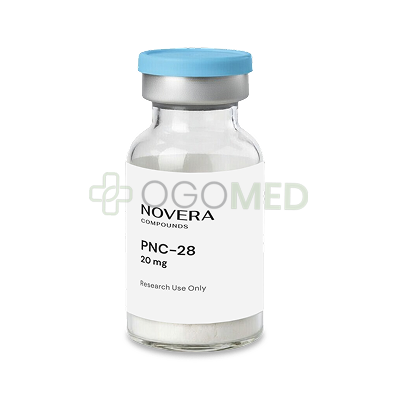
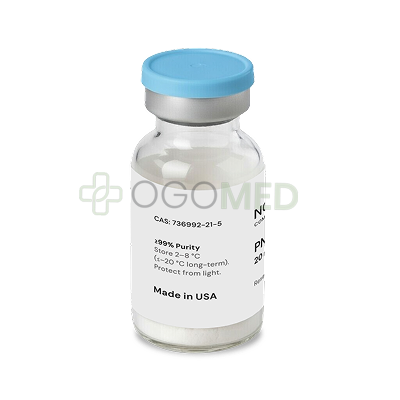
Novera PNC-28
| Category: | Peptides |
| Brand | Novera |
| Strength | 20mg |
| Form | Lyophilized powder |
| Purity (%) | ≥99 |
| CAS number | 392661-17-5 |
| Chemical Formula | C₁₆₄H₂₅₅N₄₇O₃₇S |
| Molecular weight | 3509.1 |
| Synonyms | Cancer-selective-lytic-peptide, PNC28-anti-tumor-peptide |
| Peptide sequence | N/A (peptide derivative) |
| Storage | Store at 2-8 °C or -20 °C. Protect from light |
| Shelf Life (lyophilized) | 12-24 months |
| Shelf Life (after reconstitution) | 24-72 hours |
Learn more...
PNC 28 peptide is a synthetic molecule derived from the MDM2-binding domain of the tumor suppressor protein p53, specifically residues 17-26, fused at its carboxyl terminus to a penetratin sequence that confers membrane-penetrating properties. First described by the Pincus and Michl group at SUNY Downstate Medical Center in 2001, this experimental anti-cancer peptide is studied primarily for its ability to induce death in various human tumor cell lines and for its use in pancreatic cancer research, where it has shown complete destruction of simultaneously transplanted tumors in rodent models.
Novera PNC-28 is supplied for laboratory research use only. Despite preclinical efficacy in cell culture and animal models, PNC-28 is not an approved clinical treatment by any regulatory agency. No human clinical trials demonstrating safety or efficacy have been published in the peer-reviewed literature.
What Novera PNC-28 Is
The compound is a fragment of the p53 transactivation domain, covering the short stretch of residues that bind MDM2 with high affinity. Full-length p53 functions as a transcription factor, activating genes that control cell cycle arrest and apoptosis. PNC 28, by contrast, lacks the DNA binding domain, oligomerization domain, and regulatory regions of p53 entirely. It acts as a competitive inhibitor of the MDM2-p53 complex and can increase the half-life of p53 in cancer cells by disrupting that interaction.
What makes the peptide experimentally distinct is its C-terminal penetratin sequence. Without this leader, the p53 17-26 fragment tends to induce apoptosis via intracellular MDM2 binding. With penetratin attached, the molecule binds membrane-localized HDM2 on cancer cells and triggers necrosis through direct membrane pore formation. Its mechanism is independent of the p53 pathway and remains effective even in cells carrying p53 mutations or homozygous deletions. Control peptides such as PNC-29, which lack the p53-derived sequence or the penetratin leader, show no cytotoxic activity, confirming that both components are required.
Why Researchers Study PNC-28
Interest in PNC-28 centers on the MDM2-p53 interaction and the unusual finding that a short peptide fragment, when fused to a membrane-penetrating sequence, can selectively lyse cancer cell membranes through a mechanism distinct from classical apoptosis. The following subsections summarize what specific studies have found across several research areas.
Pancreatic Cancer Cell Growth In Vivo
Michl et al. published the principal in vivo study in 2006 in the International Journal of Cancer. Nude mice were implanted with rat pancreatic acinar carcinoma BMRPA1.Tuc3 cells and administered PNC-28 via osmotic pump over two weeks, either intraperitoneally or subcutaneously. When delivered concurrently with tumour transplantation into the peritoneal cavity, PNC-28 caused complete destruction of those tumours over the two-week period.
The same paper reports three delivery arms, and only one of them ended in destruction. Concurrent intraperitoneal delivery destroyed the tumours. Delivery at a site remote from the tumour, concurrent with explantation, blocked any growth during the two weeks of administration and two weeks afterwards, followed by weak tumour growth that plateaued at low tumour sizes against control peptide. Delivery started after tumours had already grown produced a decrease in size followed by a slow increase that was significantly slower than control. Tumour regrowth therefore occurred in two of the three arms once administration stopped.
“When administered over a 2-week period in the peritoneal cavities of nude mice containing simultaneously transplanted tumors, PNC-28 causes complete destruction of these tumors.” Josef Michl et al., 2006, International Journal of Cancer.
The results established that PNC-28 blocks pancreatic cancer cell growth in vivo. PNC-28 has been evaluated in pancreatic cancer models with promising preclinical results, though the evidence remains limited to rodent models.
Mechanism Against Cancer Cells: MDM2-p53 and Membrane Binding
The mechanism of PNC-28 involves rapid necrotic cell death through pore formation in cancer cell membranes rather than the caspase-dependent apoptosis seen with many chemotherapeutics. Evidence linking the peptide to disruption of MDM2-p53 binding comes from studies showing that PNC-28 can lyse cancer cell membranes directly, even in cell lines with homozygous p53 deletion, confirming that endogenous p53 is not required for the cytotoxic effect.
Bowne et al. (2008, Annals of Surgical Oncology) treated MiaPaCa-2 human pancreatic carcinoma cells with PNC-28 and found no elevation of the proapoptotic proteins seen in p53-induced apoptosis, but rapid release of lactate dehydrogenase indicating necrosis, together with membrane pore formation and dose-dependent killing.
LDH release assays confirmed membrane lysis without activation of caspase 3/7, distinguishing the mechanism from apoptosis. The presence of HDM2 on cancer cell membranes appears essential. Immuno-scanning electron microscopy of cancer cells treated with the close analogue PNC-27 found anti-peptide and anti-HDM-2 gold labels in roughly 1:1 ratios in layered ring-shaped structures lining the pores near the cell surface, with no pores forming in untransformed fibroblasts (Sarafraz-Yazdi et al., 2022, Biomedicines).
Tumor Cell Selectivity Across Cancer Cells
PNC-28 induces death of various human tumor cell lines beyond pancreatic carcinoma. Kanovsky et al. (2001) found the p53 17-26 penetratin peptide cytotoxic to human cancer cells in culture and as effective in p53-null cancer cells as in those carrying mutant or normal p53, while a control peptide attached to the same penetratin sequence had no effect on the same lines.
Normal cells lack membrane-associated HDM-2 and are largely spared by PNC-28. In preclinical studies, PNC-28 showed minimal cytotoxicity toward healthy cells, including untransformed rat pancreatic acinar cells (BMRPA1), human breast epithelial cells, and human hematopoietic stem cells.
“The same three cytotoxic peptides had no effect on the growth of normal cells, including human cord blood-derived stem cells.” Kanovsky et al., 2001, Proceedings of the National Academy of Sciences.
Delivery and Penetratin Sequence Effects
The penetratin sequence is required for the necrotic mechanism. Without it, the p53 17-26 fragment induces apoptosis rather than membrane lysis, a finding that has guided experimental controls across multiple studies. In nude mice bearing BMRPA1.Tuc3 tumours, Michl et al. delivered PNC-28 by mini-osmotic pump over 14 days, intraperitoneally or subcutaneously, and the outcome depended on the delivery route and on whether the tumour was already established.
Time-lapse electron microscopy of MiaPaCa-2 cells revealed membrane pore formation after exposure to the peptide. In the same study, cells transfected with a plasmid encoding the p53 17-26 segment without penetratin died by apoptosis instead, expressing high levels of caspase-3 and caspase-7 with only background LDH, which is the direct evidence that the leader sequence, not the p53 fragment, sets the death mechanism (Bowne et al., 2008).
How PNC-28 Compares With Related Compounds
| Compound | Receptor/Target | Evidence Level | Typical Research Use |
|---|---|---|---|
| PNC-28 (p53 17-26 + penetratin) | Membrane-bound HDM2; induces membrane pore formation and necrosis | In vitro cancer cell lines; rodent xenograft models | Selective necrosis studies, tumor growth inhibition, membrane binding assays |
| PNC-27 (p53 12-26 + penetratin) | Same HDM2 target; slightly longer p53 fragment | In vitro; rodent models | Structure-activity mapping, microscopy of membrane pores, broader spectrum screening |
| p53 17-26 fragment (no penetratin) | Intracellular MDM2; induces apoptosis, not membrane lysis | In vitro only | Comparing apoptosis versus necrosis pathways; confirming requirement for penetratin leader |
Researchers studying membrane lysis, rapid necrotic cell death, or in vivo tumor shrinkage will find PNC-28 the appropriate choice given its demonstrated ability in rodent models. PNC-27 is better suited for structural mapping of the binding domain because its longer p53 fragment provides additional residues for mutagenesis studies. The naked p53 17-26 fragment, lacking the penetratin leader, serves as a tool for apoptosis-focused assays and as an essential control for confirming that the membrane-targeting view of the mechanism depends on the leader sequence.
What Research on PNC-28 Does Not Establish
All published peer-reviewed evidence for PNC-28 comes from in vitro cell culture or rodent xenograft models. No human clinical trials have been published demonstrating safety, pharmacokinetics, biodistribution, or efficacy. Claims that clinical trials for PNC-28 have been successful outside the U.S., and that PNC-28 is currently in use outside of the United States, circulate in non-peer-reviewed sources but have no published support in indexed journals. The precise lipid and co-factor composition of cancer cell membranes required for PNC-28 binding remains unidentified. Durability is already in question in the animal data itself: in two of the three delivery arms of Michl et al. (2006) tumours regrew once administration stopped, and in a third the tumour decreased and then grew again more slowly. No peer-reviewed data address resistance development or effects on metastatic disease. No negative or terminated trials have been formally reported, which itself limits the ability to assess publication bias. Any claim of treating cancers in human patients with this peptide is unsupported.
Where to Buy Novera PNC-28
Novera PNC-28 is available for purchase by licensed professionals conducting laboratory research. To request this peptide, contact the store by phone or email during business hours.
-
Estimated delivery time 3 to 7 days.
-
Free shipping on orders over $750.
-
All US import fees and tariffs are covered by Ogomed, so the buyer pays nothing extra; customs checks under the new US import rules can add a little time to delivery.
-
Price match: if the same product is listed for less elsewhere, Ogomed will try to match it.
-
Support by phone +1-650-457-5621 and email, 10am to 6pm EST.
-
Sold to licensed professionals, for laboratory research use only.
Novera PNC-28 is sold exclusively to licensed professionals for laboratory research use only.
References
- Kanovsky, M., Raffo, A., Drew, L., et al. (2001). Peptides from the amino terminal mdm-2-binding domain of p53, designed from conformational analysis, are selectively cytotoxic to transformed cells. Proceedings of the National Academy of Sciences, 98(22), 12438-12443. DOI: 10.1073/pnas.211280698
- Michl, J., Scharf, B., Schmidt, A., et al. (2006). PNC-28, a p53-derived peptide that is cytotoxic to cancer cells, blocks pancreatic cancer cell growth in vivo. International Journal of Cancer, 119(7), 1577-1585. DOI: 10.1002/ijc.22029
- Bowne, W. B., Sookraj, K. A., Vishnevetsky, M., et al. (2008). The penetratin sequence in the anticancer PNC-28 peptide causes tumor cell necrosis rather than apoptosis of human pancreatic cancer cells. Annals of Surgical Oncology, 15(12), 3588-3600. DOI: 10.1245/s10434-008-0147-0
- Sarafraz-Yazdi, E., Mumin, S., Cheung, D., et al. (2022). PNC-27, a chimeric p53-penetratin peptide binds to HDM-2 in a p53 peptide-like structure, induces selective membrane-pore formation and leads to cancer cell lysis. Biomedicines, 10(5), 945. DOI: 10.3390/biomedicines10050945
PNC 28 is a synthetic peptide consisting of residues 17-26 from the p53 transactivation domain fused to a penetratin leader sequence. First described by the Pincus and Michl group at SUNY Downstate Medical Center in 2001, it was designed to target membrane-bound HDM2 on cancer cells. The compound is for laboratory research use only.
The pnc-28 peptide binds HDM2 localized on cancer cell membranes rather than intracellular MDM2. Upon binding, it forms transmembrane pores that cause rapid necrotic cell death, distinct from caspase-dependent apoptosis. The penetratin leader is required for this membrane-targeting mechanism.
In vitro, PNC-28 kills MiaPaCa-2 pancreatic carcinoma cells by necrosis rather than apoptosis, with rapid LDH release, membrane pore formation and dose-dependent killing (Bowne et al., 2008). In the 2006 Michl et al. rodent study the peptide destroyed simultaneously transplanted intraperitoneal tumours, but in both remote-site arms tumours regrew after treatment stopped. All current evidence is in vitro or mouse xenograft.
PNC-27 contains a longer p53 fragment (residues 12-26) and is primarily used for structural mapping and broader screening. PNC-28 uses the shorter 17-26 fragment and is preferred for focused necrosis and membrane-lysis studies. Both share the same HDM2 membrane target and penetratin leader.
Cell culture models include MiaPaCa-2, HeLa, SW1417, TUC-3, and several p53-null lines. The primary in vivo model is nude mice bearing BMRPA1.Tuc3 pancreatic tumors, with delivery via mini-osmotic pumps through subcutaneous or intraperitoneal routes.
Human safety, pharmacokinetics, and biodistribution remain uncharacterized. The precise membrane components enabling PNC-28 binding are not fully identified. No data exist on resistance development or long-term tumor recurrence after treatment cessation.
PNC-28 is not on the 2026 WADA Prohibited List, by name or as a class. Because it has no current approval as a human therapeutic it falls under S0, the catch-all class for non-approved substances, which is prohibited at all times.
Novera PNC 28 peptide is available through this store for licensed professionals conducting laboratory research. Estimated delivery is 3 to 7 days, with free shipping on orders over $750. Contact support at +1-650-457-5621 or by email, 10am to 6pm EST.
| Category: | Peptides |
| Brand | Novera |
| Strength | 20mg |
| Form | Lyophilized powder |
| Purity (%) | ≥99 |
| CAS number | 392661-17-5 |
| Chemical Formula | C₁₆₄H₂₅₅N₄₇O₃₇S |
| Molecular weight | 3509.1 |
| Synonyms | Cancer-selective-lytic-peptide, PNC28-anti-tumor-peptide |
| Peptide sequence | N/A (peptide derivative) |
| Storage | Store at 2-8 °C or -20 °C. Protect from light |
| Shelf Life (lyophilized) | 12-24 months |
| Shelf Life (after reconstitution) | 24-72 hours |
Learn more...