










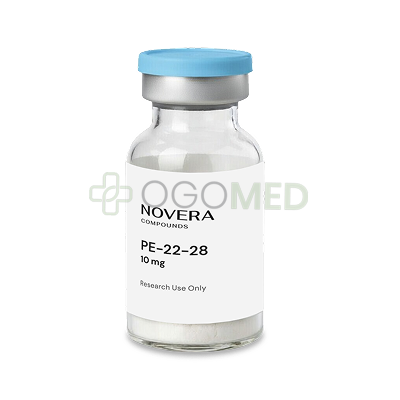

Novera PE-22-28
| Category: | Peptides |
| Brand | Novera |
| Strength | 10mg |
| Form | Lyophilized powder |
| Purity (%) | ≥99 |
| CAS number | 1801959-12-5 |
| Chemical Formula | C₃₅H₅₅N₁₁O₉ |
| Molecular weight | 773.9 |
| Synonyms | Peptide-22-28, ACTH-fragment-22-28 |
| Peptide sequence | Proprietary modified peptide |
| Storage | Store at 2-8 °C or -20 °C. Protect from light |
| Shelf Life (lyophilized) | 12-24 months |
| Shelf Life (after reconstitution) | 24-72 hours |
Learn more...
PE-22-28 is a synthetic heptapeptide derived from the naturally occurring peptide spadin, studied primarily for its potent antagonism of the TREK-1 (KCNK2) potassium channel. The compound is classified as an investigational peptide, and the results from research on PE-22-28 are primarily based on animal models and in vitro cell-line work.
Research-grade PE-22-28 is intended for laboratory research use only. It is not approved for therapeutic use by the FDA, has never been tested in a controlled human trial, and is not supplied for human or animal consumption. PE-22-28 requires comprehensive clinical development for approval as a therapeutic agent, and no human adverse-event data for PE-22-28 is published.
What Novera PE-22-28 Is
Spadin, the parent compound, is a 17-amino-acid fragment (residues 12-28) of the propeptide released when sortilin (also known as NTSR3) undergoes processing. PE-22-28 corresponds to the final seven residues of that propeptide, residues 22 to 28. By dropping the upstream residues 12 to 21 it retains the region responsible for TREK-1 interaction while offering practical advantages over full length spadin.
Those advantages matter in the laboratory. The shorter chain simplifies synthesis and improves in vivo stability relative to spadin, whose activity disappears beyond about seven hours after administration. Djillani et al. reported in 2017 that shortened spadin analogs display better TREK-1 inhibition, greater in vivo stability, and longer-lasting antidepressant activity than the parent 17-mer. PE-22-28 can be prepared by standard Fmoc solid-phase synthesis without post-translational modification, which is part of why it has displaced the 17-mer as the working tool compound in TREK-1 studies.
Why Researchers Study PE-22-28
PE-22-28 acts as an antagonist of the TREK-1 potassium channel, a two-pore domain (K2P) channel encoded by the KCNK2 gene. The TREK-1 potassium channel is expressed in brain regions related to mood regulation, including the hippocampus and dorsal raphe nucleus. Blocking the TREK-1 channel impacts mood-related pathways by reducing outward potassium currents, which increases neuronal excitability in serotonergic and other relevant circuits. Notably, PE-22-28 operates independently of serotonin or norepinephrine pathways in the conventional pharmacological sense: rather than inhibiting reuptake of these monoamines, the peptide modulates the ion channel whose deletion produces a depression-resistant phenotype in mice.
TREK-1 Channel Blockade
Heurteaux et al. demonstrated in 2006 that TREK-1 knockout mice (Kcnk2−/−) exhibit a depression-resistant phenotype with elevated serotonergic neuron firing rates, establishing the channel as a candidate target for antidepressant drug design. PE-22-28 recapitulates key features of that genetic deletion pharmacologically. In whole-cell patch-clamp recordings using HEK293 cells expressing human TREK-1, Djillani et al. (2017, Frontiers in Pharmacology, 8, 643) measured an IC50 of 0.12 nM for PE-22-28, against 40 to 60 nM for full length spadin. That is a 300- to 500-fold increase in potency, which lets researchers work at much lower concentrations in vitro and improves signal-to-noise in electrophysiology.
The compound does not significantly inhibit other K2P family members, including TREK-2, TRAAK, TRESK, and TASK-1, under conditions tested in vitro. It also spares the hERG cardiac channel, a finding with implications for the safety profile of any future translational work, since hERG blockade is a common cause of cardiac toxicity flags in drug development.
“PE 22-28 displayed a better specificity and affinity for TREK-1 channel compared to spadin, IC50 of 0.12 nM vs. 40-60 nM for spadin” Djillani et al., 2017, Frontiers in Pharmacology.
Antidepressant-Like Activity in Animal Models
In the forced swim test, mice treated intraperitoneally with PE-22-28 at 3 to 4 micrograms per kilogram per day for four days showed significantly reduced immobility compared with saline controls (Djillani et al., 2017). Similar antidepressant activity was observed in novelty-suppressed feeding and learned helplessness paradigms in the same publication. These behavioral readouts are standard screening tools for antidepressant compounds in animal studies, though they are imperfect proxies for human depression.
The action duration of PE-22-28 and its analogs runs to about 23 hours, against roughly seven hours for spadin, which is the main practical reason the shortened peptide replaced the 17-mer in this group’s later work. All of this evidence comes from mice; no human clinical data on mood, anxiety, or depression outcomes exists for this compound.
In a 2017 rodent study by Djillani et al. (Frontiers in Pharmacology), PE-22-28 administered at 3 to 4 micrograms per kilogram per day for four days produced a statistically significant reduction in forced swim test immobility and increased hippocampal BrdU-positive cell counts to 1,736 plus or minus 126 versus 899 plus or minus 109 in saline controls (n=5, p<0.0001), all in mice.
Hippocampal Neurogenesis
Animal studies suggest PE-22-28 promotes neurogenesis in the hippocampal subgranular zone. After four days of treatment at 3 to 4 micrograms per kilogram per day in mice, Djillani et al. (2017) reported that BrdU-positive proliferating cells nearly doubled: from approximately 899 cells in saline-treated controls to approximately 1,736 cells in the PE-22-28 group, a difference that reached p<0.0001 with five animals per group.
Synaptic Plasticity Markers
PSD-95, a postsynaptic density protein associated with synaptogenesis, showed increased expression in the same 2017 study; the measurement was made by western blot on mouse cortical neurons, not in treated animals. This marker is commonly used as evidence of synaptic remodelling in preclinical neuroscience, although a change in PSD-95 alone does not confirm functional synaptic strengthening.
“the deletion of its gene (Kcnk2, also called TREK-1) led to animals with an increased efficacy of 5-HT neurotransmission” Heurteaux et al., 2006, Nature Neuroscience.
Cognitive Function
No dedicated cognitive study using standardised learning and memory tasks, such as the Morris water maze or novel object recognition, has been published for PE-22-28. What exists is an inference: TREK-1 modulation alters neuronal excitability in hippocampal circuits that serve both memory and affective processing. Claims of cognitive benefit in non-peer-reviewed venues have no published support behind them.
How PE-22-28 Compares With Related Compounds
Researchers planning TREK-1 experiments often weigh PE-22-28 against full length spadin and modified spadin analogs. The table below summarizes how these compounds differ in target affinity, evidence base, and typical research use.
| Compound | Receptor / Target | Evidence Level | Typical Research Use |
|---|---|---|---|
| Spadin (PE 12-28) | TREK-1 antagonist; IC50 40 to 60 nM in vitro | Rodent in vivo and in vitro; behavioral depression models; neurogenesis after 4-day dosing (Mazella et al., 2010) | Proof-of-concept studies establishing TREK-1 as an antidepressant target; comparison with SSRIs; longer fragment with shorter duration of action than PE-22-28 |
| PE-22-28 | TREK-1 antagonist; IC50 0.12 nM in HEK293 cells | Preclinical: in vitro electrophysiology, rodent behavioral tests, neurogenesis and synaptogenesis markers (Djillani et al., 2017) | When maximum potency and minimal peptide size are needed; mechanism studies, pharmacodynamic time-course work, and dose comparisons with spadin |
| G/A-PE-22-28 | TREK-1 antagonist; IC50 approximately 0.10 nM in vitro | Similar preclinical dataset to PE-22-28; action duration up to 23 hours (Djillani et al., 2017) | When investigators want to assess the impact of N-terminal substitution on stability or brain uptake; slightly extended vivo stability over unmodified PE-22-28 |
Labs studying selective TREK-1 blockade with the shortest possible peptide generally pick PE-22-28. Those interested in stability modifications choose G/A-PE-22-28 or biotinylated analogs. Full length spadin remains useful when the upstream sequence (residues 12-21) is relevant to the biological question, for instance in studies of sortilin interaction. Non-peptide TREK-1 modulators and SSRIs such as fluoxetine have off-target channel effects that make them less suitable when specificity for TREK-1 is the experimental priority.
What Research on PE-22-28 Does Not Establish
Every published finding on PE-22-28 comes from cell lines (HEK293, COS-7, hippocampal slices) or rodent models. No controlled clinical trial in humans has been registered, conducted, or published as of 2026. PE-22-28 lacks extensive human safety studies, and no human adverse-event data for PE-22-28 is published. The FDA has not flagged PE-22-28 as unsafe, but this reflects the absence of a regulatory submission rather than a positive safety finding. PE-22-28 is not FDA approved for therapeutic use.
Claims that circulate on some website forums and vendor page listings about intranasal administration, rapid mood improvement, or cognitive enhancement in humans have no support in peer-reviewed literature. No pharmacokinetic study in humans has characterised its absorption, distribution, metabolism or excretion by any route, and the rodent work used intraperitoneal injection and gavage rather than any route with published human data.
“Any pharmacological substance which is not addressed by any of the subsequent sections of the List … is prohibited at all times.” WADA, 2026 Prohibited List, Section S0.
Behavioral tests like the forced swim test and novelty-suppressed feeding are screening tools with known limitations: they detect acute behavioral shifts in mice but do not model the full complexity of human depression, nor do they predict therapeutic efficacy in patients. The neurogenesis data, while statistically significant in the Djillani et al. (2017) study, reflects cell proliferation counts in a single brain region of five mice per group over four days of treatment. Long-term dosing effects, tolerance, immunogenicity, and potential compensatory channel upregulation remain unstudied. No negative trial or retraction currently affects the core PE-22-28 literature, but the dataset is small: essentially one primary research group (Mazella, Borsotto, Heurteaux and colleagues at CNRS/IPMC) has generated the published evidence. Independent replication by other laboratories has not been reported.
It is not a drug, cure, or approved treatment for any disease, and the regulatory status of PE-22-28 does not permit its sale for human consumption or human use.
Where to Buy Novera PE-22-28
Novera PE-22-28 is available through this store to laboratory buyers working on TREK-1 channel pharmacology, and is supplied to licensed professionals for laboratory research use only.
-
Estimated delivery time 3 to 7 days.
-
Free shipping on orders over $750.
-
All US import fees and tariffs are covered by Ogomed, so the buyer pays nothing extra; customs checks under the new US import rules can add a little time to delivery.
-
Price match: if the same product is listed for less elsewhere, Ogomed will try to match it.
-
Support by phone +1-650-457-5621 and email, 10am to 6pm EST.
-
Sold to licensed professionals, for laboratory research use only.
Whether you need to buy pe 22 28 for electrophysiology assays or rodent behavioral pharmacology, the compound is sold exclusively to credentialed researchers and institutions for research use.
References
- Heurteaux, C., Lucas, G., Guy, N., et al. (2006). Deletion of the background potassium channel TREK-1 results in a depression-resistant phenotype. Nature Neuroscience, 9(9), 1134-1141. DOI: 10.1038/nn1749
- Mazella, J., Petrault, O., Lucas, G., et al. (2010). Spadin, a sortilin-derived peptide, targeting rodent TREK-1 channels: a new concept in the antidepressant drug design. PLoS Biology, 8(4), e1000355. DOI: 10.1371/journal.pbio.1000355
- Djillani, A., Pietri, M., Moreno, S., Heurteaux, C., Mazella, J., Borsotto, M. (2017). Shortened Spadin Analogs Display Better TREK-1 Inhibition, In Vivo Stability and Antidepressant Activity. Frontiers in Pharmacology, 8, 643. DOI: 10.3389/fphar.2017.00643
- Djillani, A., Mazella, J., Heurteaux, C., Borsotto, M. (2019). Role of TREK-1 in Health and Disease, Focus on the Central Nervous System. Frontiers in Pharmacology, 10, 379. DOI: 10.3389/fphar.2019.00379
PE-22-28 is a synthetic heptapeptide corresponding to residues 22 through 28 of the propeptide released during sortilin processing, and a shortened analog of spadin. It is classified as an investigational peptide, supplied for laboratory research only, and is not an approved medicine for any indication.
The compound functions as an antagonist of the TREK-1 potassium channel, blocking outward K+ currents activated by agents such as arachidonic acid. By reducing TREK-1 conductance, PE-22-28 increases neuronal excitability in brain regions such as the hippocampus and dorsal raphe nucleus, based on rodent electrophysiology and cell-line data. It operates independently of serotonin or norepinephrine reuptake pathways.
Animal studies by Djillani et al. (2017) report sub-nanomolar TREK-1 inhibition in vitro, reduced immobility in the mouse forced swim test, and a near-doubling of hippocampal BrdU-positive cells after four days of dosing at 3 to 4 micrograms per kilogram per day. All published evidence is preclinical. No controlled human trial has been conducted, and the compound has not been evaluated for human therapeutic use by any regulatory body.
PE-22-28 is roughly 300- to 500-fold more potent than full length spadin at inhibiting TREK-1 in HEK293 cell assays, with an IC50 of 0.12 nM against spadin’s 40 to 60 nM (Djillani et al., 2017). Its behavioural effect in mice also lasts longer, up to about 23 hours against roughly 7 hours for spadin. While they share the same target, they are not interchangeable in experimental design because of differences in potency, size, and stability.
Researchers have employed this compound in whole-cell patch-clamp recordings on HEK293 cells expressing human TREK-1, mouse hippocampal slice preparations, BrdU labeling for hippocampal neurogenesis, and rodent behavioral assays including the forced swim test and novelty-suppressed feeding test. All of these models are preclinical, and results from them do not constitute evidence of efficacy in humans.
Translational safety, pharmacokinetics, blood-brain barrier penetration, immunogenicity, and metabolism in humans are entirely untested. Long-term dosing effects beyond four days, dose-response relationships outside narrow experimental ranges, and potential tolerance or compensatory upregulation of TREK-1 have not been studied even in rodents. PE-22-28 requires comprehensive clinical development for approval.
PE-22-28 is not named anywhere on the 2026 WADA Prohibited List, which is the current one. Because it has no approval from any governmental regulatory health authority for human therapeutic use, it falls under S0, the class covering non-approved substances, which is prohibited at all times, in and out of competition. S0 names BPC-157, 2,4-dinitrophenol and a handful of others as examples; PE-22-28 is not among them.
Novera PE-22-28 can be ordered through this store by researchers in the USA and internationally, with delivery in 3 to 7 days. The peptide is sold to licensed professionals for laboratory research use only and is not intended for human consumption, animal consumption, or any therapeutic application. Support is available by phone and email, 10am to 6pm EST.
| Category: | Peptides |
| Brand | Novera |
| Strength | 10mg |
| Form | Lyophilized powder |
| Purity (%) | ≥99 |
| CAS number | 1801959-12-5 |
| Chemical Formula | C₃₅H₅₅N₁₁O₉ |
| Molecular weight | 773.9 |
| Synonyms | Peptide-22-28, ACTH-fragment-22-28 |
| Peptide sequence | Proprietary modified peptide |
| Storage | Store at 2-8 °C or -20 °C. Protect from light |
| Shelf Life (lyophilized) | 12-24 months |
| Shelf Life (after reconstitution) | 24-72 hours |
Learn more...