






























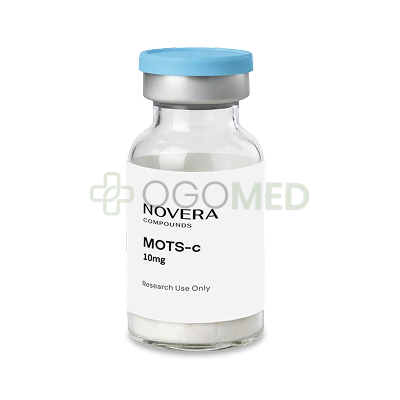

Novera MOTS-c
In Stock
| Category: | Peptides |
| Brand | Novera |
| Strength | 10mg |
| Form | Lyophilized powder |
| Purity (%) | ≥99 |
| CAS number | 1627580-64-6 |
| Chemical Formula | C₁₀₁H₁₅₂N₂₈O₂₂S₂ |
| Molecular weight | 2174.6 |
| Synonyms | Mitochondrial-ORF-peptide |
| Peptide sequence | Met-Arg-Trp-Gln-Glu-Met-Gly-Tyr-Ile-Phe-Tyr-Pro-Arg-Lys-Leu-Arg |
| Storage | Store at 2-8 °C. Protect from light and moisture |
| Shelf Life (lyophilized) | 12-24 months |
| Shelf Life (after reconstitution) | 7-14 days |
Learn more...
MOTS-c has become one of the most discussed peptides in modern metabolic research. Scientists are exploring its potential role in how cells respond to energy demands, adapt to environmental stress, and maintain normal physiological balance. Novera MOTS-c is offered exclusively for research use, providing laboratories and qualified professionals with a high-quality material intended for scientific investigation rather than clinical application.
Unlike many experimental compounds that originate from synthetic screening, this peptide has attracted attention because it is a mitochondrial derived peptide composed of amino acids encoded within the mitochondrial genome. More specifically, researchers identified it within the mitochondrial open reading frame of the 12s rrna c region of mitochondrial DNA, making it one of the few signaling molecules produced directly from this unique genetic source. This discovery has expanded scientific interest in mitochondrial communication and its influence on whole-body physiology.
What Is Novera MOTS-c?
Novera MOTS-c contains the mitochondrial derived peptide MOTS-c, a naturally occurring signaling peptide currently investigated in numerous fields of biomedical science. It belongs to a growing family of molecules involved in communication between mitochondria and the cell nucleus, encouraging researchers to examine how these signals may contribute to metabolic regulation under changing physiological conditions. The naturally occurring peptide consists of 16 amino acids with the sequence — a structure that has become widely recognized in studies exploring mitochondrial signaling and metabolic adaptation:
Met–Arg–Trp–Gln–Glu–Met–Gly–Tyr–Ile–Phe–Tyr–Pro–Arg–Lys–Leu–Arg
Current evidence suggests that this bioactive peptide participates in complex pathways associated with cellular metabolism, helping researchers better understand how cells react to nutrient availability and environmental challenges. Rather than acting as a traditional hormone, MOTS-c appears to function as an intracellular messenger capable of regulate nuclear gene expression through stress-responsive pathways. This has made it a valuable subject in mots c research, particularly when scientists investigate mechanisms associated with maintaining metabolic homeostasis.
Researchers are also interested in whether this recent mitochondrial derived peptide influences the body’s ability to adapt during periods of increased metabolic stress, making it relevant for studies focused on long-term metabolic adaptation.
Who May Be Interested in MOTS-c Research
The mitochondrial derived peptide MOTS-c is primarily intended for laboratories and research institutions investigating cellular energy balance and mitochondrial biology. As scientific understanding of mitochondrial signaling continues to evolve, this peptide has become a valuable research tool for experiments designed to explore how cells respond to environmental stress, nutrient availability, and physiological adaptation. Interest has also expanded because researchers are examining possible interactions between MOTS-c and pathways linked to the folate cycle, opening new directions for metabolic research.
This research peptide may be suitable for professionals involved in:
- designing in vitro or preclinical metabolic studies;
- evaluating mitochondrial signaling pathways under controlled conditions;
- investigating molecular responses to cellular stress and aging;
- comparing experimental compounds involved in energy regulation.
Because MOTS-c remains an investigational peptide, its primary value lies in supporting carefully designed laboratory studies rather than delivering immediate clinical applications. Researchers often select it when they require a well-characterized mitochondrial signaling peptide that has been described in a growing number of scientific publications and continues to generate interest within the biomedical research community.
Composition and Product Information
Novera MOTS-c is supplied as a research-grade peptide manufactured under carefully controlled production standards to support consistency between batches. The product is typically provided as a lyophilized powder, a stable form that helps preserve peptide integrity during transportation and storage before reconstitution. Once prepared, the solution should be handled using standard laboratory techniques to minimize contamination and maintain sample quality throughout the course of an experiment.
To preserve the physical and chemical stability of the peptide, researchers generally follow several handling recommendations:
- Store the unopened vial in a refrigerator or freezer according to the manufacturer’s specifications, avoiding unnecessary exposure to elevated temperatures.
- Keep the product protected from direct sunlight, humidity, and repeated temperature fluctuations, as environmental conditions may affect peptide stability over time.
- After reconstitution, prepare only the amount required for ongoing experiments whenever possible, reducing the need for repeated freeze-thaw cycles that can contribute to peptide degradation.
- Use sterile laboratory equipment and appropriate diluents during reconstitution to minimize contamination and ensure reliable experimental conditions.
- Clearly label reconstituted samples with the preparation date, storage conditions, and concentration to simplify laboratory documentation and improve reproducibility between experiments.
Proper storage is only one part of maintaining sample quality. Careful handling throughout every stage of an experiment helps reduce unnecessary variability, allowing researchers to focus on biological outcomes rather than inconsistencies introduced during preparation. Even small differences in storage temperature, solution preparation, or sample handling may influence the stability of sensitive research peptides.
Novera MOTS-c is intended for research use only and is not approved as a pharmaceutical product, dietary supplement, or cosmetic ingredient. It is not for human or animal use and should be handled exclusively by qualified personnel working in appropriate laboratory environments while following institutional safety procedures and applicable research guidelines.
How MOTS-c Works: AMPK Activation
Scientists continue investigating how MOTS-c interacts with multiple signaling pathways involved in energy metabolism. One of the primary mechanisms currently being explored involves AMPK activation, a cellular response that becomes active when energy availability changes. This pathway is closely connected with amp activated protein kinase, which acts as an important metabolic sensor inside cells.
Experimental findings indicate that MOTS-c may influence glucose metabolism by encouraging adaptive responses during periods of nutritional imbalance. Researchers have observed changes related to glucose uptake, glucose utilization, and fatty acid oxidation, all of which are essential components of normal metabolic function. Rather than forcing a single biological response, the peptide appears to promote broader cellular adaptation that helps cells respond to changing energy demands.
Scientists are equally interested in its possible role in gene regulation, since mitochondrial signals may affect how nuclear genes respond during periods of physiological challenge. This interaction continues to be investigated in carefully controlled laboratory settings, where researchers attempt to understand the relationship between mitochondrial signaling and whole-body metabolic adaptation.
Insulin Sensitivity, Metabolic Regulation and Other Areas of Scientific Interest
The growing number of published studies has connected MOTS-c with several active areas of metabolic research. While no therapeutic claims can be made, scientists continue examining its biological effects across different experimental systems.
Current research frequently explores:
- metabolic health and adaptive cellular responses;
- muscle function during physical activity;
- muscle homeostasis under metabolic challenges;
- energy homeostasis during nutritional stress;
- adipose homeostasis in experimental conditions.
Interest has expanded because disturbances affecting obesity and insulin resistance often involve multiple interconnected pathways rather than a single molecular target. Researchers therefore investigate whether MOTS-c may enhance insulin sensitivity in experimental systems while simultaneously supporting mechanisms related to mitochondrial function. This has generated additional discussion regarding its possible value for understanding treating metabolic disorders, although these investigations remain strictly preclinical.
Research Findings on Mitochondrial Derived Peptide MOTS-c
Several published studies have reported intriguing observations in experimental models. In some investigations, MOTS-c treatment was associated with reduced weight gain, lower fat mass, and improvements in markers connected with insulin resistance. Other experiments examined whether the peptide could influence biological responses observed during ovariectomy induced metabolic dysfunction, providing additional insight into hormone-related metabolic changes.
Researchers have also explored whether MOTS-c may support targeting skeletal muscle metabolism, especially during exercise-related adaptation and recovery. These findings have encouraged further investigation into possible connections with age dependent physical decline, changes observed during human aging, and broader questions surrounding age related metabolic decline. Continuing studies are also evaluating how circulating mots c levels vary across different populations and whether declining concentrations are associated with age related diseases.
Current Research Limitations
Although the number of published studies continues to grow, important limitations remain when interpreting the available evidence. Most findings involving MOTS-c originate from cell-based experiments or animal models conducted in controlled research contexts, meaning the results cannot be directly applied to human physiology. Differences in study design, dosage, treatment duration, and experimental models also make it difficult to compare outcomes across individual publications.
Researchers have reported encouraging observations related to metabolic adaptation, including changes in glucose uptake and reduced weight gain in certain preclinical models. However, these findings have not been consistently replicated across all studies, and many of the underlying biological mechanisms remain under investigation. Larger, standardized studies will be necessary to clarify how MOTS-c functions under different physiological conditions and to better define its role within mitochondrial signaling and metabolic research.
Possible Side Effects and Safety Considerations
Current knowledge about the MOTs-c peptide comes almost entirely from laboratory research, meaning its safety profile has not been established for clinical use. Although published studies have generally reported good tolerability within carefully designed experiments, these findings should not be interpreted as evidence that the peptide is safe or effective for personal use. Research protocols are performed under controlled conditions with clearly defined doses, monitoring procedures, and ethical oversight that cannot be replicated outside scientific facilities.
Because MOTS-c remains an investigational compound, potential adverse effects have not been fully characterized. Depending on the design of a study, researchers monitor for changes in metabolic markers, organ function, inflammatory responses, and overall physiological status. The absence of widespread reports of serious complications in preclinical studies does not eliminate the possibility of unknown risks, particularly with long-term exposure or inappropriate handling.
Researchers are commonly attentive to several factors during experimental work:
- Unexpected changes in metabolic biomarkers.
- Alterations in liver or kidney function measurements.
- Local reactions related to laboratory handling procedures.
- Variations in physiological responses between different experimental models.
Some published studies have explored whether MOTS-c reduces obesity in experimental settings by influencing energy balance and metabolic pathways. However, these findings are preliminary and should not be interpreted as proof of effectiveness in humans. Until additional evidence becomes available through future scientific investigation, Novera MOTS-c should remain strictly a research material and must only be handled by qualified professionals following appropriate laboratory protocols.
Where to Buy MOTS-c 10mg for Maintaining Metabolic Health
Choosing a reliable supplier is an important part of any peptide research project. Product quality, manufacturing consistency, and transparent handling standards all contribute to more dependable experimental outcomes, especially when investigating complex metabolic processes. Researchers working with topics such as mitochondrial signaling, aging cell biology, and metabolic adaptation often prioritize suppliers that provide research-grade materials intended exclusively for laboratory applications.
OGOMed offers Novera MOTS-c 10 mg for qualified research purposes, with attention to product quality and appropriate storage throughout the supply chain. Although MOTS-c continues to be investigated as a potential therapeutic agent in preclinical studies, it has not been approved for medical treatment or personal use. Every vial is supplied strictly for laboratory research and should be handled only by trained professionals following established research protocols and institutional safety guidelines.
| Category: | Peptides |
| Brand | Novera |
| Strength | 10mg |
| Form | Lyophilized powder |
| Purity (%) | ≥99 |
| CAS number | 1627580-64-6 |
| Chemical Formula | C₁₀₁H₁₅₂N₂₈O₂₂S₂ |
| Molecular weight | 2174.6 |
| Synonyms | Mitochondrial-ORF-peptide |
| Peptide sequence | Met-Arg-Trp-Gln-Glu-Met-Gly-Tyr-Ile-Phe-Tyr-Pro-Arg-Lys-Leu-Arg |
| Storage | Store at 2-8 °C. Protect from light and moisture |
| Shelf Life (lyophilized) | 12-24 months |
| Shelf Life (after reconstitution) | 7-14 days |
Learn more...