









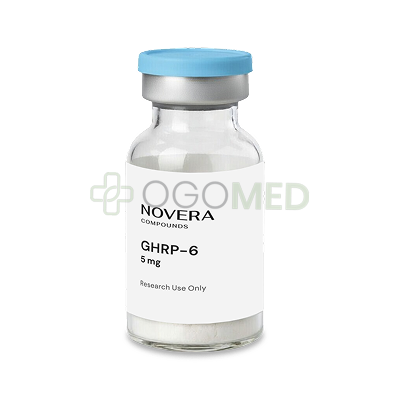
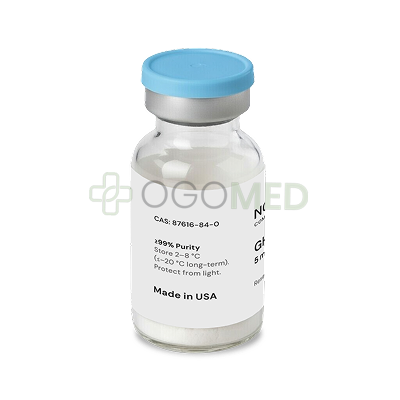
Novera GHRP-6
In Stock
| Category: | Peptides |
| Brand | Novera |
| Strength | 5mg |
| Form | Lyophilized powder |
| Purity (%) | ≥99 |
| CAS number | 87616-84-0 |
| Chemical Formula | C₄₆H₅₆N₁₂O₆ |
| Molecular weight | 873.0 |
| Synonyms | Growth-Hormone-Releasing-Peptide-6, Hexapeptide-GHRP6 |
| Peptide sequence | His-D-Trp-Ala-Trp-D-Phe-Lys-NH₂ |
| Storage | Store at 2-8 °C. Protect from light and moisture |
| Shelf Life (lyophilized) | 18-24 months |
| Shelf Life (after reconstitution) | 14-21 days |
Learn more...
With peptide research and endocrine science continuously evolving, GHRP-6 has gained significant attention as one of the most studied growth hormone-releasing peptide compounds. Recognized for its ability to interact with specific hormonal pathways involved in growth hormone regulation, this synthetic peptide has become an important subject of investigation in studies focused on pituitary signaling, metabolic processes, recovery mechanisms, and endocrine function.
The GHRP-6 (Novera) formulation offered through OGOMED is developed as a high-purity (greater than 98%), research-grade peptide intended exclusively for qualified laboratories, scientific institutions, and professional researchers. It is not manufactured for personal use, self-administration, human consumption, or veterinary applications. Instead, it is designed for controlled scientific research, analytical testing, and laboratory-based investigations where reliability, purity, and consistency are essential.
GHRP-6 is widely examined because of its ability to stimulate growth hormone release through interaction with the ghrelin receptor pathway. Compared with other compounds in the growth hormone secretagogue category, GHRP-6 remains a valuable research tool due to its established role in studying hormonal regulation and growth hormone secretion patterns.
The Novera GHRP-6 formulation focuses on quality control, molecular stability, and dependable batch performance, providing researchers with a consistent peptide material determined for experimental protocols and potential future use.
Note:
GHRP-6 is not approved for general therapeutic use by regulatory organizations such as the FDA. It should not be used for bodybuilding, athletic enhancement, anti-aging purposes, or any personal treatment outside authorized research environments. The compound is intended only for scientific investigation under appropriate laboratory conditions.
What Is GHRP-6 (Growth Hormone Releasing Peptide-6)
GHRP-6 (Growth Hormone Releasing Peptide-6, also known as growth hormone releasing hexapeptide and a ghrelin receptor agonist) is a synthetic hexapeptide belonging to the class of growth hormone secretagogues. It was developed through research into compounds capable of activating pathways responsible for stimulating endogenous growth hormone production. GHRP-6 has a molecular mass of 873 Dalton.
Unlike externally supplied growth hormone, GHRP-6 works by signaling the body’s own endocrine system to increase growth hormone secretion. Its primary mechanism involves interaction with the growth hormone secretagogue receptor (GHS-R1a), also known as the ghrelin receptor, which is located primarily in areas involved in hormonal regulation, including the pituitary gland and hypothalamus.
Through receptor activation, GHRP-6 can promote the release of growth hormone in a pulsatile manner. This makes it an important compound in scientific research exploring natural hormone secretion patterns and the relationship between growth hormone signaling and physiological processes.
The molecular structure of GHRP-6 consists of six amino acids arranged into a compact peptide chain. This relatively small structure allows researchers to examine receptor-mediated activity and investigate the biological effects associated with growth hormone stimulation.
Note:
Having actions at both pituitary and hypothalamic sites, GHRP-6 is frequently studied in relation to appetite regulation, metabolic signaling, sleep-related hormone patterns, and growth hormone pathways. However, these areas remain research topics rather than approved therapeutic applications.
Key Scientific Characteristics
GHRP-6 is classified as a synthetic growth hormone secretagogue and has been investigated extensively due to several important biochemical properties:
- Synthetic hexapeptide structure designed to activate growth hormone secretagogue pathways;
- Ability to stimulate GH release and growth hormone secretion through GHS-R1a receptor interaction;
- Research association with ghrelin-related signaling mechanisms;
- Potential influence on growth hormone pulsatility in experimental models;
- Investigational relevance in endocrine, metabolic, and recovery-related studies;
- Non-steroidal peptide structure with receptor-based biological activity.
These characteristics make GHRP-6 a valuable research compound for studying growth hormone regulation, endocrine communication, tissue maintenance mechanisms, and metabolic processes.
Note:
Research involving GHRP-6 continues to explore its relationship with growth hormone signaling, appetite pathways, and anabolic processes. Results may vary depending on study design, experimental model, and research conditions.
Composition of GHRP-6 (Novera)
The GHRP-6 (Novera) molecular formula is produced under controlled laboratory standards designed to maintain purity, structural accuracy, and consistency between production batches. The peptide is intended solely for research applications and undergoes analytical verification to confirm quality parameters. A typical GHRP-6 formulation includes:
- Active ingredient: GHRP-6 synthetic growth hormone-releasing peptide;
- Purity level: Typically above 98% based on validated laboratory analysis;
- Physical form: Lyophilized (freeze-dried) peptide powder prepared for laboratory reconstitution;
- Storage conditions: Controlled refrigerated storage before preparation;
- Quality verification: Batch-specific testing for peptide identity, purity, and structural confirmation.
The Novera approach emphasizes reproducibility and traceability, allowing researchers to work with a dependable peptide compound suitable for controlled experimental environments.
Note:
GHRP-6 is often researched alongside other growth hormone-related peptides to examine combined effects on endocrine signaling pathways. Such combinations remain within the scope of laboratory investigation only.
Mechanism of Action
GHRP-6 functions by activating pathways associated with ghrelin receptor signaling. The peptide binds to the growth hormone secretagogue receptor GHS-R1a, triggering intracellular signaling processes that influence the secretion of growth hormone from the pituitary gland.
Following receptor activation, the pituitary may release growth hormone in a pattern resembling natural hormonal pulses. This mechanism allows researchers to examine how synthetic peptides can influence endocrine communication without directly replacing naturally produced hormones.
Scientific research suggests that GHRP-6 may:
- Encourage pituitary growth hormone release by acting directly on pituitary somatotrophs;
- Influence natural hormone secretion rhythms;
- Activate ghrelin-associated signaling pathways;
- Affect metabolic and anabolic research markers;
- Support investigation of recovery-related biological mechanisms.
GHRP-6 is considered a secretagogue rather than a hormone replacement compound. Its role is to stimulate endogenous hormone pathways rather than introduce external growth hormone into the system.
Note:
GHRP-6 is not the same as stability lyophilized growth hormone. While the first is a synthetic GH-releasing peptide that stimulates the body’s natural GH secretion pathways, the second one is the actual freeze-dried growth hormone molecule itself, which makes them fundamentally different compounds.
Research Applications and Indications
GHRP-6 is frequently used in laboratory research involving endocrine regulation, metabolism, and physiological signaling. Because of its ability to influence growth hormone pathways, it has become an important compound in experimental studies.
Common research applications include:
- GH secretion analysis;
- Pituitary function and endocrine pathway research;
- Metabolic regulation studies;
- Tissue recovery and regeneration models (namely, GHRP-6 has been studied for improving collagen synthesis);
- Aging-related hormonal research;
- Investigation of anabolic signaling pathways.
Researchers also examine GHRP-6 in comparison with other GH secretagogues to better understand differences in receptor interaction, hormonal response, and biological activity.
Note:
It is important to mention that GHRP-6 does not contain a non-glycosylated polypeptide chain since it is a synthetic hexapeptide with small molecular mass that acts as a GH secretagogue which does not consist of the GH protein structure.
Observed and Expected Research Outcomes
Experimental investigations involving GHRP-6 have reported various biological observations. These outcomes depend heavily on research methodology, model system, and experimental parameters.
Reported areas of study include:
- Increased GH release in experimental models;
- Changes in ghrelin-related signaling activity;
- Alterations in appetite-associated pathways;
- Investigation of metabolic regulation mechanisms;
- Effects on tissue-related biological processes.
It is important to recognize that these findings represent research observations and do not establish approved medical benefits or therapeutic outcomes in humans.
GHRP-6 Peptide and Metabolic Signaling Research
Beyond growth hormone stimulation, GHRP-6 is investigated for its possible relationship with broader metabolic pathways. Since growth hormone interacts with energy metabolism, protein synthesis, and tissue maintenance, researchers use GHRP-6 as a tool to explore these interconnected systems.
Scientific investigations commonly examine:
- Interaction between GH and IGF-1 signaling;
- Energy utilization and metabolic regulation;
- Protein synthesis-related pathways;
- Hormonal feedback mechanisms;
- Endocrine changes associated with aging models.
Its receptor-based activity makes GHRP-6 useful for studying specific GH-related processes within controlled research settings.
Handling and Storage
As a peptide-based research material, a GHRP-6 (Novera) vial requires careful storage and handling procedures to preserve peptide stability. Recommended laboratory practices include:
- Storage at stable refrigerated temperatures before reconstitution;
- Protection from moisture, heat, and direct light;
- Avoidance of unnecessary freeze-thaw cycles (to prolong the life of a product, it is strongly recommended to prevent freeze thaw cycles);
- Use of appropriate sterile laboratory equipment;
- Dilution to H2O or other aqueous solutions;
- Proper sealing of containers after handling.
Having the product stored and administered in accordance with these recommendations helps maintain peptide integrity and ensures reliable experimental results.
Note:
For long-term storage of GHRP-6, it is recommended to add a carrier protein.
Ongoing Research Use of GHRP-6
GHRP-6 remains an important subject in peptide and endocrine research due to its established relationship with growth hormone secretagogue pathways. Researchers continue to investigate its role in understanding hormonal communication, metabolic regulation, and receptor-mediated signaling.
Current research discussions include:
- The function of ghrelin receptor activation in endocrine regulation;
- Comparisons between different growth hormone secretagogues;
- Growth hormone pulse regulation studies;
- Connections between hormonal pathways and metabolic processes.
Although GHRP-6 has been widely studied, it remains an investigational peptide and continues to be evaluated within scientific research frameworks.
Potential Side Effects
In research contexts, GHRP-6 is recognized as a bioactive peptide capable of influencing endocrine pathways. Because it interacts with growth hormone and ghrelin-related mechanisms, experimental studies have monitored various physiological responses.
Potentially observed effects include:
- Temporary appetite changes associated with ghrelin receptor activity;
- Fluid balance changes;
- Temporary sensations of warmth or flushing;
- Headache or discomfort reported in some research subjects;
- Local irritation following experimental administration methods.
Some studies also investigate possible interactions with glucose metabolism and insulin-related pathways due to the broader role of growth hormone in metabolic regulation.
The long-term safety profile of GHRP-6 has not been fully established, and the compound remains restricted to controlled research environments. Appropriate supervision, laboratory standards, and ethical research practices are required.
Note:
Unsupervised use of growth hormone secretagogues may result in unwanted hormonal effects and should not be undertaken outside professional research settings.
Why Researchers Choose GHRP-6 (Novera)
Researchers select GHRP-6 (Novera) because of its suitability for controlled peptide studies and its consistent laboratory characteristics. Key benefits of the peptide include:
- Reliable peptide purity;
- Consistent production standards;
- Suitability for endocrine research models;
- Established scientific relevance;
- Compatibility with laboratory investigation protocols.
These qualities make GHRP-6 (Novera) a useful compound for researchers studying growth hormone regulation and peptide-based biological pathways.
Order GHRP-6 Through OGOMED
GHRP-6 (Novera) represents a well-established peptide compound within the field of growth hormone and endocrine research. Its ability to activate specific secretagogue pathways continues to make it a valuable subject for scientific investigation, especially when it comes to hormonal regulation, metabolic signaling, and physiological mechanisms related to growth hormone activity. Through OGOMED’s website, GHRP-6 (Novera) and a wide variety of other research peptides are available for medical professionals at advantageous terms.
Note:
GHRP-6 belongs to synthetic secretagogues intended for professional use, which is why the use by non-professionals is strictly prohibited.
| Category: | Peptides |
| Brand | Novera |
| Strength | 5mg |
| Form | Lyophilized powder |
| Purity (%) | ≥99 |
| CAS number | 87616-84-0 |
| Chemical Formula | C₄₆H₅₆N₁₂O₆ |
| Molecular weight | 873.0 |
| Synonyms | Growth-Hormone-Releasing-Peptide-6, Hexapeptide-GHRP6 |
| Peptide sequence | His-D-Trp-Ala-Trp-D-Phe-Lys-NH₂ |
| Storage | Store at 2-8 °C. Protect from light and moisture |
| Shelf Life (lyophilized) | 18-24 months |
| Shelf Life (after reconstitution) | 14-21 days |
Learn more...