







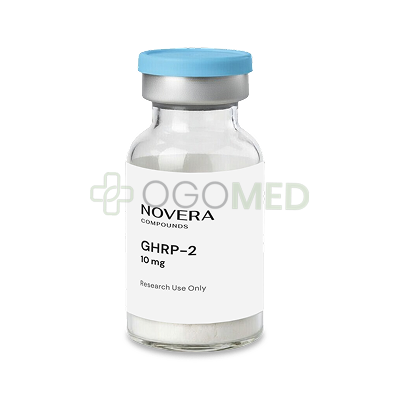
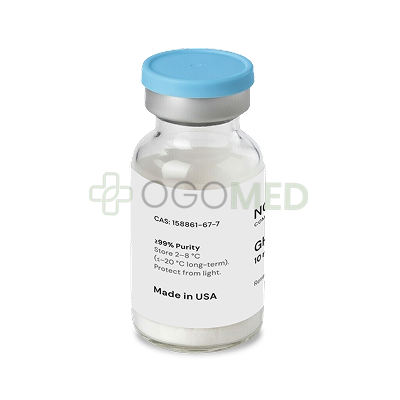
Novera GHRP-2
| Category: | Peptides |
| Brand | Novera |
| Strength | 10mg |
| Form | Lyophilized powder |
| Purity (%) | ≥99 |
| CAS number | 158861-67-7 |
| Chemical Formula | C₄₅H₅₅N₉O₆ |
| Molecular weight | 818.0 |
| Synonyms | Growth-Hormone-Releasing-Peptide-2, Pralmorelin |
| Peptide sequence | His-D-2-MethylTrp-Ala-Trp-D-Phe-Lys-NH₂ |
| Storage | Store at 2-8 °C. Protect from light and moisture |
| Shelf Life (lyophilized) | 18-24 months |
| Shelf Life (after reconstitution) | 14-21 days |
Learn more...
Novera GHRP-2 is a research-grade synthetic peptide supplied as 10 mg of lyophilized powder with a stated purity of at least 99%. Also known as pralmorelin or hormone releasing peptide 2, it is designed to stimulate endogenous GH release rather than supply recombinant growth hormone directly. The material is designated for laboratory research use and is not a finished medicine or approved self-administration product.
The listed specifications are:
- Brand: Novera;
- Strength: 10 mg;
- Form: lyophilized powder;
- Purity: ≥99%;
- CAS number: 158861-67-7;
- Molecular formula: C₄₅H₅₅N₉O₆;
- Molecular weight: approximately 818.0 g/mol;
- Sequence: His-D-2-MethylTrp-Ala-Trp-D-Phe-Lys-NH₂.
GHRP-2 is a hexapeptide, meaning that its sequence contains six amino acids. Batch identity can be assessed through methods such as HPLC and mass spectrometry.
How GHRP-2 Activates Growth Hormone Release
GHRP-2 functions as a ghrelin receptor agonist, primarily targeting the growth hormone secretagogue receptor GHS-R1a. Researchers suggested, that this target while discussing synthetic growth hormone secretagogue receptors, but the receptor itself is naturally expressed in the body. GHRP-2 is the synthetic ligand.
GHS-R1a is present in hypothalamic tissue and on anterior pituitary gland cells. Receptor activation initiates a signaling cascade involving G proteins, phospholipase C, and protein kinase C. This process raises intracellular calcium ions, encouraging secretory granules in pituitary cells to release stored GH.
The mechanism differs from that of native GHRH, another hypothalamic releasing hormone. GHRH more strongly engages adenylyl cyclase and cyclic adenosine monophosphate, whereas GHRP-2 works mainly through calcium-dependent signaling. Both systems can interact, which is why combined receptor activation may produce a larger experimental response than either signaling pathway alone.
Pulses, Peak Levels, and Endocrine Feedback
Natural GH release occurs in episodes rather than at a constant rate. GHRP-2 can amplify pulsatile growth hormone activity when functional somatotroph cells and hypothalamic control remain present. The resulting response depends on age, nutritional status, sex, body composition, sleep, baseline GH output, and somatostatin tone.
Common endocrine endpoints include:
- timing and amplitude of pulsatile GH secretion;
- changes in peak GH levels;
- total GH exposure during the sampling period;
- downstream insulin like growth factor I measurements;
- IGF binding protein concentrations;
- ACTH, prolactin, glucose, and cortisol levels.
A strong acute response does not necessarily mean a sustained elevation in daily hormone exposure or clinical improvement. GH is cleared quickly, and IGF-I is subject to feedback from the hypothalamus, pituitary, and peripheral tissues. Repeated stimulation may also produce different responses from a single challenge.
Research on Growth Hormone Deficiency
One established scientific application of GHRP-2 is examining pituitary secretory capacity. In Japan, pralmorelin has been used within a controlled diagnostic challenge for suspected growth hormone deficiency, but this medical test is not equivalent to using Novera powder. Clinical testing relies on a standardized formulation, supervised administration, timed blood collection, and validated interpretation thresholds.
The response can help distinguish severe secretory impairment from a partially functioning GH axis. Still, test performance may vary with hypothalamic-pituitary disease, age, obesity, glucose regulation, and other hormonal deficiencies. A laboratory result should therefore be interpreted within the wider endocrine picture rather than treated as a direct measure of general health.
Comparative studies have explored GH releasing peptide efficacies under different endocrine conditions. Some included hypogonadal males studied during an experimental hypogonadal clamp to examine interactions between sex steroids and GH secretion. Such work can reveal novel relationships between testosterone, estrogen, GH, and secretagogue responsiveness, but it does not establish an enhancement protocol.
Growth Hormone Releasing Peptide 2 Regulatory and Anti-Doping Status
GHRP-2 is included in the World Anti-Doping Agency Prohibited List under growth hormone-releasing factors and is prohibited for athletes at all times. Its regulatory status outside sport varies: pralmorelin is used as a controlled diagnostic agent in Japan, while GHRP-2 is not an FDA-approved prescription medicine in the United States. Novera GHRP-2 is supplied only as a research material and should not be described as a prescription product.
Health authorities warn against self-administering unregulated synthetic peptides because their identity, concentration, sterility, and contaminant levels may be uncertain. Products obtained outside regulated channels can contain incorrect amounts or undeclared substances, creating risks of contamination and dosing errors.
Appetite and Feeding Behavior
The ghrelin receptor also participates in appetite control. In a small crossover study of healthy men, GHRP-2 increases food intake compared with saline, while significantly raising circulating GH. The experiment appeared in the Journal of Clinical Endocrinology & Metabolism vol. 90,2 (2005) and was designed to study eating behavior, not long-term weight management.
Researchers examining appetite may measure:
- subjective increased hunger;
- meal size and eating duration;
- total energy consumption;
- selection of carbohydrate, fat, and protein;
- hypothalamic agouti related peptide activity;
- reward-driven food motivation.
Ghrelin-sensitive circuits communicate with the mesolimbic reward system, which connects feeding with motivation and reinforcement. This helps explain why GHRP-2 may influence food seeking even when immediate energy requirements are not high. Such responses complicate claims about fat reduction or improved physical composition. By increasing hunger and caloric intake, GHRP-2 may contribute to unintended weight gain.
Ghrelin Receptor Agonist Muscle Growth Performance
GH and IGF-I participate in protein turnover, connective-tissue remodeling, substrate use, and recovery from catabolic stress. These connections have generated interest in GHRP-2 and muscle growth, but direct human evidence for meaningful increases in strength or lean tissue remains limited. Raising a hormone marker does not prove improved growth performance.
Experimental endpoints may include nitrogen balance, muscle proteolysis, glucose handling, lipid oxidation, and activation of the IGF-I receptor. Researchers also examine whether GH-related signals activate protein kinase networks involved in transcription and protein synthesis. The outcome depends on nutrition, exercise, receptor sensitivity, and baseline endocrine function.
In growth-retarded yak models, GHRP-2 increased muscle-fiber diameter, reduced markers of muscle protein breakdown, and raised skeletal-muscle IGF-1 expression. These findings have not been confirmed in healthy humans.
GHRP-2 may indirectly affect gh production, but it does not replace sleep, adequate protein intake, resistance loading, or treatment of an underlying disease. Appetite stimulation can increase calorie intake, potentially affecting visceral adiposity if energy intake remains above expenditure. The metabolic result is therefore not predictably anabolic or fat-reducing.
Cellular and Vascular Experiments
GHS-R1a and related targets are present outside the pituitary. Studies have examined GHRP-2 in cardiovascular cells, immune tissues, and the nervous system, looking beyond its endocrine action. These findings concern individual experimental systems and should not be interpreted as evidence of cardiovascular treatment.
One mouse and cell-culture study evaluated:
- vascular superoxide production;
- macrophage uptake of oxidized low density lipoprotein;
- intracellular lipid accumulation;
- expression of pro inflammatory cytokines;
- atherosclerotic plaque coverage;
- survival signaling in vascular smooth-muscle cells.
In that work, GHRP-2 reduced some markers of vascular oxidative stress and decreased lipid loading in macrophages exposed to oxidized LDL. It also affected vascular expression of interferon gamma and macrophage migration inhibitory factors. However, the treatment did not reduce atherosclerosis itself, illustrating the difference between improving a cellular marker and changing disease outcome.
Immune and Neural Questions
Ghrelin-receptor signaling may interact with the immune system, inflammatory mediators, and autonomic regulation. Depending on the cell type, GHRP-2 may alter kinase activity, cytokine output, oxidative signaling, or survival responses. The synthetic peptide appears to have context-dependent actions rather than one uniform anti-inflammatory effect.
Animal studies have also asked whether GHRP-2 produces antinociceptive effects. Proposed mechanisms include central signaling and possible interaction with an opioid receptor, but these findings do not establish human pain relief. Endocrine changes, stress responses, and locomotor effects can complicate interpretation of pain-behavior assays.
The compound should not be confused with melanocyte stimulating hormone or its analogs, which act through melanocortin receptors. Although melanocortin and ghrelin circuits both influence appetite and energy balance, they represent distinct receptor systems and forms of cellular signaling.
Effects on Other Hormones
GHRP-2 is not completely selective for GH release. Human experiments have observed increases in ACTH, cortisol, and sometimes prolactin, particularly at stronger experimental exposures. These effects matter because a large GH response may occur alongside changes in the stress axis.
Androgen status may also modify endocrine responsiveness. Studies examining the androgen receptor and sex-steroid environment suggest that GH secretagogue responses cannot be interpreted independently of testosterone and estrogen. The significant role of these hormones may vary with age, sex, health status, and study design.
A valid control group is essential when assessing such changes. Stress from sampling, fasting, intravenous access, or unfamiliar surroundings can independently alter GH and cortisol. Without matched controls, an apparent response may reflect the study procedure as much as the test material.
Side Effects and Unresolved Risks
Regular medical supervision is necessary to monitor side effects of GHRP-2. A healthcare provider should conduct blood work before starting peptide therapy. Short controlled studies have reported flushing, warmth, sleepiness, headache, dizziness, nausea, abdominal discomfort, increased appetite, and transient changes in blood pressure or heart rate. Local irritation may occur when an injectable research design is used. Water retention, tingling, altered glucose control, prolactin elevation, and cortisol changes are also plausible consequences of GH-axis stimulation.
Important experimental risks include:
- excessive appetite or unintended changes in food intake;
- elevated cortisol, ACTH, or prolactin;
- impaired glucose regulation;
- fluid retention and swelling;
- hypersensitivity or immune reactions;
- microbial, endotoxin, or particulate contamination;
- incorrect identity or concentration;
- unknown effects of repeated exposure.
There is no dependable long-term safety dataset for Novera GHRP-2. Most mechanistic studies were short and designed around hormonal endpoints rather than chronic health outcomes. Findings from cells, rodents, or selected volunteers cannot establish safety for unsupervised use.
Storage and Laboratory Handling
The supplier specifies storage at 2-8°C with protection from light and moisture. The unopened lyophilized material has a listed shelf life of 18-24 months, while the stated period after reconstitution is 14-21 days. These figures depend on appropriate laboratory settings, intact packaging, and adherence to batch-specific documentation.
Reconstituted stability depends on solvent, concentration, pH, container material, and microbiological controls. Repeated warming, shaking, light exposure, and freeze-thaw cycles can damage the molecule even when the solution looks unchanged. Novera GHRP-2 should be handled only by qualified personnel in controlled experimental models, not used as a consumer injection or personal hormone regimen.
Where to Buy GHRP 2
For controlled laboratory work, OGOMed supplies Novera GHRP-2 as 10 mg of lyophilized material with a stated purity of at least 99%. The clearly identified sequence, strength, storage conditions, and batch-related specifications help researchers assess the material before ordering and maintain traceability throughout the planned study.
| Category: | Peptides |
| Brand | Novera |
| Strength | 10mg |
| Form | Lyophilized powder |
| Purity (%) | ≥99 |
| CAS number | 158861-67-7 |
| Chemical Formula | C₄₅H₅₅N₉O₆ |
| Molecular weight | 818.0 |
| Synonyms | Growth-Hormone-Releasing-Peptide-2, Pralmorelin |
| Peptide sequence | His-D-2-MethylTrp-Ala-Trp-D-Phe-Lys-NH₂ |
| Storage | Store at 2-8 °C. Protect from light and moisture |
| Shelf Life (lyophilized) | 18-24 months |
| Shelf Life (after reconstitution) | 14-21 days |
Learn more...