









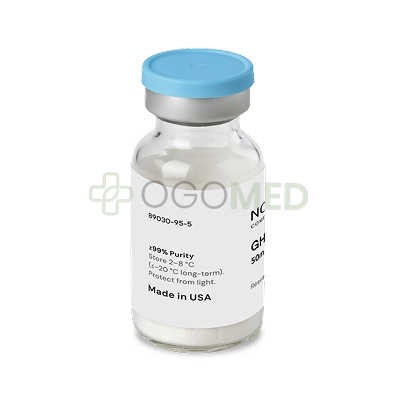
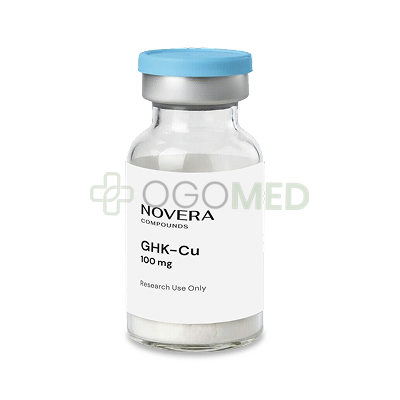
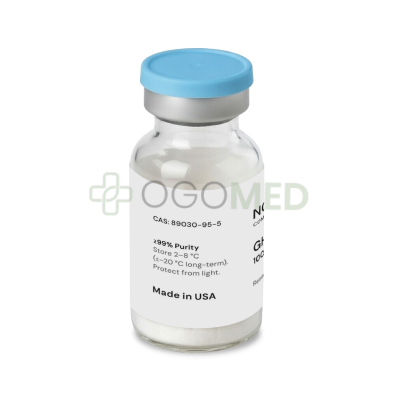
Novera GHK-Cu
| Category: | Peptides |
| Brand | Novera |
| Strength | 100mg, 50mg |
| Form | Lyophilized powder |
| Purity (%) | ≥99 |
| CAS number | 89030-95-5 |
| Chemical Formula | C₁₄H₂₄CuN₆O₄ |
| Molecular weight | 402.92 |
| Synonyms | Copper-peptide-GHK, Copper-tripeptide, GHK-Cu-complex, Tripeptide-1-Copper |
| Peptide sequence | Gly-His-Lys (Cu complex) |
| Storage | Store at 2-8 °C. Protect from light and moisture |
| Shelf Life (lyophilized) | 18-24 months |
| Shelf Life (after reconstitution) | 7-14 days |
Learn more...
GHK-Cu is a copper(II) complex of the tripeptide glycyl-L-histidyl-L-lysine, a naturally occurring compound first isolated from human plasma in the 1970s. Researchers study the peptide ghk cu for its regenerative and protective actions across tissue repair, lung inflammation, and oxidative stress pathway modulation in preclinical models. Nearly all controlled human work on this tripeptide is topical; the injectable format exists only in animal and cell-culture studies. The antioxidant and anti-inflammatory activity reported for the complex comes from rodent lung, wound and emphysema models, not from human trials.
Novera GHK-Cu is supplied as a lyophilized research compound for laboratory research use only. It is not an approved drug or medicine, and no regulatory authority has authorized injectable GHK-Cu for therapeutic use in humans. GHK-Cu is not approved by the FDA for injection or therapeutic use, and there are no established clinical trials for the safety of injectable GHK-Cu.
What Novera GHK-Cu Is
The compound belongs to the class of copper peptides and consists of the tripeptide gly his lys coordinated to a single copper(II) ion in a 1:1 ratio. GHK-Cu is synthesized as a copper(II) complex where Cu binds through the imidazole nitrogen of histidine, the terminal amine of glycine, and the carbonyl oxygen of the peptide backbone. This coordination geometry distinguishes it from free GHK peptide, which lacks the metal center and shows weaker activity in several bioassays. The endogenous form circulates in human plasma at roughly 200 ng/mL in young adults, with concentrations declining in older populations according to data compiled by Pickart L and colleagues.
GHK-Cu is composed of glycine, histidine, and lysine, three amino acids that form the tripeptide backbone. Unlike larger copper-binding proteins such as ceruloplasmin or albumin, this molecule is small enough to permeate tissue layers in animal wound models, a property that makes it practical for injection-based preclinical work. Researchers evaluating ghk cu copper peptide biology often compare the complexed form against the metal-free tripeptide to isolate copper-dependent effects on collagen synthesis, fibroblast migration, and gene expression.
Why Researchers Study GHK-Cu
The compound modulates several well-characterized pathways: it activates the Nrf2/Keap1 axis for reducing oxidative stress pathway activation, suppresses NF-κB-mediated inflammatory signaling, and alters TGF-β1/Smad2/3 cascades involved in fibrosis. These actions have been studied across multiple animal models, generating new gene data on how a single small molecule can shift broad transcriptional programs. Human data exist almost exclusively for topical formulations; the injectable research format targets a different set of questions about systemic distribution and organ-level effects.
Wound Repair and Extracellular Matrix Remodeling
The wound-chamber paper is Maquart, F. X., et al. (1993) in the Journal of Clinical Investigation, not the 1988 FEBS Letters fibroblast-culture study with which it is routinely confused. Stainless steel mesh cylinders were implanted subcutaneously in rats and injected with saline or GHK-Cu; the GHK-Cu chambers showed concentration-dependent increases in dry weight, DNA, total protein, collagen and glycosaminoglycan, with type I and type III collagen mRNA raised but TGF-beta mRNA unchanged. A control tripeptide, L-glutamyl-L-histidyl-L-proline, had no significant effect. No equivalent human injection study exists.
“The stimulation of collagen synthesis was twice that of noncollagen proteins.” Maquart et al., 1993, Journal of Clinical Investigation.
Lung Inflammation and Fibrosis Models
In a 2017 study in Frontiers in Pharmacology, Zhou, X. M., et al. gave C57BL/6 mice intraperitoneal GHK at 2.6, 26 and 260 µg/ml/day on alternate days from day 4 to day 21 after intratracheal bleomycin, and reported reduced fibrosis with suppression of TGF-β1/Smad-mediated epithelial-to-mesenchymal transition and a shifted MMP-9/TIMP-1 ratio. The compound decreased collagen deposition, epithelial-mesenchymal transition markers, and inflammatory cell infiltration in a dose-dependent manner.
The lipopolysaccharide acute lung injury work is Park, J. R., et al. (2016) in Oncotarget, not the “Dou 2017” citation that circulates alongside it. GHK-Cu reduced reactive oxygen species production, raised superoxide dismutase activity and lowered TNF-α and IL-6 through suppression of NF-κB p65 and p38 MAPK, in RAW 264.7 macrophages in vitro and in mice in vivo, and it reduced inflammatory cell infiltration into the lung parenchyma. These findings are animal and cell-culture only.
“GHK-Cu possesses a protective effect in LPS-induced ALI by inhibiting excessive inflammatory responses.” Park et al., 2016, Oncotarget.
Oxidative Stress and Antioxidant Pathways
Zhang, Q., et al. (2022, Frontiers in Molecular Biosciences) exposed C57BL/6J mice to cigarette smoke for 12 weeks and injected GHK-Cu intraperitoneally at 0.2, 2 or 20 µg/g/day on alternate days from day 1, reporting attenuated emphysematous change, a partially reversed MMP-9/TIMP-1 imbalance, lower MPO and MDA activity and restored total antioxidant capacity and glutathione, alongside reduced NF-κB expression.
“GHK-Cu reduced the inflammation and oxidation by decreasing the expression of inflammatory cytokines (IL-1β and TNF-α) in the bronchoalveolar lavage.” Zhang et al., 2022, Frontiers in Molecular Biosciences.
Cognitive Function in Aging Models
A 2026 preprint from Mazzola and colleagues, posted on Research Square and not yet peer reviewed, gave aged C57BL/6J mice (20 to 21 months) GHK-Cu at 15 mg/kg intraperitoneally for 5 days or intranasally for 8 weeks. The intraperitoneal route activated oxidative phosphorylation in hippocampal tissue; the intranasal route suppressed it, along with MYC target programs. The behavioural result was not symmetrical: intranasal dosing improved escape latency across trials in both sexes, while intraperitoneal dosing produced only a transient improvement in males on one trial and none in females. This work underscores that route of administration changes which pathways the peptide activates, a critical consideration for researchers planning injection studies.
Skin Biology and Topical Research Context
The human literature on this tripeptide is topical and small. Published studies on copper-peptide formulations report mixed results, are usually manufacturer-funded and have not been independently replicated. None of them bears on the injectable research format, because route determines distribution: the 2026 aged-mouse preprint showed two routes of the same compound driving opposite transcriptional programs in the same tissue.
How GHK-Cu Compares With Related Compounds
Several copper peptides appear in the research literature, and laboratories studying copper-dependent biology must choose between them based on the model system and pathway of interest. The table below summarizes how ghk cu differs from closely related compounds evaluated in published preclinical work.
| Feature | GHK-Cu | AHK-Cu (Alanyl-Histidyl-Lysine-Copper) | Free GHK (No Copper) |
|---|---|---|---|
| Core structure | Tripeptide Gly-His-Lys + Cu(II) complex | Tripeptide Ala-His-Lys + Cu(II) | Tripeptide Gly-His-Lys, no metal |
| Primary research targets | NF-κB, Nrf2, TGF-β, ECM remodeling | Hair follicle stimulation, skin ECM | Copper-independent peptide signaling |
| Published injection models | Rat wound, mouse lung injury, mouse fibrosis, aged mouse cognition | Limited; mainly topical and in vitro | Some wound models without copper |
| Evidence volume | Largest among copper peptides; multiple species and organ systems | Smaller body of literature, mostly dermal | Moderate; used as control for copper-dependent effects |
| Typical lab use | Systemic injection studies, mechanistic pathway work | Hair and beauty biology assays | Negative control or copper-free comparison arm |
Researchers investigating systemic tissue repair, lung disease models, or neurobiology tend to select GHK-Cu because it has the broadest preclinical evidence base across injectable protocols. Laboratories focused on hair follicle or scalp biology sometimes prefer AHK-Cu, while free GHK serves as a control to determine whether observed effects require the copper ion. Selection depends on whether the experiment aims to study copper-dependent pathways or peptide-only signaling, and on the species and injection route planned.
What Research on GHK-Cu Does Not Establish
There are no established clinical trials for the safety of injectable GHK-Cu. All controlled human studies identified in the literature use topical application: creams, gels, or serum formulations applied to skin. No published randomized trial has evaluated systemic or injectable GHK-Cu in human subjects for any indication, whether tissue repair, fibrosis, inflammation, or cosmetic improvement. Claims about injectable GHK-Cu treating disease, reversing aging, or serving as a cure for any condition are unsupported by human evidence.
The copper is the unexamined variable. Every injection delivers copper(II) as well as peptide, and the two are rarely separated in vivo. Where they have been separated in vitro, the copper carried the effect: Siméon et al. (2000, Life Sciences) found that GHK-Cu raised MMP-2 levels and MMP-2 mRNA in cultured dermal fibroblasts, and that copper ions alone reproduced it while the metal-free tripeptide did not. No pharmacokinetic profile has been published for the complex in any species, and exposure beyond 12 weeks has not been studied.
“This effect was reproduced by copper ions but not by the tripeptide GHK alone.” Siméon et al., 2000, Life Sciences.
The direction of effect on matrix turnover is also unsettled. Siméon 2000 reports GHK-Cu raising MMP-2 while also raising TIMP-1 and TIMP-2, and Badenhorst and colleagues reported increased MMP-1 and MMP-2 at the lowest concentration tested. Concentration cannot be treated as a monotonic variable in experimental design, and a page that presents the peptide as straightforwardly matrix-preserving is wrong.
Claims circulating online about systemic rejuvenation, reversing hair loss by injection, or cosmetic effect through subcutaneous delivery have no published support of any kind. Nor is there a dose-response relationship for the injectable form in any species: the three published rodent injection studies used 2.6-260 µg/ml/day, 0.2-20 µg/g/day and 15 mg/kg, in three different units, three different models and three different schedules, which is not a dataset that can be compared or scaled.
Where to Buy Novera GHK-Cu
Laboratories and licensed professionals searching for where to buy ghk-cu peptide injection for preclinical studies can purchase Novera GHK-Cu directly from this product page. GHK-Cu is available in lyophilized powder form, ready for reconstitution by trained laboratory staff according to institutional protocols. No auxiliary reagents, buffers, diluents, or injection equipment are included; labs must supply these according to their own experimental procedures.
-
Estimated delivery time 3 to 7 days.
-
Free shipping on orders over $750.
-
All US import fees and tariffs are covered by Ogomed, so the buyer pays nothing extra; customs checks under the new US import rules can add a little time to delivery.
-
Price match: if the same product is listed for less elsewhere, Ogomed will try to match it.
-
Support by phone +1-650-457-5621 and email, 10am to 6pm EST.
-
Sold to licensed professionals, for laboratory research use only.
Novera GHK-Cu is sold exclusively to licensed professionals for laboratory research use only and is not intended for human administration, cosmetic application, or veterinary treatment.
References
- Maquart, F. X., et al. (1993). In vivo stimulation of connective tissue accumulation by the tripeptide-copper complex glycyl-L-histidyl-L-lysine-Cu2+ in rat experimental wounds. Journal of Clinical Investigation, 92(5), 2368-2376. DOI: 10.1172/JCI116842
- Siméon, A., et al. (2000). The tripeptide-copper complex glycyl-L-histidyl-L-lysine-Cu2+ stimulates matrix metalloproteinase-2 expression by fibroblast cultures. Life Sciences, 67(18), 2257-2265. DOI: 10.1016/S0024-3205(00)00803-1
- Pickart, L., et al. (2012). The human tripeptide GHK-Cu in prevention of oxidative stress and degenerative conditions of aging: implications for cognitive health. Oxidative Medicine and Cellular Longevity, 2012, 324832. DOI: 10.1155/2012/324832
- Park, J. R., et al. (2016). The tri-peptide GHK-Cu complex ameliorates lipopolysaccharide-induced acute lung injury in mice. Oncotarget, 7(36), 58405-58417. DOI: 10.18632/oncotarget.11168
- Zhou, X. M., et al. (2017). GHK peptide inhibits bleomycin-induced pulmonary fibrosis in mice by suppressing TGF-beta1/Smad-mediated epithelial-to-mesenchymal transition. Frontiers in Pharmacology, 8, 904. DOI: 10.3389/fphar.2017.00904
- Zhang, Q., et al. (2022). Glycyl-L-histidyl-L-lysine-Cu2+ attenuates cigarette smoke-induced pulmonary emphysema and inflammation by reducing oxidative stress pathway. Frontiers in Molecular Biosciences, 9, 925700. DOI: 10.3389/fmolb.2022.925700
GHK-Cu is a copper(II) complex of the tripeptide gly-his-lys, a naturally occurring compound isolated from human plasma. Researchers use the synthesized form in laboratory settings to study tissue repair, oxidative stress pathways, collagen biology, and gene expression modulation. It is not an approved medicine or cosmetic injectable.
The molecule binds copper(II) through coordination with histidine, glycine, and lysine residues, enabling it to influence pathways including NF-κB inflammatory signaling, the Nrf2/Keap1 antioxidant axis, and TGF-β1/Smad2/3 fibrotic cascades. In cell culture and rodent models, this combination of activities shifts transcriptional programs toward ECM remodeling and reduced inflammation. These mechanisms have been evaluated in published preclinical work, not in human injection trials.
Rodent injection studies report measurable changes in collagen deposition, inflammatory cytokine levels (TNF-α, IL-6), and lung injury scores compared with untreated controls. All of these findings come from animal experiments, primarily in mice and rats, and do not constitute evidence of clinical efficacy in humans.
GHK-Cu has the largest published evidence base among copper peptides for injection-route preclinical work, spanning wound, lung, and cognitive models. AHK-Cu is studied primarily for hair follicle and dermal applications with a smaller literature. Selection depends on the target pathway, species, and whether the experiment requires copper-dependent signaling.
Published protocols include intraperitoneal injection in mice for bleomycin induced pulmonary fibrosis and LPS-induced acute lung injury, intradermal injection in rat wound-chamber models for ECM accumulation studies, and intraperitoneal or intranasal delivery in aged mice for hippocampal cognition work. All models are conducted by trained personnel within institutional animal ethics guidelines.
No controlled human trial has tested injectable or systemic GHK-Cu for safety or efficacy. Long-term copper accumulation risks from repeated dosing are unstudied beyond 12-week rodent protocols. Large-animal data is absent, and the field lacks standardized dosing guidelines for any injectable application.
No. GHK-Cu is not named anywhere on the 2026 WADA Prohibited List and it does not fall into a listed class such as S2.3, Growth Factors and Growth Factor Modulators. Note that S0, Non-Approved Substances, is a catch-all for substances without current human-therapeutic approval and is not limited to the compounds it names.
Licensed professionals looking to buy ghk-cu peptide for injection-model research can order Novera GHK-Cu directly from this page. The compound ships within the estimated delivery window to qualified buyers for laboratory research use only. Contact support by phone or email for volume inquiries.
| Category: | Peptides |
| Brand | Novera |
| Strength | 100mg, 50mg |
| Form | Lyophilized powder |
| Purity (%) | ≥99 |
| CAS number | 89030-95-5 |
| Chemical Formula | C₁₄H₂₄CuN₆O₄ |
| Molecular weight | 402.92 |
| Synonyms | Copper-peptide-GHK, Copper-tripeptide, GHK-Cu-complex, Tripeptide-1-Copper |
| Peptide sequence | Gly-His-Lys (Cu complex) |
| Storage | Store at 2-8 °C. Protect from light and moisture |
| Shelf Life (lyophilized) | 18-24 months |
| Shelf Life (after reconstitution) | 7-14 days |
Learn more...