
Content
An Evenity injection is a monthly subcutaneous dose of romosozumab-aqqg: 210 mg given as two 105 mg prefilled-syringe shots, one after the other, for a maximum of 12 months. Prolia (denosumab) is a single 60 mg subcutaneous injection given once every 6 months for as long as treatment is warranted. Both are Amgen biologics for osteoporosis, but they work in opposite directions: Evenity builds new bone, while Prolia stops existing bone from being broken down.
That difference drives almost every practical question clinicians and patients ask: how often the shots are given, how long therapy lasts, what happens when it stops, and which drug should come first. This article compares Evenity and Prolia on mechanism, dosing, injection sites, trial results, boxed warnings and sequencing, using the current FDA prescribing information and the pivotal trials as sources.
One point causes frequent confusion in searches: Evenity is not an infusion. It is never given intravenously. Each monthly visit consists of two quick subcutaneous injections administered by a healthcare provider.

Evenity contains romosozumab-aqqg, a humanized monoclonal antibody that binds sclerostin. Sclerostin is a protein made by osteocytes that brakes bone formation. Blocking it has a dual effect: bone formation rises sharply, and bone resorption falls. That makes Evenity an anabolic (bone-building) agent, in the same broad group as teriparatide and abaloparatide, rather than an antiresorptive like Prolia or the bisphosphonates.
According to the Evenity prescribing information, the drug is indicated for postmenopausal women with osteoporosis at high risk for fracture, defined as a history of osteoporotic fracture, multiple risk factors, or failure of or intolerance to other osteoporosis therapy. It is not approved for men or for glucocorticoid-induced osteoporosis in the United States.
The dose is fixed. Each month the patient receives 210 mg, which requires two separate 105 mg/1.17 mL prefilled syringes injected subcutaneously one after the other. There is no higher “double dose” option: 210 mg is the standard monthly dose. Therapy is capped at 12 monthly doses because the bone-building response fades over time.
“The anabolic effect of EVENITY wanes after 12 monthly doses of therapy.” FDA, Evenity Prescribing Information (DailyMed)
The word “infusion” appears in many searches, likely because many osteoporosis drugs given in clinics (such as zoledronic acid) are IV infusions. Evenity is different: the whole monthly appointment involves two short subcutaneous shots, with no IV line and no infusion chair. Patients take calcium and vitamin D throughout treatment.
Prolia contains denosumab, a fully human monoclonal antibody against RANK ligand (RANKL). RANKL is the signal that recruits and activates osteoclasts, the cells that resorb bone. By blocking it, Prolia sharply suppresses bone turnover, which allows bone mineral density (BMD) to rise and fracture risk to fall. It does not build new bone the way Evenity does.
The Prolia prescribing information lists a broader set of indications than Evenity:
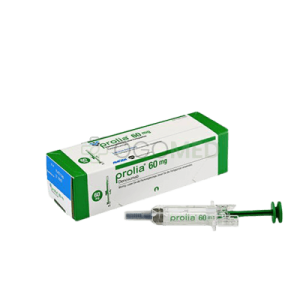
The dose is 60 mg as a single subcutaneous injection once every 6 months, given by a healthcare provider, with daily calcium 1000 mg and at least 400 IU vitamin D. Prolia is contraindicated in hypocalcemia (which must be corrected first), in pregnancy, and in patients with known systemic hypersensitivity to the product. Pregnancy must be ruled out in women of reproductive potential before Prolia is given. Licensed practices can order Prolia through ogomed after license verification.
 Orthopedics products
17 products available
Explore our Orthopedics products collection and browse available products.
View category
The table summarizes the FDA labeling for both drugs. Numbers on fracture reduction come from each drug’s pivotal placebo-controlled trial and are not head-to-head comparisons.
| Feature | Evenity (romosozumab-aqqg) | Prolia (denosumab) |
|---|---|---|
| Drug class | Sclerostin inhibitor (anabolic) | RANKL inhibitor (antiresorptive) |
| FDA approval | 2019 | 2010 |
| Dose per visit | 210 mg (two 105 mg/1.17 mL syringes) | 60 mg (one 60 mg/1 mL syringe) |
| Injections per visit | 2 subcutaneous injections | 1 subcutaneous injection |
| Frequency | Once a month | Once every 6 months |
| Duration | Limited to 12 monthly doses | Long term while benefit outweighs risk |
| Injection sites | Abdomen, thigh or upper arm | Upper arm, upper thigh or abdomen |
| Who is it approved for | Postmenopausal women at high fracture risk | Postmenopausal women, men, glucocorticoid-induced osteoporosis, cancer-therapy bone loss |
| New vertebral fractures vs placebo | 73% lower at 12 months (FRAME) | 68% lower at 3 years (FREEDOM) |
| Boxed warning | Myocardial infarction, stroke, cardiovascular death | Severe hypocalcemia in advanced chronic kidney disease |
| Most common side effects | Arthralgia, headache | Back pain, arthralgia, pain in extremity, musculoskeletal pain |
| After stopping | BMD returns toward baseline within about 12 months without an antiresorptive | Rapid bone loss and risk of multiple vertebral fractures without an antiresorptive |
| Biosimilars in the US | None | Yes (first interchangeable biosimilars approved March 2024) |
The Evenity label lists three subcutaneous injection sites: the abdomen, the thigh, and the upper arm. Because each dose needs two injections, the provider gives both shots at the same visit, typically in different spots. Rotating sites from month to month helps limit local reactions. In the pooled trials, injection site reactions occurred in 4.9% of Evenity-treated women versus 2.8% of controls, mostly mild pain and redness, and led to discontinuation in only 0.1%.
Prolia uses the same three areas (upper arm, upper thigh, abdomen), but only one injection is given every 6 months. Older guidance that mentions the buttocks is not consistent with the current Prolia label.
If a monthly Evenity dose is missed, the label says to give it as soon as it can be rescheduled and then continue monthly from that date. For Prolia, timing matters even more: a delayed dose lets bone turnover rebound, so practices usually schedule the next injection at the 6-month mark and track it.
Why one drug is monthly and the other is every 6 months comes down to pharmacology. Evenity’s bone-forming signal peaks within weeks and needs regular redosing over a short, defined window. Denosumab stays active long enough to suppress osteoclasts for roughly 6 months after a single injection.
No randomized trial has compared Evenity directly with Prolia. The evidence comes from three large trials, all published in the New England Journal of Medicine.
FRAME (Evenity vs placebo). In this study of 7,180 postmenopausal women, published by Cosman and colleagues in 2016, new vertebral fractures occurred in 0.5% of the romosozumab group versus 1.8% of the placebo group at 12 months, a 73% lower risk. After both groups switched to denosumab, the vertebral fracture rate at 24 months stayed 75% lower in women who started with romosozumab (0.6% vs 2.5%). The reduction in nonvertebral fractures at 12 months was not statistically significant.
ARCH (Evenity vs alendronate). This trial enrolled 4,093 women with osteoporosis and a prior fragility fracture. Saag and colleagues reported in 2017 that 12 months of romosozumab followed by alendronate produced a 48% lower risk of new vertebral fractures at 24 months (6.2% vs 11.9%), a 27% lower risk of clinical fractures, and a 38% lower risk of hip fracture compared with alendronate alone. ARCH is also where the cardiovascular signal appeared (see the safety section below).
FREEDOM (Prolia vs placebo). In 7,868 women aged 60 to 90 years, Cummings and colleagues reported in 2009 that denosumab every 6 months for 36 months reduced new vertebral fractures from 7.2% to 2.3% (68% relative reduction), hip fractures from 1.2% to 0.7% (40%), and nonvertebral fractures from 8.0% to 6.5% (20%).
Bone density gains differ in speed. In FRAME, Evenity raised lumbar spine BMD by 12.7% more than placebo within 12 months, according to the label. Prolia’s gains accumulate more gradually, over years of continued dosing. This is why Evenity is usually framed as a short, intensive bone-building phase, and Prolia as a maintenance option.
The most common adverse reactions (5% or more) were arthralgia and headache. The serious concern is cardiovascular. In ARCH, adjudicated major adverse cardiac events occurred in 2.0% of women on Evenity versus 1.1% on alendronate (hazard ratio 1.87), which led to the boxed warning.
“EVENITY may increase the risk of myocardial infarction, stroke, and cardiovascular death” FDA, Evenity Prescribing Information (DailyMed)
Evenity should not be started in patients who had a myocardial infarction or stroke within the preceding year and should be stopped if one occurs during therapy. Other warnings include hypersensitivity reactions, hypocalcemia (a contraindication until corrected), osteonecrosis of the jaw and atypical femoral fractures. An Endocrine Society guideline update from 2020 considers romosozumab a treatment option for postmenopausal women at very high fracture risk, with careful attention to each woman’s cardiovascular risk profile.
Common adverse reactions in postmenopausal osteoporosis include back pain, pain in extremity, musculoskeletal pain, hypercholesterolemia and cystitis. In January 2024 the FDA added a boxed warning for severe hypocalcemia in patients with advanced chronic kidney disease (eGFR below 30 mL/min/1.73 m², including dialysis), where hospitalizations and deaths have been reported. The label asks clinicians to evaluate for chronic kidney disease-mineral and bone disorder before starting Prolia in these patients.
Prolia also carries warnings for serious infections, dermatologic reactions, osteonecrosis of the jaw, atypical femoral fractures and severe musculoskeletal pain. Its most important practical risk, however, is what happens when it is stopped.
Once the 12 Evenity doses are finished, the BMD it built is not permanent on its own. The label states that BMD returns to approximately baseline within 12 months if no antiresorptive follows, and directs clinicians to consider continued therapy with an antiresorptive agent. In FRAME, women went straight from romosozumab to denosumab and their BMD kept rising through month 24. In ARCH, alendronate served the same role. Zoledronic acid and other bisphosphonates are also used as follow-on agents. In FRAME, the first denosumab injection was given at month 12, directly after the romosozumab phase; in routine care the exact start date is a prescriber decision.
This “anabolic first, antiresorptive second” order is the reason a clinician may recommend 12 months of Evenity and then long-term Prolia for a woman at very high fracture risk.
Unlike bisphosphonates, denosumab is not retained in bone, so its effect fades once doses stop. After the last dose, bone turnover rises above pretreatment levels by about 9 months, and BMD returns to baseline within 18 months. New vertebral fractures have occurred as early as 7 months after the last dose, sometimes several at once.
“If Prolia treatment is discontinued, patients should be transitioned to an alternative antiresorptive therapy.” FDA, Prolia Prescribing Information (DailyMed)
Prolia is not tapered or “gradually reduced”; it is either continued on schedule or replaced by another antiresorptive.
Yes, it is done in practice, but the response is smaller. Evenity is not an antiresorptive, so on its own it does not fully cover the rebound after denosumab, and evidence on this order is mostly observational. In one 2026 prospective study from Japan, lumbar spine BMD rose 9.5% after 12 months of romosozumab in treatment-naive women but only 4.3% in women previously treated with denosumab. All groups then continued on denosumab. For this reason, many specialists prefer to start with Evenity in very high-risk patients rather than reach for it after years on Prolia.
Evenity suits postmenopausal women at very high fracture risk, especially after a recent fracture or with very low BMD, who have no myocardial infarction or stroke in the past year and can commit to 12 monthly visits with two injections each. It works fastest, but it is time-limited and must be followed by an antiresorptive. Prolia suits a wider group, including men, glucocorticoid users and patients on cancer hormone therapy, and offers twice-yearly dosing, but it requires a long-term commitment and a planned exit strategy. For many high-risk women the answer is not one or the other but both, in sequence: Evenity first, then Prolia.
The choice depends on fracture history, cardiovascular risk, kidney function, calcium status and the patient’s ability to keep a strict injection schedule. That decision belongs to the treating clinician.
Last updated: November 2026.
Evenity is an injection, not an infusion. Each monthly dose of 210 mg is given as two separate 105 mg subcutaneous injections from prefilled syringes, one right after the other, by a healthcare provider. No IV line is used. Treatment lasts a maximum of 12 monthly doses, after which an antiresorptive medicine is usually started to keep the bone gained.
Evenity is injected under the skin of the abdomen, the thigh or the upper arm, according to the FDA label. Because every dose needs two injections, both are given at the same visit, usually in different spots. Injection site reactions such as mild pain or redness were reported in 4.9% of women in clinical trials, compared with 2.8% in control groups.
Neither drug is better for every patient, and they have never been compared head to head. Evenity builds bone quickly and cut new vertebral fractures by 73% versus placebo in 12 months, but it is limited to one year and carries a cardiovascular boxed warning. Prolia is an antiresorptive with broader indications and twice-yearly dosing that can be used long term.
Yes, romosozumab can be started after denosumab, but the bone density response tends to be smaller. In a 2026 prospective study from Japan, lumbar spine BMD rose 4.3% after 12 months of Evenity in women previously on denosumab, versus 9.5% in treatment-naive women. Stopping Prolia also requires continued antiresorptive cover, so the switch is planned by a specialist.
Prolia or another antiresorptive is normally started right after the 12-month Evenity course ends. In the FRAME trial, denosumab was given at month 12, immediately after the last romosozumab phase, and bone density kept rising through month 24. Without follow-on therapy, the Evenity label notes that BMD returns to about baseline within 12 months.
No. There is no generic or biosimilar romosozumab approved in the United States, so Evenity is available only as the Amgen brand. Prolia is different: the FDA approved the first interchangeable denosumab biosimilars in March 2024. Out-of-pocket cost for either drug depends on the patient’s insurance plan and on manufacturer support programs.