
Content
Euflexxa vs Orthovisc comes down to small but practical differences, because no randomized trial has compared the two products directly and neither has been shown to work better than the other. Both are FDA-approved hyaluronic acid (HA) injections for knee osteoarthritis (OA) pain. Euflexxa delivers 20 mg of non-cross-linked sodium hyaluronate in 2 mL as three weekly injections; Orthovisc delivers 30 mg in 2 mL as three or four weekly injections.
The other differences are in the details that matter to clinics: where the HA comes from, molecular weight, how many visits a course takes, the billing code, and how much placebo-controlled evidence each product has. Euflexxa has always been made by bacterial fermentation. Orthovisc was originally extracted from rooster combs, and the FDA approved a switch to bacterial fermentation in 2007, which is why older sources still describe it as avian.
This comparison is written for licensed practitioners and clinic buyers, with plain-language notes for patients comparing Orthovisc vs Euflexxa, and also covers how both stack up against Synvisc-One, including cost.

The table summarizes the US labeling for each product: the Euflexxa prescribing information (Ferring, Rev. 07/2016) and the Orthovisc labeling filed under PMA P030019, plus the FDA PMA database for approval dates.
| Feature | Euflexxa | Orthovisc |
|---|---|---|
| HA type | Sodium hyaluronate, not cross-linked | Sodium hyaluronate, not cross-linked |
| HA source | Bacterial fermentation (“extracted from bacterial cells”) | Rooster combs in the 2004 label; bacterial fermentation since PMA supplement S009 (October 2007) |
| Molecular weight | 2.4 to 3.6 million daltons | 1.0 to 2.9 million daltons (2004 label) |
| Concentration and dose per injection | 10 mg/mL; 20 mg in 2 mL | 15 mg/mL; 30 mg in 2 mL |
| Injections per course | 3, one week apart | 3 or 4, one week apart |
| Total HA per course | 60 mg | 90 mg (3 injections) or 120 mg (4 injections) |
| FDA approval | PMA P010029, December 3, 2004 | PMA P030019, February 4, 2004 |
| Manufacturer / distributor | Ferring Pharmaceuticals (PMA holder) | Anika Therapeutics; distributed in the US by J&J MedTech (Ortho Biotech in the 2004 label) |
| Avian allergy relevance | Not bird-derived | 2004 label contraindicated it for avian allergy; current HA is fermentation-derived, so check the current package insert |
| Common adverse events | Arthralgia, back pain, pain in extremity, joint swelling; device-related events 9.9% (saline 10.8%) | Arthralgia 12.6% (saline 17.2%), injection-site pain 2.5%, back pain, headache |
| Duration evidence | 26-week FLEXX trial; repeat course safety established up to 1 year | Pivotal studies followed patients to week 27/28; label does not establish more than one course |
| HCPCS code | J7323, per dose | J7324, per dose |
Orthovisc carries more HA per syringe, but more milligrams do not translate into a proven clinical advantage; no trial has tested whether the differences in concentration and molecular weight matter for patients. Note also that Euflexxa is fermentation-derived, not synthetic, as an earlier version of this page said.
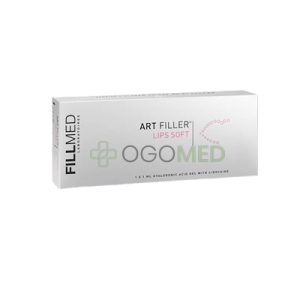
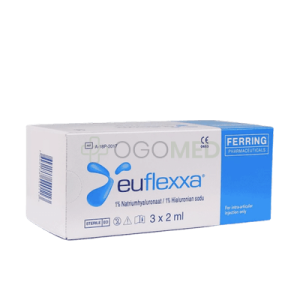
Euflexxa is a sterile, viscoelastic solution of highly purified, high molecular weight sodium hyaluronate in phosphate-buffered saline. Each prefilled syringe holds 20 mg in 2 mL, and the full course is three intra-articular injections one week apart. It was first approved by the FDA on December 3, 2004, under the name Nuflexxa, with Ferring Pharmaceuticals as the applicant, according to the FDA PMA database entry for P010029. Like every product in this class, it is regulated as a medical device, not a drug, so there is no generic Euflexxa.
The labeled indication is pain in knee OA in patients who have not responded adequately to conservative non-drug therapy and simple analgesics such as acetaminophen. The main evidence is the US FLEXX trial, in which 588 patients received either Euflexxa or saline and were followed for 26 weeks. The patient information summarizes the result this way:
“Study results showed significant improvement in osteoarthritis knee pain relief with EUFLEXXA therapy lasting up to 6 months.”
Ferring Pharmaceuticals, EUFLEXXA Patient Information (Rev. 07/2016)
The absolute difference over saline was modest (6.6 mm on a 100 mm pain scale), and the saline group also improved. The label states that the safety of repeated treatment cycles has been established up to 1 year, based on a second course given in the trial’s extension phase. Our full explainer on what Euflexxa injection is covers composition, administration steps and coverage in more detail, and licensed buyers can order Euflexxa 2 mL through a verified account.
 Orthopedics products
17 products available
Explore our Orthopedics products collection and browse available products.
View category
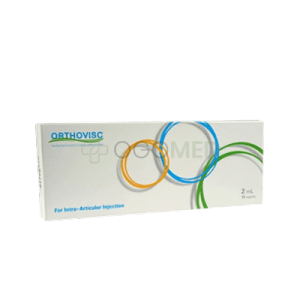
Orthovisc (full device name: Orthovisc High Molecular Weight Hyaluronan) is a sterile solution of sodium hyaluronate in physiological saline, made by Anika Therapeutics. Each 2 mL syringe contains 30 mg of hyaluronan and 18 mg of sodium chloride, with no synthetic additives, according to the PMA labeling. The FDA approved it on February 4, 2004, for the same knee OA indication as Euflexxa. The course is three or four injections one week apart, and the label is explicit about timing:
“Pain relief may not be seen until after the third injection.”
FDA, Orthovisc Labeling (PMA P030019)
The HA source needs a careful answer. The 2004 labeling states that the hyaluronan was extracted from rooster combs and lists allergy to avian products, including eggs, feathers and poultry, as a contraindication. On October 26, 2007, the FDA approved PMA supplement P030019/S009, which changed the manufacturing process to one that produces sodium hyaluronate from bacterial fermentation, and Anika now describes Orthovisc as fermentation-derived. The fermentation switch is documented; the current allergy wording should be confirmed on the package insert. The comparison of Orthovisc vs Synvisc walks through this history and Orthovisc’s trial data in more detail.
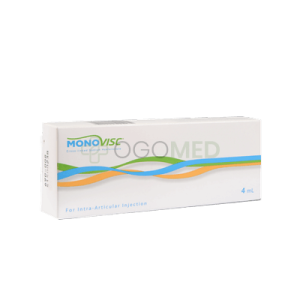
Orthovisc is also the parent of Monovisc, Anika’s single-injection product made from the same fermented HA but cross-linked and given as one 4 mL injection. Clinics weighing “Monovisc vs Euflexxa” are really choosing between one visit and three. Licensed buyers can buy Orthovisc through the same catalog.
No direct comparison. A search of PubMed for trials naming both products found reviews, rheology studies and claims-database analyses, but no randomized trial of Euflexxa against Orthovisc. Any statement that one is clearly better is therefore an inference from separate trials with different designs, patients and comparators.
Placebo-controlled evidence. Euflexxa’s FLEXX trial, published in Seminars in Arthritis and Rheumatism in 2009, met its primary endpoint against saline at 26 weeks. Orthovisc’s two pivotal trials did not reach significance on their own primary analyses; FDA approval rested on a combined analysis of patients with grade II or III OA. A 2021 systematic review of US-approved HA products in Cartilage reported that efficacy was consistently shown for Supartz, Monovisc and Euflexxa, but not for Hyalgan, Orthovisc and Durolane. The authors disclosed personal fees from Sanofi, which makes Synvisc.
Active-comparator evidence. In a double-blind German trial of 321 patients published in Osteoarthritis and Cartilage in 2006, Euflexxa was non-inferior to an avian-derived, cross-linked HA over 12 weeks, with WOMAC pain improving by 29.8 mm and 28.8 mm. Orthovisc’s only randomized active comparison is a 92-patient trial against hylan G-F 20 (Synvisc), which found no significant difference over 52 weeks. Both products have therefore held up against the same reference product, in separate small trials.
Real-world data. Two US claims analyses included both brands, and both were industry-funded. In a 50,389-patient analysis in Drugs in Context (2016), funded by Seikagaku, patients treated with Euflexxa and with Orthovisc both had longer delays to knee replacement than those treated with Synvisc. A Sanofi-funded analysis of 694,404 HA injections in Cartilage (2021) found that inflammation or infection within 3 days was rare for all products (up to 0.03%); surrogate markers of severe local reactions, such as aspiration or arthroscopy within 3 days, were somewhat lower with Euflexxa and somewhat higher with Orthovisc than with 3-injection Synvisc. Claims data cannot prove cause, but they are the closest head-to-head signal available.
Guidelines. The AAOS 2021 knee OA guideline does not recommend routine HA injections for symptomatic knee OA, and the 2019 ACR/Arthritis Foundation guideline conditionally recommends against them. Both statements apply to the whole class, not to one brand.
Side effects of both products are mostly local and short-lived. The Euflexxa label lists arthralgia, back pain, pain in an extremity, musculoskeletal pain and joint swelling as the most common device-related events, and notes that transient pain or swelling of the injected joint may occur. In FLEXX, device-related events occurred in 9.9% of Euflexxa patients and 10.8% of saline patients, and in the German comparative trial only 1 patient (0.6%) had an effusion after Euflexxa, against 13 patients (8.1%) on the cross-linked avian product.
For Orthovisc, the integrated safety analysis in the label reports arthralgia in 12.6% of treated patients (17.2% with saline), injection-site pain in 2.5% (2.0% with saline), and back pain and headache at rates similar to or below the control groups. The label also warns that transient increases in inflammation have been reported in some patients with inflammatory OA.
Shared precautions: neither product should be injected into a knee with infection or skin disease at the injection site, effusion should be aspirated first, quaternary ammonium disinfectants such as benzalkonium chloride must be avoided because they precipitate HA, and patients should avoid strenuous activity or more than an hour of weight-bearing for 48 hours. Safety in pregnancy, lactation and children has not been established for either.
Avian allergy. Euflexxa’s patient information states plainly that it does not come from bird-derived sources, which makes it a straightforward choice for patients who report allergy to eggs, feathers or poultry. Orthovisc’s current HA is also fermentation-derived, but because its original label carried an avian contraindication, many clinicians still check the current insert before using it in these patients. A non-avian source does not remove the risk of hypersensitivity to hyaluronan itself, which is a contraindication for both.
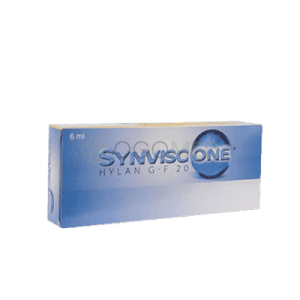
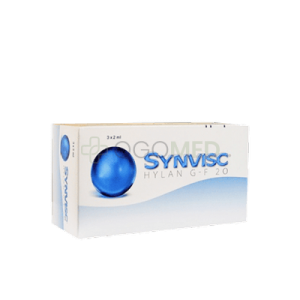
Searches for “Euflexxa vs Synvisc One” usually come from patients or clinics deciding between one visit and three. Synvisc-One is hylan G-F 20, a chemically cross-linked HA produced from chicken combs, packed as one 6 mL injection containing 48 mg (the same total dose as a three-injection Synvisc course). It was approved as PMA supplement P940015/S012 on February 26, 2009, on the basis of a 253-patient saline-controlled trial with 26 weeks of follow-up. Its label asks for caution in patients allergic to avian proteins, feathers or egg products.
No trial has compared Euflexxa with Synvisc-One directly. The closest evidence is the German trial above, in which the comparator was the three-injection form of hylan G-F 20. The 2021 Cartilage review drew this conclusion:
“Of the IAHA preparations with strong evidence of efficacy in placebo-controlled studies, Euflexxa was found to be noninferior to Hylan G-F 20.”
Webner et al., Cartilage, 2021
In practice, Synvisc-One suits patients who want a single appointment and have no avian allergy; Euflexxa suits patients who can attend three weekly visits, need a non-avian product, or have had effusions after a cross-linked HA. Our review of Synvisc-One pros and cons covers the single-injection option in more depth.
There is no fixed price difference to quote. What a clinic pays depends on the supplier and order volume, and what a patient pays depends on the insurer, the plan’s preferred-brand or step-therapy rules, deductibles and the number of administration visits. Coding differs as well: Euflexxa is billed under HCPCS J7323 per dose (three units per course), while Synvisc and Synvisc-One share J7325 per 1 mg (48 units for one Synvisc-One injection). A three-injection product also means three administration fees and three visits, which a single injection avoids. A Ferring-funded cost-utility model published in Advances in Therapy (2016) found Euflexxa had the most favorable cost per quality-adjusted life year among the HA brands it modeled, but that analysis predates current pricing and did not include Synvisc-One, so checking the payer policy before the first injection is the more reliable guide.
On current evidence, neither Euflexxa nor Orthovisc has been shown to be superior, because they have never been compared in a randomized trial. Euflexxa has the stronger placebo-controlled record, a documented non-avian source throughout its history, low effusion rates in its comparative trial and a fixed three-injection course, which makes it a practical default for patients with poultry allergies or a history of post-injection swelling. Orthovisc delivers more HA per injection, allows a four-injection course when a clinician wants one, and has the option of moving to its single-injection sibling, Monovisc. If a single visit matters most, the realistic comparison is with Synvisc-One or Monovisc rather than between these two.
Whichever product is chosen, it belongs inside a broader knee OA plan that includes exercise, weight management and analgesics, and it should be administered only by trained clinicians. For related questions, see how long Euflexxa lasts and Euflexxa vs cortisone.
Last updated: November 2026.
Neither has been proven better, because no randomized trial has compared Euflexxa and Orthovisc directly. Euflexxa has a stronger placebo-controlled record, including the 588-patient FLEXX trial, and has always been non-avian. Orthovisc delivers more hyaluronic acid per injection (30 mg versus 20 mg) and allows a three- or four-injection course. The choice usually depends on allergy history, visit schedule and payer rules.
Euflexxa is given as three 2 mL injections into the knee, one week apart. Orthovisc is given as three or four 2 mL injections, one week apart, and its label states that a course of fewer than three injections has not been shown to work. The Orthovisc label also notes that pain relief may not appear until after the third injection.
There is no fixed answer, because cost depends on the supplier, the insurer and the number of visits. Synvisc-One is one injection billed under J7325 per mg, so a single administration fee applies. Euflexxa needs three injections billed under J7323 per dose, plus three administration visits. Many plans also use preferred-brand or step-therapy rules, so checking the payer policy first is the most reliable guide.
Euflexxa is the more straightforward option, because its labeling states that it does not come from bird-derived sources. Orthovisc now uses fermentation-derived hyaluronic acid, but its original 2004 label listed avian allergy as a contraindication, so clinicians should check the current package insert. Synvisc and Synvisc-One are made from chicken combs and carry a labeled caution for avian allergies.
Most patients feel brief needle discomfort similar to other knee injections. The Euflexxa label notes that transient pain or swelling of the injected joint may occur, and arthralgia and joint swelling are among the most common device-related events. In the FLEXX trial, device-related events were reported in 9.9% of Euflexxa patients and 10.8% of saline patients. Pain that worsens after a few days should be assessed.